
Who We Serve · Government & Utilities

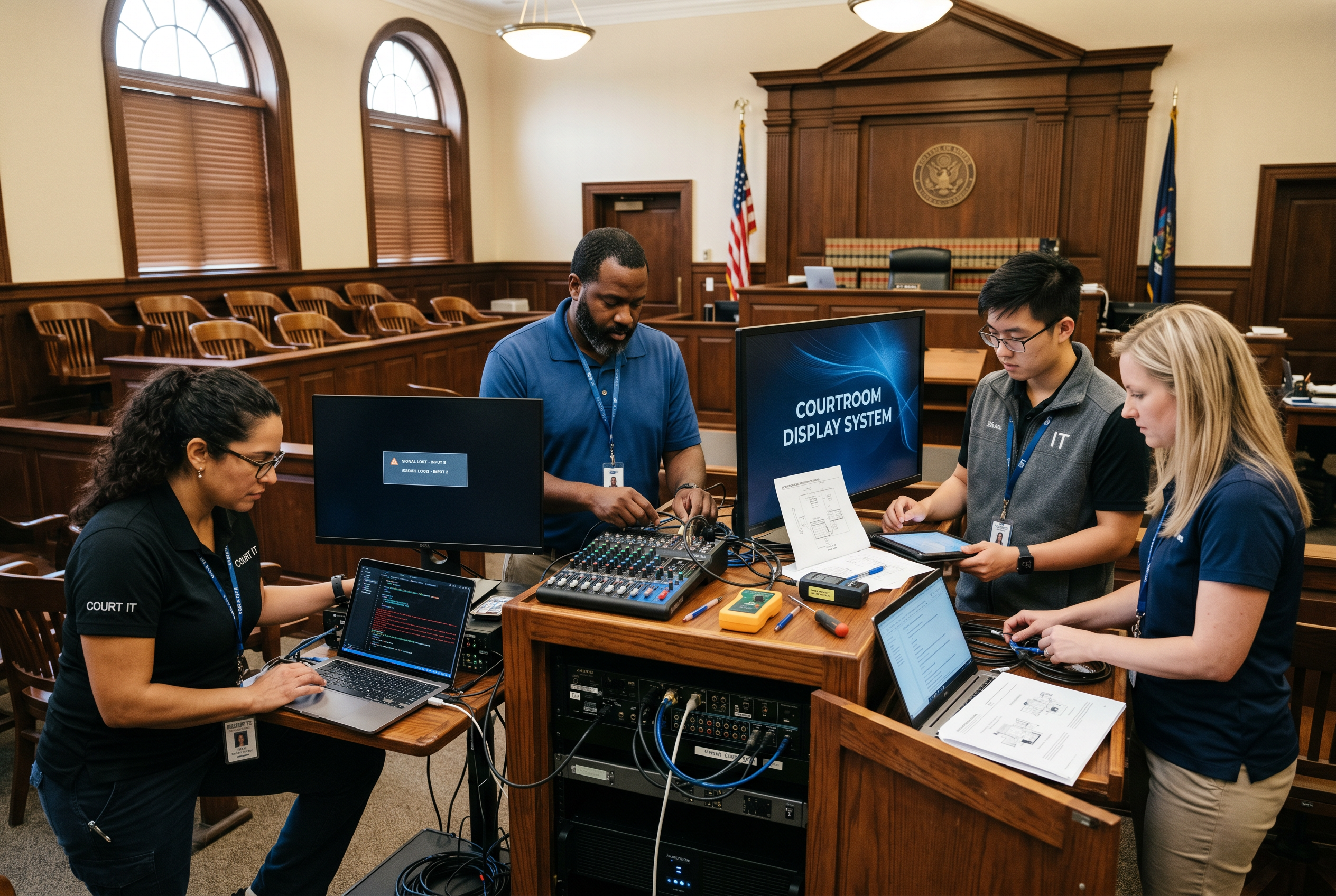
Courts & Judicial Technology

Independent technology governance for court technology that has to hold up under public scrutiny, sealed-record discipline, and the permanence of the official record.

THE COURTS REALITY

Built for case management, e-filing, and evidence platforms that hold up to appellate scrutiny and self-represented litigants alike.

State courts run the everyday machinery of American justice: criminal, civil, family, juvenile, traffic, probate. The technology that records, schedules, and serves that machinery is held to the standard of the bench, not the standard of the vendor. Every record is a court record. Every interface is a public interface. Every breach is an integrity event.

0

cases handled by state courts annually across the United States

0

state court judges presiding over the daily work of American justice

0

of US legal cases handled in state courts rather than federal courts

0

state court systems, each with distinct e-filing, sealed-record, and CMS rule sets

THE PROBLEM WE SOLVE

CMS vendors with sales targets. Bench expectations with no margin. Records with constitutional weight.

Court technology operates at the intersection of vendor incentive structures and judicial expectations that do not bend. The CMS that schedules a hearing also produces the appellate record. The e-filing rule the vendor wants to ship is the rule a self-represented litigant has to navigate. The configuration choice that simplifies a vendor's roadmap can compromise sealed-record handling, evidence chain of custody, or rules of court.

That is the work Sentinel does for courts. We govern the program. We never sell the platforms.

Independent. Practitioner-led. Vendor-neutral.

Position

One court. Many vendors. One permanent-record discipline.

Court technology does not fail in the courtroom. It fails in the docket, in the sealed-records audit, in the appellate record, and in the public-records request that uncovers what should never have been visible. Sentinel sits on the court’s side of every vendor decision, every CMS configuration, and every public-records boundary. And we produce the documentation that proves the configuration discipline is real, not aspirational.

The Pressures

Five forces are reshaping how courts deliver and govern technology.

These are the structural pressures we hear from court administrators, presiding judges, and clerk leadership in nearly every conversation. Sentinel’s role is to help you navigate them with documentation and evidence on your side.

Heightened in 2025-2026 by Tyler Odyssey market dominance, expanding e-filing mandates, and sealed-records scrutiny in Florida, Washington, and other states.
PRESSURE 01

CMS market consolidation around a single vendor

Tyler Odyssey holds dominant case management market share across most U.S. states. The consolidation simplifies vendor evaluation. It also concentrates configuration risk, integration risk, and the appellate record on a single platform whose roadmap is set by one company.

PRESSURE 02

Sealed records under increasing scrutiny

Florida, Washington, and other states have surfaced cases where sealed-record protections failed, with records visible through public-access portals. Each incident reshapes the legislative and bench expectation. The configuration discipline that prevents it is technical, statutory, and documented in equal measure.

PRESSURE 03

Mandatory e-filing expansion

State supreme courts continue expanding e-filing mandates, including in jurisdictions that have not modernized the underlying CMS. The expansion forces configuration choices about acceptance, redaction, sealing, and public access. The bench owns the consequences.

PRESSURE 04

Specialty court growth without standard tech patterns

Drug courts, mental health courts, veterans courts, and DV courts each have specialized workflows, outcome reporting, and stakeholder coordination requirements. The CMS vendors offer modules. The actual fit between module and court program is rarely audited.

PRESSURE 05

CJIS Security Policy revisions ongoing

CJIS Security Policy continues evolving, and court technology that touches criminal justice information has to keep pace. Audits arrive on a cycle the court does not control. The posture documentation has to be ready before the auditor walks in.

Our Approach

We govern the record. We never sell the CMS.

Court technology and judicial governance

Court technology is not a product purchase. It is a multi-decade discipline built on judicial authority, statutory access rules, public-records law, and the contracts a court signs with every vendor that touches the docket. Most courts inherit a configuration written by the implementer, defended by IT, and never owned by an independent custodian who answers to the bench, the clerk, and the appellate record. We change that.

Sentinel reads the actual configuration. We map it against the statute, the rules of court, the sealed-record requirements, and the public-records guarantees. We document the configuration decisions before the next CJIS audit, before the next sealed-records incident, and before the next appellate review. The artifacts we produce are structured under the assumption that they will be read by the bench, by counsel, by the appellate court, and by the public-records requester whose access depends on the configuration being right.

Our work is independent. We sell no platforms. We collect no referral fees. We are not the implementer that built the CMS, and we are not the e-filing vendor that wants to expand its footprint. Every recommendation is auditable, defensible, and built to survive the year-five conversation when the original implementer has moved on and the court still owns the consequences.

While the phases move, Sentinel stays.

What We Do Here

How Sentinel shows up inside a court technology program.

Court Management System governance with configuration authority over fields, workflows, and outcome codes, plus version-upgrade discipline at every contract cycle
Electronic filing platform implementation and governance for self-represented litigants, clerk review queues, fee management, and attorney portals
Digital evidence management with chain-of-custody architecture, body-cam and dashcam intake from law enforcement, secure storage, and retention scheduling that survives appeal
Court reporting and recording systems covering digital audio, video arraignment, transcript workflow, and ADA accommodations
Jury management modernization across summons workflow, voir dire support, juror pay and reimbursement, and communications
Specialty court workflow design for drug, mental health, veterans, and family courts, each with distinct phases, sanctions, and outcome reporting
Public access and open records covering docket portals, redaction workflows, sealed-record enforcement, and state public records compliance
CJIS audit and remediation across policy alignment, access control, audit logging, and training for clerks and judicial staff
ADA accessibility for court-facing systems with Section 508 conformance, accommodations workflow, and multilingual interfaces
Criminal justice continuum interfaces connecting police RMS, jail booking, prosecution case files, probation and parole exchange, and PACER for federal-touching cases
The Sentinel Difference

Four practices. One permanent-record discipline. End to end.

Forged in public safety. Tested where the record is permanent. From statutory authorization to permanent-record outcome, Sentinel’s signature practices govern every phase of the court’s technology program.

COURT TECHNOLOGY LIFECYCLESTATUTORYAUTHORIZATIONRules of court & access lawCMSSELECTIONVendor evaluationCONFIGURATIONBUILDDocket / sealed / e-filingAUDIT &CJIS REVIEWAnnual posture cyclePERMANENTRECORDAppellate horizonSDFSENTINEL DELIVERYFRAMEWORKPRACTICECMS ProgramDeliverySRMSENTINEL READINESSMETHODPRACTICEBench & ClerkReadinessSDBSENTINEL DEPLOYMENTBLUEPRINTPRACTICECMS ConfigurationAuthoritySVASENTINEL VALUEASSURANCEPRACTICEPermanent-RecordOutcome Governance
Specialized Services

Three discrete deliverables. Scope-defined. Boundary-respected.

For courts that need a defensible artifact this quarter, not a six-month conversation. Each engagement is fixed-scope, independently delivered, and structured to survive scrutiny.

CMS Configuration Authority Engagement

On the court’s side of the table

Discrete engagement to own configuration-authority decisions on the court’s side during a Tyler Odyssey, Journal Technologies eCourt, or other CMS deployment. Sentinel governs the field choices, workflow rules, outcome codes, and sealed-record discipline that the implementer would otherwise default to vendor presets. The court keeps configuration authority where it belongs.

Output: a configuration-authority playbook and a documented decision record per workflow.

CJIS & Public Records Posture Review

For the audits that arrive on their own calendar

Joint posture review covering CJIS Security Policy compliance, sealed-record enforcement at the platform level, and state public-records compliance. Sentinel reads the active CJIS Security Policy, maps the court’s posture against it, and documents the gaps in a form the auditor and the bench both accept.

Output: a CJIS-and-public-records posture-and-gap memo.

Specialty Court Technology Integration Build

Drug, mental health, veterans, DV

For jurisdictions standing up drug, mental health, veterans, or DV courts that require specialized case-management workflows. Sentinel maps the program model against the CMS module capabilities, designs the workflow that fits the court’s actual practice, and documents the integration plan in a form the bench can review and the clerk can implement.

Output: a specialty-court technology integration plan and clerk-facing implementation runbook.

The Four Practices

How Sentinel’s signature practices show up inside a court technology program.

Every engagement draws on the practices below. Each has its own discipline, its own training pedigree, and its own boundary. None of them are platforms.

SDF

Sentinel Delivery Framework™

Public-sector program management. Used on every deployment.

CMS program delivery means coordinating procurement, bench engagement, clerk readiness, and configuration discipline in one documented motion. SDF is the program management discipline Sentinel runs on every court technology engagement, scaled to the bench-and-clerk reality without losing audit-grade documentation. Every checkpoint is documented to survive a CJIS audit and an appellate review. Every decision is captured in a record the next presiding judge can read.

SRM

Sentinel Readiness Method™

Public-sector organizational change management. Used on every rollout.

A new CMS or e-filing system is a change management problem before it is a technology problem. SRM coordinates the readiness work across the bench, the clerk’s office, the bar, and the public-facing access. The discipline manages stakeholder alignment, training cadence, communication architecture, and the bench-and-clerk handoff. Go-live becomes an operational event, not a docket-day surprise.

SDB

Sentinel Deployment Blueprint™

Configuration authority on the court’s side of the table. Practitioner-delivered only.

When the implementer builds the CMS, someone has to govern the configuration choices. Statute, rules of court, and access law become platform behavior through a thousand small decisions. SDB is Sentinel’s configuration authority discipline, deployed on strategic court engagements where the configuration decisions need an independent custodian on the court’s side. Never offered as training. Practitioner-delivered, on the court’s side of the table.

SVA

Sentinel Value Assurance™

Post-deployment outcome governance. Advisory and non-binding by design.

A go-live is not an outcome. SVA is Sentinel’s post-deployment governance discipline, designed for the multi-year horizon when the original implementer has moved on, the appellate cases test the configuration discipline, and the system is still expected to deliver an accurate and defensible record. Findings are advisory and non-binding by design. Sentinel documents. We do not litigate.

Deep Expertise

The layers of expertise we bring to court technology governance.

Sentinel’s court technology bench leans on cross-domain pedigree. The disciplines that show up on day one of a court engagement.

CMS Configuration-Authority Pedigree

Court management systems do not configure themselves. Someone owns the field choices, workflow rules, sealed-record handling, and outcome codes. Sentinel brings the configuration-authority discipline to that work, on the court’s side of the table, with the documentation that survives an appellate review and a CJIS audit.

Sealed-Record & Public-Access Discipline

Sealed-records statutes and public-records statutes pull in opposite directions. The configuration choices that satisfy both are technical and statutory in equal measure. Sentinel reads the rule, maps the configuration, and documents the reconciliation in a form the bench, the clerk, and the public-records officer all accept.

CJIS Posture Fluency

CJIS Security Policy continues to evolve. Court technology that touches criminal justice information has to keep pace, with documentation ready before the auditor arrives. Sentinel reads the active policy version, maps the court’s posture against it, and produces the gap-and-remediation memo in regulator-ready language.

Bench-In-Flight Honest Framing

Sentinel’s court technology bench is named, deep, and growing. Where additional court-domain specialists are needed for a specific engagement (specialty court program design, statewide CMS coordination, e-filing rule integration), we say so up front, name the bench-in-flight specialist, and bring them in under the engagement governance the court already trusts. We do not invent expertise we do not have.

We Know the Tricks

Five vendor games courts see, and how to read them.

The court technology vendor playbook is patterned. Once you have read enough procurement files and watched enough configuration disputes, the moves become obvious. These are five Sentinel sees most often.

02 Trick of the Trade

The "Sealed Records Properly Handled" Vague Promise

A vendor responds to a sealed-records question with reassuring language about access controls, role-based permissions, and audit logs. None of the language addresses the specific statute, the specific configuration, or the specific failure modes that have surfaced in Florida, Washington, and other states. We require the configuration-and-statute mapping, in writing, before the system goes into production with sealed cases.

03 Trick of the Trade

The "E-Filing Vendor Recommendation" Conflict

The CMS implementer recommends an e-filing partner. The recommendation is convenient. It is also rarely independent. Integration favors the partner. The court loses the leverage that an arms-length e-filing procurement would have produced. We treat the e-filing decision as a separate procurement, with separate evaluation criteria and a separate decision file.

04 Trick of the Trade

The "Specialty Court Module" Add-On Path

A vendor offers a specialty court module (drug, mental health, veterans, DV) as a configuration add-on. The add-on is real. The fit between the module and the actual court program is rarely audited. The clerk discovers the fit gaps in production, after the program has already started. We map the program model against the module capabilities, in writing, before the procurement closes.

05 Trick of the Trade

The "Court of Competent Jurisdiction" Vendor Defense

When a configuration choice surfaces a problem, vendors often point to the contract’s jurisdiction-and-venue clause as a defensive structure. The clause matters. It does not substitute for documentation of the configuration decisions, the rationale at the time, and the alternatives considered. We document the decision record on the court’s side of the table, before the dispute, not during it.

WHO YOU ARE WORKING WITH

The people on the other side of the engagement, and the bench they bring.

The people on the other side of every Sentinel court engagement have run government technology programs from inside, with the procurement, contract, and configuration discipline the bench expects. Not consultants who learned court technology in slide decks.

JS

Justin Scott

Managing Partner · Operations & Change

Twenty years inside the largest public safety and government technology programs in the country. The program management discipline he ran at LAPD became the foundation of the Sentinel Delivery Framework. Owns the operations and change management arc on every Sentinel court engagement, including bench communications and the audit-defensible record.

JF

Jason Floyd

Managing Partner · Engineering & Technology

Two decades inside mission-critical CAD, RMS, P25, and dispatch architectures. DC Metro CAD/RMS. National Capital Region Mutual Aid Hub. Owns the engineering and technical posture on every Sentinel court engagement, including CMS architecture review, e-filing integration discipline, and configuration authority on the court's side of the table.

Kendra Branson
ADVISOR · ON THE BENCH

Kendra Branson

Procurement, Contracts, Compliance

Brings the procurement, contracts, and compliance discipline that turns a CMS vendor pitch into a defensible procurement file. Hands-on local-and-state government project experience, federal grant compliance fluency, and the contract-language judgment that protects sealed-record handling, evidence chain of custody, and rules of court before a vendor signature lands.

Kendra reviews every court engagement's procurement posture before Sentinel signs off on a recommendation.

The bench Sentinel built specifically for court technology program work.

How We Work Together

Four ways to bring Sentinel into a court technology program.

The right engagement depends on where the court is in the program lifecycle. Each tier has its own scope discipline and its own deliverable cadence.

Sentinel Sustain

Managed Technology Subscription

End-to-end managed operations for the platforms Sentinel helped you stand up. Sustainment, on-site systems administration, vendor coordination, version-upgrade discipline, and 24/7 incident response. The CMS is still delivering an accurate docket and a defensible record because someone is still accountable for it.

Sentinel Guardian

Retained Governance & Advisory

Ongoing retainer with quarterly governance reviews, pre-decision advisory, and an open line for bench briefings, CJIS audit response, sealed-records incidents, and vendor escalations. The court has independent counsel on the technology side of the table, every cycle.

Practice-Led Engagement

Anchored to one of the four signature practices

Anchored to one of SDF, SRM, SDB, or SVA. Best when the court knows which discipline is needed: program delivery, bench-and-clerk readiness, CMS configuration authority, or post-deployment outcome governance. Fixed scope, named practice, defined deliverables.

The Integrated Package

Specialized Services + Practice + Institute

A specialized service plus a signature practice plus Sentinel Institute training, packaged as a single integrated engagement. For courts standing up a CMS modernization, an e-filing rollout, or a specialty court program and building the institutional capacity to operate it.

Ready to govern your court technology program with Sentinel?

Whether you are scoping a CMS replacement, hardening CJIS posture, standing up a specialty court, or assuring the value of work already done, Sentinel's four practices are designed for the way courts operate.

Schedule a Conversation →