WHO WE SERVE · DEFENSE & MILITARY · INSTALLATIONS & GARRISON IT
Independent technology governance for the installations that run like cities, the public-safety stacks they share with civilian jurisdictions, and the garrison environments where service members and their families live every day.
THE INSTALLATION REALITY
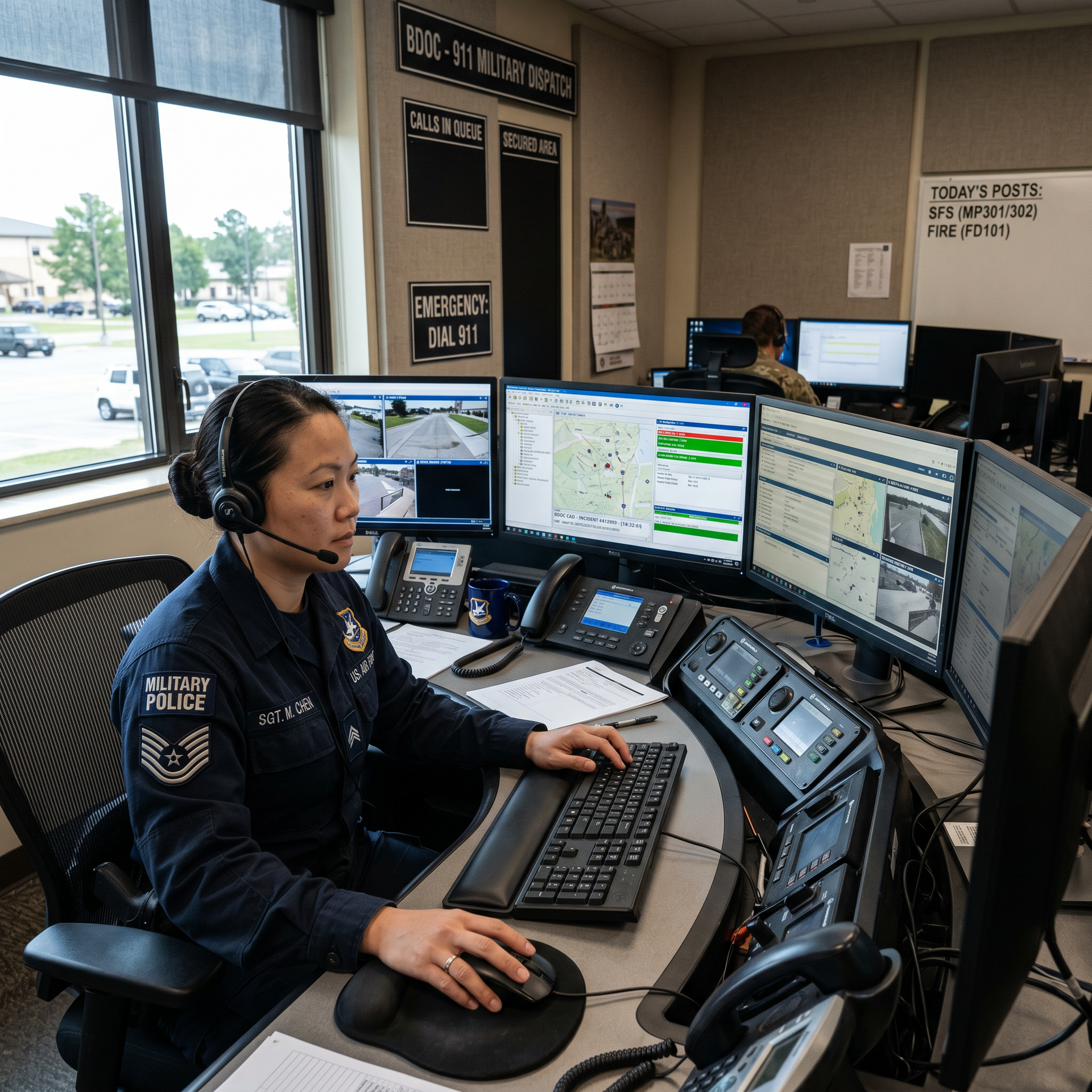
An installation runs every discipline a municipal city does, and a few civilians never see. Public-safety dispatch and fire response. Law-enforcement records and evidence chains. Emergency operations and mutual-aid coordination with surrounding civilian jurisdictions. Cybersecurity and OT/IT controls protecting every utility on base. Most defense consultancies do not understand the public-safety stack. Most public-safety consultancies do not understand the installation regulatory frame. Sentinel was built understanding both.
800+
DoD installations operating in CONUS alone, plus several hundred more OCONUS and in U.S. territories
24/7
every installation PSAP operates around the clock, with the same response standards as any civilian PSAP
100s
federal-municipal mutual aid agreements active across CONUS, requiring cross-jurisdiction interoperability the technology rarely supports cleanly
FY27 / FY32
DoD Zero Trust target maturity dates, pressing every installation network simultaneously
CHALLENGE
An installation’s PSAP picks up the same 911 calls a municipal PSAP does. They just route to a different agency. The Military Police and Security Forces dispatch CAD looks like a civilian law enforcement CAD because, functionally, it is one. The DoD Fire and Emergency Services dispatch tracks the same NHTSA alignment as any civilian fire dispatch. And alongside all of it sits a layer of civilian operations: schools, family services, MWR, commissaries. That layer defines daily life on every installation but rarely makes the headline. Most defense consultancies do not understand any of it. Sentinel was built understanding all of it.
THE PRESSURES
These are the structural pressures we hear from installation IT leadership, security forces and military police staffs, federal fire chiefs, and command-level decision-makers. Sentinel’s role is to help your installation navigate them with documentation and operational evidence on its side.
NHTSA, DHS, and the federal 911 Office have steadily pushed federal PSAPs to align with civilian Next Generation 911 standards. Text-to-911, IP-based call routing, ESInet integration with surrounding municipal PSAPs. Most installation PSAPs are mid-modernization, planning modernization, or aging out of compatibility. None of those positions is comfortable.
Service security forces are now standing up BWV programs. The platform selection, evidence-management workflow, redaction discipline, FOIA-equivalent response procedures, and chain-of-custody integrity are all being built for the first time on most installations. The civilian playbook exists. Few defense consultancies know it.
Service security forces increasingly carry FirstNet-capable devices alongside P25 LMR. Cross-band gateway design, dispatch console integration, encryption-key management, and interoperability with surrounding municipal LMR networks all collide on the installation perimeter.
CISA advisories on Chinese state-actor pre-positioning in critical infrastructure made installation OT, including utilities, water, HVAC, perimeter security, and badging, a documented soft target. DoD CIO has pushed hard on installation OT cybersecurity, but the controls catalog and operational integration are immature in most installations.
Many installation PSAP and dispatch systems are running aging vendor platforms that have been deployed ten to fifteen years and are years past graceful upgrade pathway. Sustainment costs balloon. Vendor leverage grows. The replacement programs move slowly due to procurement timelines, but the pressure is constant.
DoD Comply-to-Connect (C2C) regime mandates endpoint posture management and access controls across installation networks. DoD Zero Trust Reference Architecture mandates re-architecture toward target maturity by FY27, advanced by FY32. Both are happening simultaneously, on networks that handle every classification level and a heterogeneous device population from DoD computers to family-member devices to contractor laptops to IoT, utility, and HVAC controllers.
Sentinel’s installation approach is built around four principles that protect installation operations from the structural problems we see most often: vendor-jurisdiction confusion, weak documentation discipline, and platform decisions that do not survive command turnover. The disciplines are the same ones we apply to municipal public-safety. The jurisdiction context is what we add. Four principles follow.
NHTSA NG911 standards, FCC LMR licensing, DoD F&ES program manuals, Service security-forces regulations, RMF authorization frames. We translate between them because we have worked in both, and we will not blur the distinctions when they matter to your IG inspector.
The artifacts we produce are built to survive a Service IG inquiry, a DoDIG inspection, a GAO audit, or a FOIA-equivalent records request. The documentation grade is the same one a municipal PSAP needs to survive a state auditor. We did not design it for installations. The installations are who get to use it now.
Sentinel does not resell CAD, RMS, dispatch console, BWV, LMR, or any of the platforms an installation chooses among. We do not partner with them. We do not take referral fees. The advice you get is the advice we would give if it were our own installation.
Our governance work documents what we find and surfaces evidence. It does not become a party to disputes between installations and vendors, between Services, or between the installation and outside auditors. Sentinel documents, never litigates.
CORE CAPABILITIES
Every engagement is anchored in six disciplines that map directly from civilian public-safety practice into the installation jurisdictional environment. The disciplines are identical. Only the regulatory frame and the chain of command change.
Independent oversight of the installation Public Safety Answering Point: call-taking, CAD performance, NG911 alignment, mutual-aid integration with surrounding municipal PSAPs. The same discipline Sentinel has applied to municipal PSAPs, applied to federal-fire and military-police call streams.
Vendor-neutral oversight of MP/SF dispatch CAD, RMS-equivalent records, evidence-management integration, and patrol management. Translates directly from civilian law-enforcement dispatch governance Sentinel has delivered.
Federal-fire dispatch governance aligned with DoDM 6055.06-M, NHTSA fire-service standards, and integration with surrounding municipal fire dispatch for mutual-aid. Same NFPA-adjacent discipline applied in the federal-fire jurisdictional frame.
P25 Phase 2 LMR, FirstNet device integration, encryption-key management, console integration, and cross-jurisdiction interoperability with surrounding municipal LMR. Vendor-neutral oversight across the radio program.
Body-worn video selection, evidence-management workflow, redaction discipline, retention policy, and chain-of-custody integrity. Civilian-LE BWV pedigree applied to security-forces program standup.
Emergency Operations Center technology, command-and-coordination center integration, cross-Service interoperability for joint-exercise scenarios, and integration with surrounding civilian emergency management. The discipline that connects every other capability above.
Most defense consultancies do not understand municipal public safety. Most municipal public-safety consultancies do not understand installations. We were built understanding both, and we have done the work in both.
That is the differentiator. Everything else is implementation detail.
Each is fixed-scope, fixed-fee, and fixed-timeline. Each delivers a documented artifact your installation can act on, audit against, or hand to a successor command.
Independent roadmap for aligning your installation PSAP with NHTSA-aligned Next Generation 911 standards. Covers ESInet integration, IP-based call routing, text-to-911, and mutual-aid interoperability with surrounding municipal PSAPs. Documented vendor-neutral options analysis.
Full inventory and vendor-risk assessment across the installation public-safety stack: PSAP, MP/SF dispatch, F&ES, LMR, BWV, and EOC. Maps current platforms, contracts, ATO status, and sustainment posture against operational requirements. Actionable findings, not slideware.
Cybersecurity posture review focused on the OT-IT convergence zone where public-safety systems live alongside utilities, badging, and perimeter security. CISA Volt Typhoon advisory framing, DoD Comply-to-Connect alignment, Zero Trust gap analysis. Documented for IG inquiry, not vendor pitch.
OUR PRACTICES
Every Sentinel engagement draws on the practices that match the program’s stage. We bring them in proportionally; we never sell the whole stack when only part of it earns its keep.
PROGRAM MANAGEMENT
How we govern your program.
Program execution discipline for installation IT modernization across multi-year capital programs. Phase gates that survive Installation Commander rotations, change of contractor, and budget fluctuation. Decision logs that survive Service-level program reviews and IG inquiries.
CHANGE MANAGEMENT
How we prepare your operators.
Operator readiness for new public-safety technology fielding on installations. Dispatcher transition training, MP/SF system rollouts, F&ES system updates, BWV program launches. The rhythms that determine whether the new system actually works on day one of operation.
CONFIGURATION AUTHORITY
How we own the configuration.
Configuration authority for the installation public-safety stack. Translating installation-specific operational SOPs into platform configuration. The team that owns “is this how the dispatcher’s CAD should behave during a base-wide alarm activation?” decisions.
VALUE ASSURANCE
How we prove the mission outcome.
Independent governance documenting whether the installation’s PS-technology investments are delivering operational outcomes: response times, system availability, audit readiness, mutual-aid responsiveness. Findings advisory and non-binding. Critical for command-level briefings and IG inquiries.
After engagement closes, Sentinel Sustain keeps the practice active across the life of the investment. Three tiers: Core, Active, and Strategic.
Learn more →DEEP EXPERTISE
Sentinel’s installation bench is rooted in the same operational disciplines that gave the firm its name. Public-safety dispatch operations, cross-jurisdiction emergency coordination, federal-fire and law enforcement program governance, and state-federal regulatory navigation are not adjacent expertise. They are the foundation. The installation jurisdiction adds context. The disciplines are the same.
WE KNOW THE TRICKS
The PS-technology vendor playbook does not change much when the buyer wears a uniform. The same tricks that get pulled on municipal PSAPs get pulled on installation PSAPs, often by the same vendors. Here is what we look for, before the contract is signed.
01
Vendor charges a defense-grade premium on what is fundamentally civilian-grade technology with a paint scheme. The hardware is the same as the municipal version; the software is the same as the municipal version; the support is the same as the municipal version. The premium is the spec sheet. We benchmark against civilian comparables and ask the vendor to defend the delta in writing.
02
Vendor claims “DoD-compliant” without specifying which RMF artifacts are produced, which authorization boundary they assume, or which ATO inheritance applies. The installation IT staff signs the contract. Six months later, the security control assessor asks for the body of evidence the vendor never planned to produce. We require the artifacts list before contract signature.
03
Vendor claims their LMR or device platform is “FirstNet-compatible” without documenting the testing, the gateway design, the encryption-key approach, or the dispatch-console integration. Compatible means many things. Operationally compatible means few of them. We require operational-test documentation before the deployment plan is approved.
04
Vendor’s installation PSAP solution does not interoperate cleanly with surrounding municipal PSAPs. The pitch deck shows EMAC-style cross-jurisdiction. The implementation does not. When the installation responds to a fire that crosses the gate, or the surrounding city responds to an installation incident, the radio traffic, the CAD records, and the evidence chain do not flow. We test mutual-aid scenarios against the vendor architecture before purchase.
05
Sustainment costs balloon as the installed platform ages out. Vendor offers a “modernization discount” if the installation commits early to the next generation. The discount disappears when the migration starts costing what the vendor projected. We model TCO across the platform lifecycle, including the migration path, before the renewal is signed.
WHO YOU ARE WORKING WITH
The people on the other side of every Sentinel installation engagement have run these disciplines on both sides of the gate. Public-safety dispatch operations, federal-fire program governance, military-police and civilian law enforcement coordination, and state-federal regulatory boundary work. The bench is built around practitioners who carried the wrench, not just the slide deck.

Justin co-founded Sentinel after a career running technology programs inside Colorado state government, county operations, and law-enforcement agencies. His public-safety pedigree includes direct work with military communications centers during some of Colorado’s largest wildfire responses, coordinating equipment and managing communications across federal, state, local, and military teams under operational tempo. The disciplines he applies on the installation floor are the same ones he applied to a municipal CAD that could not afford to fail at 0300.
Jason co-founded Sentinel after sitting on every side of the technology-program table: vendor, integrator, program office, operator. His practitioner-grade perspective on multi-system program governance is what shaped Sentinel’s vendor-neutral standard. When Jason says he has carried the wrench, he means it. The bench he assembles for installation engagements is built around people who can do the same.
Sentinel rotates senior public-safety practitioners onto installation engagements based on the scope of work and the regulatory environment. The bench includes former federal-fire program leadership, CJIS-cleared LE technology specialists, and operational-floor PSAP discipline experts. Composition is documented in the engagement letter; no fixed seat, every seat earned.
Also Supporting Your Program
The right engagement depends on where your installation is, what you are trying to defend or deliver, and what your existing IT and PS-tech bench looks like. Each subscription has a clear scope, deliverable structure, and exit point. Subscriptions stack.
Managed Technology Subscription
End-to-end managed operations for the platforms Sentinel helped your installation stand up. Sustainment, on-site systems administration, vendor coordination, version-upgrade discipline, ATO-aware change management, and 24/7 incident response. The system is still operating to authorization standards three years out, because someone is still accountable for it.
The installation needs ongoing operations of a Sentinel-deployed platform; mission-essential systems demand continuous availability; or the program runs across multiple commanders and budget cycles.
We govern the operation. We never sell the platforms.
Read more about Sustain →Retained Governance & Advisory
Ongoing retainer with quarterly governance reviews, pre-decision advisory, and an open line for command briefings, IG response, audit response, and vendor escalations. The installation has independent counsel on the technology side of the table, every cycle.
The installation has a multi-year modernization program; command rotation cycles change every two to three years; or the next ATO recertification is already on the horizon.
Sentinel documents. We do not litigate.
Read more about Guardian →Anchored to a Signature Practice or Defined Deliverable
Anchored to one of SDF, SRM, SDB, or SVA, or to a single defined deliverable: On-Base PSAP NG911 Modernization Roadmapping, Installation Public Safety Technology Audit, or Installation Cybersecurity Posture Review. Fixed scope, named practice or deliverable, defined timeline.
The installation knows the discipline or deliverable needed and wants a contained, scope-bounded engagement that produces an audit-defensible record before the next decision.
Independent. Practitioner-led. Vendor-neutral.
See how the practices apply →Specialized Services + Practice + Sentinel Institute
A specialized service plus a signature practice plus Sentinel Institute training combined into a tailored program for the installation. Best when the team needs to learn the discipline as the discipline is being applied.
The installation is standing up a new program from scratch and wants the institutional capacity to operate it themselves after Sentinel departs.
Cutting-edge. Never bleeding-edge.
See the Institute deep-dive →Templates, Tools, and Office Hours
Low-touch entry tier. Sentinel templates, tools, reference materials, and scheduled office hours. The agency runs its own program; Sentinel provides the assets and answers the questions when they come up. No retainer, no embedded staff, no committed scope.
Best when: The agency wants Sentinel's templates and judgment but is not ready to engage a subscription. A starting point that can scale up if the program grows.
Built for the agency. Sized for the start.
Read more about Standard Access →READY WHEN YOU ARE
We speak both jurisdictions. Tell us where your installation is in the modernization cycle, and we will tell you honestly whether Sentinel is the right fit, or recommend someone better if we are not. The conversation costs nothing. The decision costs even less when an independent voice is in the room.