
WHO WE SERVE · DEFENSE & MILITARY · NATIONAL GUARD & RESERVES
Independent technology governance for the components that bridge federal mission and state response, where the same technology has to work for a drill weekend, a hurricane activation, and a federal mobilization in the same calendar quarter.
THE GUARD AND RESERVE REALITY
The Guard and Reserve operate under a structural reality the active component does not face. Federal mission AND state mission. Federal funding AND state funding. Federal regulatory frame AND state regulatory frame. Drill weekend AND hurricane activation AND federal mobilization, sometimes in the same calendar quarter. The technology stack has to honor all of it. Sentinel governs across the boundary because we have done the work on both sides.
54
National Guard Joint Force Headquarters across all states, DC, Guam, Puerto Rico, and US Virgin Islands
1.1M+
total Reserve Component personnel across the seven Reserve components, requiring dual-status technology support
3
duty status authorities (Title 10 federal, Title 32 federal-funded state-controlled, State Active Duty) the same technology stack has to support
100s
annual state activations across CONUS for natural disasters, civil disturbances, and joint federal-state operations
CHALLENGE
Active-component-focused defense consultancies do not understand Title 32 funding cycles or state-side coordination requirements. State-level civilian government technology consultancies do not understand the dual-status complexity. The boundary between federal-funded IT and state-funded IT, between FedRAMP-authorized systems and state cloud environments, between federal data privacy frames and state breach notification laws. That boundary is where Guard and Reserve technology programs live, and where most consulting engagements break down. Sentinel was built across both sides of that boundary.
THE PRESSURES
These are the structural pressures we hear from JFHQ J6 staffs, Reserve component IT leadership, state CIO offices, and Adjutant General offices. Sentinel’s role is to help your command navigate them with documentation that survives both federal and state audit regimes.
Title 10 federal active duty, Title 32 federal-funded state control, and State Active Duty (state pay, state control) imply different funding flows, different IT-system access, different reporting chains, different security postures. Most technology architectures evolved organically without dual-status design intent. Operational friction is constant.
Hurricane season, wildfire season, civil-disturbance response, federal mobilization. Each activation reveals a different gap. The technology readiness review that should happen before each season often does not, because the J6 staff is running operations through the previous season’s tail.
When a state activates and pulls Guard from neighboring states under the Emergency Management Assistance Compact, the IT systems on all sides have to talk. Most do not. Cross-state radio interop, cross-state CAD integration, cross-state authentication. The architectural design rarely contemplated multi-state activation as a default.
FedRAMP authorization, FISMA boundary definition, state cloud strategies, state data privacy laws. These intersect in JFHQ environments and Reserve commands in ways that most architectures simply do not document. The boundary is where breach exposure lives.
Communications and IT roles in Guard and Reserve commands are increasingly understaffed. The senior NCOs and warrant officers who carry institutional knowledge are exiting faster than they are being trained up. Documentation discipline matters more than ever.
Service Cyber Commands increasingly draw on Reserve component cyber units. The technology support infrastructure for those units, including clearance-aligned environments, classified-access workflows, and cross-component coordination, is maturing in real time, often through the units themselves rather than through dedicated support staff.
Sentinel’s Guard and Reserve approach is built on four principles. Each reflects the operational reality that dual-status programs are not just federal programs and not just state programs. They are both, at the same time, and the technology has to honor both.
Most consulting recommendations treat Title 10 and Title 32 as edge cases and architect for steady state. Sentinel architects for the actual operational rhythm. Drill weekend Title 32, hurricane response State Active Duty, federal mobilization Title 10. Sometimes the same unit in the same calendar quarter. The architecture either supports the rhythm or fails the operators.
FedRAMP authorization, FISMA boundary definition, state cloud strategies, state data privacy laws, EMAC interoperability requirements. We translate between federal regulatory frames and state regulatory frames because we have worked in both.
The technology readiness that matters is not how the system performs on Tuesday at 1400. It is how the system performs Friday at 0300 when the Governor activates the Guard for hurricane response. We design and govern with surge as the design point.
Our governance work documents what we find and surfaces evidence. It does not become a party to disputes between commands and vendors, between state CIO offices and JFHQ J6 staffs, between federal program officers and state Adjutants General. Sentinel documents, never litigates.
CORE CAPABILITIES
Every engagement is anchored in six disciplines that protect the command from architectures that fail at activation, programs that lose continuity across change of administration, and contracts that did not contemplate dual-status reality.
Independent oversight of architectures that have to support Title 10, Title 32, and State Active Duty operational modes. Boundary mapping between federal-funded and state-funded systems. Design review for transitions across status without reconfiguration.
Multi-year program governance for technology programs that span Adjutant General terms, federal Five-Year Defense Program cycles, and state legislative cycles simultaneously. Phase gates that survive change of command at multiple levels.
Pre-event readiness review aligned to predictable activation cycles. Hurricane season for Atlantic and Gulf states. Wildfire season for Western states. Pre-deployment cycles for federally-mobilizing units. Civil-disturbance preparation for joint federal-state response.
FedRAMP, FISMA, state-cloud, and state-data-privacy intersection management. Cross-environment data handling. Joint federal-state incident response coordination. The boundary where breach exposure lives, governed proactively rather than reactively.
Multi-state coordination capability built into the architecture rather than worked around at activation time. Radio interop, CAD integration, authentication and identity propagation across state boundaries.
Programs that survive change of Governor, change of Adjutant General, change of administration, and Federal Five-Year Defense Program adjustments. Documentation discipline that holds across all of them.
The mission shifts. The duty status shifts. The activation type shifts. The Adjutants General rotate. The Governors change. Sentinel does not. The supports we hold are the same on a Tuesday morning drill weekend as on a Friday-night hurricane activation.
Two missions. One bridge. We hold the supports.
Each addresses a specific decision a JFHQ or Reserve command needs to make under dual-status pressure. All are governed by the SVA standard: findings advisory, non-binding, structured for documentation that survives both federal and state audit regimes.
A targeted engagement reviewing a JFHQ or Reserve command’s technology architecture against the dual-status reality. Identifies systems where Title 10, Title 32, and SAD funding and access boundaries cause operational friction. Proposes architecture refinements that allow seamless transitions across status without rebuilding the technology stack each time.
Pre-event readiness review aligned to predictable activation cycles. Pre-hurricane season for Atlantic and Gulf states, pre-wildfire season for Western states, pre-deployment cycle for federally-mobilizing units. Reviews technology readiness, system availability, configuration drift, communications resilience. Produces a defensible readiness package for command-level briefings.
Multi-quarter retainer-based engagement helping a state JFHQ govern the boundary between federal-funded IT and state-funded IT. Covers FedRAMP, FISMA, state-cloud, and state-data-privacy intersections, cross-environment data handling, joint federal-state incident response. Few firms credibly span both worlds.
OUR PRACTICES
Every Sentinel engagement draws on the practices that match the program’s stage. We bring them in proportionally; we never sell the whole stack when only part of it earns its keep.
PROGRAM MANAGEMENT
How we govern your program.
Program execution discipline for installation IT modernization across multi-year capital programs. Phase gates that survive Installation Commander rotations, change of contractor, and budget fluctuation. Decision logs that survive Service-level program reviews and IG inquiries.
CHANGE MANAGEMENT
How we prepare your operators.
Operator readiness for new public-safety technology fielding on installations. Dispatcher transition training, MP/SF system rollouts, F&ES system updates, BWV program launches. The rhythms that determine whether the new system actually works on day one of operation.
CONFIGURATION AUTHORITY
How we own the configuration.
Configuration authority for the installation public-safety stack. Translating installation-specific operational SOPs into platform configuration. The team that owns “is this how the dispatcher’s CAD should behave during a base-wide alarm activation?” decisions.
VALUE ASSURANCE
How we prove the mission outcome.
Independent governance documenting whether the installation’s PS-technology investments are delivering operational outcomes: response times, system availability, audit readiness, mutual-aid responsiveness. Findings advisory and non-binding. Critical for command-level briefings and IG inquiries.
After engagement closes, Sentinel Sustain keeps the practice active across the life of the investment. Three tiers: Core, Active, and Strategic.
Learn more →DEEP EXPERTISE
Sentinel’s Guard and Reserve bench combines state-government technology pedigree, multi-jurisdiction emergency-response experience, and the program governance discipline that bridges federal funding cycles with state operational rhythms. Active-duty Guard and Reserve senior officer perspective is in flight on the advisor bench; the firm-level governance discipline is operational today.
WE KNOW THE TRICKS
The vendor playbook does not change much when the buyer wears two uniforms. Active-component-focused vendors run the same plays on Guard and Reserve commands that they run on the active component, but with less awareness of dual-status reality. Here is what we look for, before the contract is signed.
Vendor pitches the platform as duty-status agnostic. Works the same whether the unit is on Title 10, Title 32, or SAD. The reality is that funding flows, system access controls, and audit regimes differ across status, and the platform’s compliance posture follows different rules depending on which status the data was created under. The first time the unit transitions, the platform breaks one of the regimes. We test the status-transition behavior before the contract is signed.
02
Vendor claims FedRAMP authorization satisfies state compliance requirements as well. State data privacy laws, state breach notification laws, state cloud strategies. None of these are satisfied by FedRAMP. The vendor’s marketing blurs the boundary; the state regulator does not. We map both regulatory frames against the proposed architecture.
03
Vendor charges a premium based on its active-component customer base, even though the implementation has to be reconfigured for the Guard’s part-time operational rhythm and dual-status reality. The premium is for credibility that does not transfer. We benchmark against vendors with actual Guard / Reserve implementation history.
04
Vendor claims EMAC-style cross-state interoperability out of the box. The reality is that cross-state radio integration, cross-state authentication, and cross-state CAD interoperability require deliberate architectural design and bilateral state-to-state agreements. The out-of-the-box is the demo; the production requires work the vendor underestimated. We test cross-state interop before the architecture is locked.
05
Vendor’s base pricing assumes steady-state usage. The activation-surge pricing kicks in when the unit responds to hurricane, wildfire, or federal mobilization. By the time the surge bill arrives, the unit is mid-activation and cannot switch vendors. We model surge-pricing scenarios into the contract before signature.
WHO YOU ARE WORKING WITH
The people on the other side of every Sentinel Guard and Reserve engagement combine state-government technology pedigree with emergency-response coordination experience. Where the discipline-specific advisor bench has gaps, we name them, and we name what is in flight.
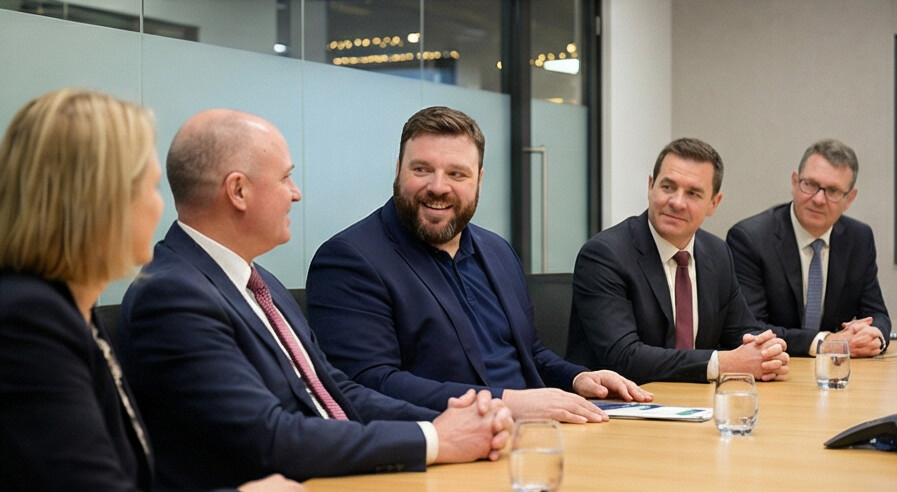
Justin co-founded Sentinel after a career in Colorado state-government technology governance, including direct work with military communications centers during major wildfire responses. He has coordinated equipment, managed communications, and structured technology programs across federal, state, local, and military teams under operational tempo. The state-side and emergency-response pedigree maps directly into the Guard and Reserve operational environment.

Jason co-founded Sentinel after sitting on every side of the technology-program table. Vendor, integrator, program office, operator. His practitioner-grade perspective on multi-system program governance is what shaped Sentinel’s vendor-neutral standard. The pedigree applies across federal and state programs alike.
Recruitment underway for all four bench seats. Engagements during the bench-in-flight period scope explicitly around the existing pedigree. Other consultancies hide their bench gaps. We name them.
Also Supporting Your Program
The right engagement depends on where your command is in the operational cycle, what your existing J6 or IT bench looks like, and which dual-status realities create the most friction. Each subscription has a clear scope, deliverable structure, and exit point. Subscriptions stack.
Managed Technology Subscription
End-to-end managed operations for the dual-status systems Sentinel helped your command stand up. Sustainment, J6 coordination, vendor coordination, version-upgrade discipline, and 24/7 incident response. The system is ready when the activation order arrives, because someone is still accountable for it.
The command needs ongoing operations of a Sentinel-deployed dual-status system; mass-activation readiness depends on continuous availability; or the program spans multiple commanders and federal-state budget cycles.
We govern the operation. We never sell the platforms.
Read more about Sustain →Retained Governance & Advisory
Ongoing retainer with quarterly governance reviews, pre-decision advisory, and an open line for command briefings, federal partner coordination, state-side legislative response, and vendor escalations. The command has practitioner-grade counsel that holds across the dual mission.
The command runs across multiple commanders or activation cycles; state-and-federal oversight bodies expect documented governance; or the next mass-activation exercise or audit is already on the calendar.
Sentinel documents. We do not litigate.
Read more about Guardian →Anchored to a Signature Practice or Defined Deliverable
Anchored to one of SDF, SRM, SDB, or SVA, or to a single defined deliverable: Dual-Status Technology Architecture Review, Mass Activation Readiness Assessment, or State-Federal IT Boundary Governance. Fixed scope, named practice or deliverable, defined timeline.
The program need is well-defined and wants a contained, scope-bounded engagement that produces a documented record across both the federal and state chains.
Independent. Practitioner-led. Vendor-neutral.
See how the practices apply →Specialized Services + Practice + Sentinel Institute
A specialized service plus a signature practice plus Sentinel Institute training combined into a tailored program for the command. Best when the J6 staff needs to learn the discipline as the discipline is being applied, particularly during stand-up of a new dual-status capability.
The command is standing up a new program from scratch and wants the institutional capacity to operate it across activation cycles without ongoing external dependency.
Cutting-edge. Never bleeding-edge.
See the Institute deep-dive →Templates, Tools, and Office Hours
Low-touch entry tier. Sentinel templates, tools, reference materials, and scheduled office hours. The agency runs its own program; Sentinel provides the assets and answers the questions when they come up. No retainer, no embedded staff, no committed scope.
Best when: The agency wants Sentinel's templates and judgment but is not ready to engage a subscription. A starting point that can scale up if the program grows.
Built for the agency. Sized for the start.
Read more about Standard Access →Interoperable communications, emergency management alignment, and the funding to sustain both.
READY WHEN YOU ARE
Tell us where your command is. Pre-season, post-activation, mid-modernization, or planning ahead. We will tell you honestly whether Sentinel is the right fit. We will also tell you honestly where our bench is in flight versus operational, because the dual-status environment deserves that honesty. The conversation costs nothing. The decision costs less when an independent voice is in the room.