PUBLIC SAFETY · FIRE SERVICE
Independent technology advisory, vendor-neutral procurement governance, and managed services for the firefighters and EMS providers who answer the alarm.
THE FIRE SERVICE REALITY
More than 29,000 fire departments stand watch across the United States (career, combination, and volunteer) with roughly 1.04 million firefighters answering the call. And increasingly, that call is a medical emergency: two of every three runs a U.S. fire department makes today are EMS, not fires. Modern fire service technology spans station alerting, mobile data terminals, NFIRS reporting, fire RMS, EMS ePCR, AVL, FirstNet broadband, wildland mapping, scheduling, training tracking, and workforce wellness platforms, all of it graded on NFPA standards and ISO PPC, all of it procured under political and budget scrutiny.
Sentinel Solutions Group exists because the department that trusts its technology vendor to make those decisions is the department that spends the next ten years trying to undo them. We have built the platforms you are evaluating, sold them, and deployed them, and we know exactly where the fine print hides.
29,000+
fire departments protect communities across the United States
1.04M
career, combination, and volunteer firefighters serve nationwide
65%
of fire department runs are EMS calls (NFPA)
CHALLENGE
Fire departments, career, combination, and volunteer, are navigating CAD modernization, records integration, mobile data, apparatus technology, and interoperability mandates with limited IT staff and competing capital priorities. Vendors sell to the chief; operators inherit the consequences. Sentinel provides the independent, practitioner-led advisory that ensures technology decisions are made with the apparatus floor, the training ground, and the fireground in mind, not just the demo room.
THE CHALLENGES
Fire chiefs are managing rising call volumes, aging apparatus, recruitment shortages, and a technology landscape that punishes the wrong decision. These are the pressures we help departments navigate.
Legacy alerting systems with slow turnout times, voice-only paging, and proprietary integrations are being replaced by modern IP-based station alerting platforms. Choosing the right system (and integrating it cleanly with CAD) is harder than vendors make it look.
Most fire departments are also EMS providers, which means ePCR vendor selection, clinical data quality, NEMSIS compliance, hospital handoff integration, and revenue capture all live in the same procurement conversation, and rarely get the attention they deserve.
The wildland-urban interface is reshaping fire service operations. Mapping, mutual aid coordination, FIRESCOPE/ICS integration, evacuation modeling, and mobile broadband resilience in remote terrain demand technology most departments are still trying to evaluate.
P25 radio fleets, FirstNet broadband, mutual aid interoperability, and the integration of voice with data on the apparatus all require coordination across vendors that rarely play nicely. Misalignment costs response time on every call.
NFIRS reporting, NFPA standard compliance (1710, 1720, 1221, 1500, etc.), and ISO Public Protection Classification grading all depend on data quality, which depends on platform choice. The wrong RMS makes accreditation a yearly nightmare.
Career departments face hiring shortages while volunteer departments face existential decline. Workforce technology (scheduling, training tracking, exposure logging, wellness programs) has become a retention tool whether departments planned for it or not.
OUR APPROACH
Sentinel was built by people who understand the fire service from the inside out. Our advisory board includes a current sitting fire chief with more than 30 years of service, a credentialed EMT-Paramedic, firefighter, and fire engineer who has worked across career, US Forest Service, and rural volunteer departments. He is joined by IT and engineering veterans who have built and supported the platforms departments rely on every day. That combination of fireground experience and technology depth shapes every recommendation we make.
Our advisory board includes a sitting fire chief with 30+ years of operational experience as an EMT-Paramedic, firefighter, and fire engineer. He has served in career departments, on US Forest Service crews, and in rural volunteer companies, so he understands how technology decisions land on the apparatus floor.
We have built, sold, and deployed the station alerting, RMS, ePCR, and CAD platforms departments are evaluating. We know the contract language, the hidden SKUs, the integration gotchas, and the renewal traps that vendors do not advertise.
Our co-founder served as a Principal Systems Engineer overseeing some of the most complex public safety IT environments in the country, including major fire and EMS systems. Our advisory board adds decades of additional engineering depth across networks, cybersecurity, and mission-critical architecture.
You do not get a single consultant, you get the full bench. Our advisory board of decorated former chiefs, officers, paramedics, and IT veterans is actively involved in every engagement, tailored to your specific program. Sentinel is one of the only firms that brings both deep technical expertise and operational breadth directly tied to mission-critical fire and EMS operations.
Most consultancies frame the work as picking the right vendor. Sentinel frames it as governing the fire service technology program, not the platform. The vendors come and go. The contracts get rewritten. The audit cycle never stops. Someone needs to be accountable to the department, not to the next sales target.
That is the work Sentinel does. We sit on the department side of the table, every meeting, every decision, every cycle. No resale margin. No referral fees. No commissions on the contracts we recommend. The only loyalty is to the operation.
We govern the program. We never sell the platforms.
The bay door, the alerting system, the apparatus, the hospital, the dispatch center, and the federal reporting database all expect to be part of the same data flow. The technology decisions a fire department makes today determine whether that flow holds at 3 a.m. and at the next ISO review.
The U.S. Fire Administration has set a multi-year sunset for NFIRS, with NERIS (National Emergency Response Information System) replacing it. The new system requires substantially richer incident data, integrated with CAD and patient care reporting, and the migration is mandatory for departments that report to the federal database.
Sentinel implication: A department whose CAD vendor has not committed to NERIS-compatible export is making a records-modernization decision without knowing it. Federal reporting depends on it, and the deadline is published.
Source: U.S. Fire Administration NERIS program; NFPA 901 incident reporting standards
Sub-second alerting, zoned activation, lighting and bay-door integration, and turnout time analytics are increasingly expected from new station builds and renovation projects. NFPA standards for response time have not loosened, and IAFC technology guidance has progressively raised expectations.
Sentinel implication: The station alerting decision and the CAD decision are now the same decision. A department that lets the CAD vendor define the integration is letting the CAD vendor set the turnout time.
Source: NFPA 1221 Standard for the Installation, Maintenance, and Use of Emergency Services Communications Systems; IAFC technology committee guidance
Vehicle telemetry, AVL, mobile data terminals, and electronic patient care reporting integrations are the norm in new apparatus specifications, and the data is increasingly subject to public records requests, civil discovery, and ISO review. NFPA 1500 expectations on member safety include data integration in the operational picture.
Sentinel implication: The apparatus is a data source. Configuration decisions on what gets logged, retained, and integrated into the operational picture are made at procurement time, often without the records-management or audit lens applied.
Source: NFPA 1500 Standard on Fire Department Occupational Safety, Health, and Wellness Program; NFPA 1901 Standard for Automotive Fire Apparatus
The ISO Public Protection Classification (PPC) review process incorporates dispatch infrastructure, water supply data, and response capability documentation. Departments with weak data systems face PPC scoring penalties that translate directly into homeowner insurance rates across their service area.
Sentinel implication: The data system is part of the ISO score. A department that cannot produce defensible records of dispatch performance, water supply, and training is leaving rating points on the table that affect every household in the jurisdiction.
Source: ISO Mitigation, Public Protection Classification (PPC) Program; NFPA 1710 / 1720 deployment standards
Regional dispatch consolidation, mutual-aid response zones, and FEMA-recognized resource typing have made the operational unit the region, not the individual department. Cross-jurisdiction interoperability of CAD, alerting, and incident reporting is the precondition for the response, not a nice-to-have.
Sentinel implication: A department's CAD decision is now a regional decision, whether the procurement is regional or not. The vendor that does not interoperate with the neighbors will not interoperate at the next mutual-aid call.
Source: FEMA NIMS Resource Typing; IAFC Mutual Aid Operating Policies; NFPA 1500 mutual aid expectations
CORE CAPABILITIES
Every engagement is anchored in six disciplines that protect departments from bad decisions, bad contracts, and bad outcomes.
Firefighters will use a system if it is built for them and rolled out the right way, and route around it if it is not. We design change strategies informed by real fire service deployments so adoption sticks across stations, shifts, and ranks.
We identify the technical, operational, contractual, cyber, and political risks that threaten your program, then build mitigation strategies your chief, board, or council can defend in any audit, after-action, or budget hearing.
RFP development, scoring rubric design, vendor evaluation, reference checks, contract negotiation, and SOW authoring. We level the playing field so the best fit wins, not the best demo.
PMP-disciplined program governance with public-sector fluency. We structure work for political visibility, audit defensibility, and multi-administration continuity, so your modernization survives elections, budgets, and command turnover.
Beyond advisory. Sentinel can operate alongside your team, maintaining station alerting, RMS, ePCR, mobile data, networks, and cybersecurity controls so your firefighters and medics never lose a tool mid-call.
We watch the vendor so you do not have to. Independent verification and validation across milestones, data conversion, acceptance testing, training, go-live, and warranty, keeping vendors accountable to the contract you signed.
Fire service technology spans dispatch, routing, command accountability, patient care, and state reporting. We have worked every link in that chain. This signature shows where Sentinel sits most actively in the flow.
Five ongoing services built for the realities of fire service technology. Lifecycle-managed equipment, reporting compliance, pre-incident data integration, and training programs that reflect what shift rotations and station life actually look like.
Managed oversight of radios, MDTs, SCBA tech, alerting systems, and apparatus electronics across their full lifecycle.
Ensures accurate, complete reporting aligned with federal and state requirements, with defensible audit trails.
Development and integration of digital preplans into operational systems, keyed to building records and response tactics.
Improving alerting reliability and reducing turnout times through system tuning, signal analysis, and protocol refinement.
Human-centered, liability-aware training programs focused on modern fire and EMS operational challenges.
OUR PRACTICES
Every Sentinel engagement is governed by proprietary practices built for the realities of fire service technology, not borrowed from commercial IT playbooks.
PROGRAM MANAGEMENT
How we govern your program.
PMP-disciplined program governance structured for fire department capital planning, apparatus technology procurement, and station infrastructure modernization. Every milestone is designed for the fire service reality, where bond cycles, ISO rating implications, mutual aid obligations, and board governance shape the timeline more than any vendor’s implementation schedule.
CHANGE MANAGEMENT
How we prepare your crews.
Organizational change management built for the engine company, the battalion office, and the volunteer station, not the corporate campus. We design adoption strategies around 24/48 shift rotations, volunteer availability, station culture, and the operational truth that apparatus must roll whether the new MDT software is comfortable or not. When the system goes live, your crews trust it.
CONFIGURATION AUTHORITY
How we own the configuration.
Configuration authority for Fire RMS, ePCR, and incident reporting deployments. Sentinel owns the foundational decisions around incident types, apparatus assignments, preplan architecture, and NFIRS compliance, producing the Blueprint, training, and administrator documentation that holds up in post-incident review and compliance audit.
VALUE ASSURANCE
How we prove the value.
Post-deployment governance for your fire RMS, EPCR, and response platform investment. Sentinel independently measures whether incident reporting, NFIRS compliance, and operational outcomes specified at procurement are being realized on the floor of the firehouse and in the apparatus bay. Findings become the evidentiary basis for renewal and optimization decisions.
After engagement closes, Sentinel Sustain keeps the practice active across the life of the investment. Three tiers: Core, Active, and Strategic.
Learn more →Four practices, applied to one operating environment: the dispatch floor, the bay, the apparatus, the records office, and the federal reporting queue. Each practice carries a specific scope and a specific deliverable cadence.
On a CAD modernization, station alerting deployment, or NFIRS-to-NERIS migration, SDF runs the phase plan, the gate reviews, and the vendor accountability cadence. The chief sees a defensible program record at every council update, and a documented audit trail at every ISO PPC review. SDF holds the program steady through chief transitions, mutual-aid coordination, and the inevitable mid-deployment surprise.
When a department rolls out new station alerting, swaps CAD vendors, or migrates to NERIS reporting, SRM prepares the personnel for what changes and what stays the same. Company officer enablement, dispatcher coordination, mobile data terminal workflow revisions, and the post-go-live support cadence are scoped against operational reality, not vendor training decks.
During CAD deployment, station alerting integration, or apparatus telemetry rollout, SDB is the practitioner-delivered configuration authority that sits on the department's side of the table. Alerting zones, integration to PSAP CAD, NERIS field mapping, mutual-aid response logic, and the technical decisions vendors typically push back on are documented with the department's answer in the room. SDB is delivered by Sentinel practitioners. It is not offered as training.
Twelve, twenty-four, and thirty-six months after deployment, SVA reviews whether the system is performing to the documented intent: turnout time accuracy, alerting integration uptime, NERIS submission quality, and configuration drift the department did not see at procurement time. The findings are advisory and non-binding by design. Sentinel documents. We do not litigate. No legal representation. No expert witness role. SVA is delivered by Sentinel practitioners. It is not offered as training.
DEEP EXPERTISE
These are the specific platforms, standards, and operational disciplines we work in every day.
WE KNOW THE TRICKS OF THE TRADE
These are the traps that consume budgets, derail timelines, and leave departments stuck with systems that do not serve them. We have seen them firsthand, and we know exactly how to neutralize them.
01
Fire RMS and CAD vendors that encode incident data, NFIRS records, and asset histories in formats only they can read. We insist on open data standards, documented schemas, and exportability clauses before the contract is signed.
02
Station alerting deals that look reasonable until you add the CAD integration, the apparatus bay automation, the audio system upgrade, and the “professional services” needed to make it all work. We surface the full cost during procurement.
03
ePCR platforms that bundle billing services, proprietary data lakes, and revenue cycle management in ways that make it impossible to switch vendors without losing years of clinical and financial data. We protect your portability up front.
04
When NFIRS submission, NFPA reporting, and ISO grading data all live inside one vendor’s walled garden, the department’s accreditation depends on that vendor’s good behavior. We design data architectures that keep the department in control.
05
Vendors who promise “intuitive” platforms and deliver weeks of firefighter and officer training the department was never warned about, especially in volunteer and combination departments where every training hour is precious. We demand realistic training in the SOW.
06
The leverage shift that happens once data, integrations, and crew muscle memory are locked in. We design exit ramps, portability clauses, and renewal protections into every deal so the department holds the cards at year three.
WHO YOU ARE WORKING WITH
The people who lead every Sentinel engagement have spent their careers inside agencies, behind the engineering consoles of the country’s most complex public safety systems, and on the apparatus floors and fire grounds where every minute matters.

MANAGING PARTNER · ENGINEERING & TECHNOLOGY
FIRE SERVICE, EMS & TRAINING ADVISOR
PRINCIPAL ADVISOR · FIRE & EMS OPERATIONS
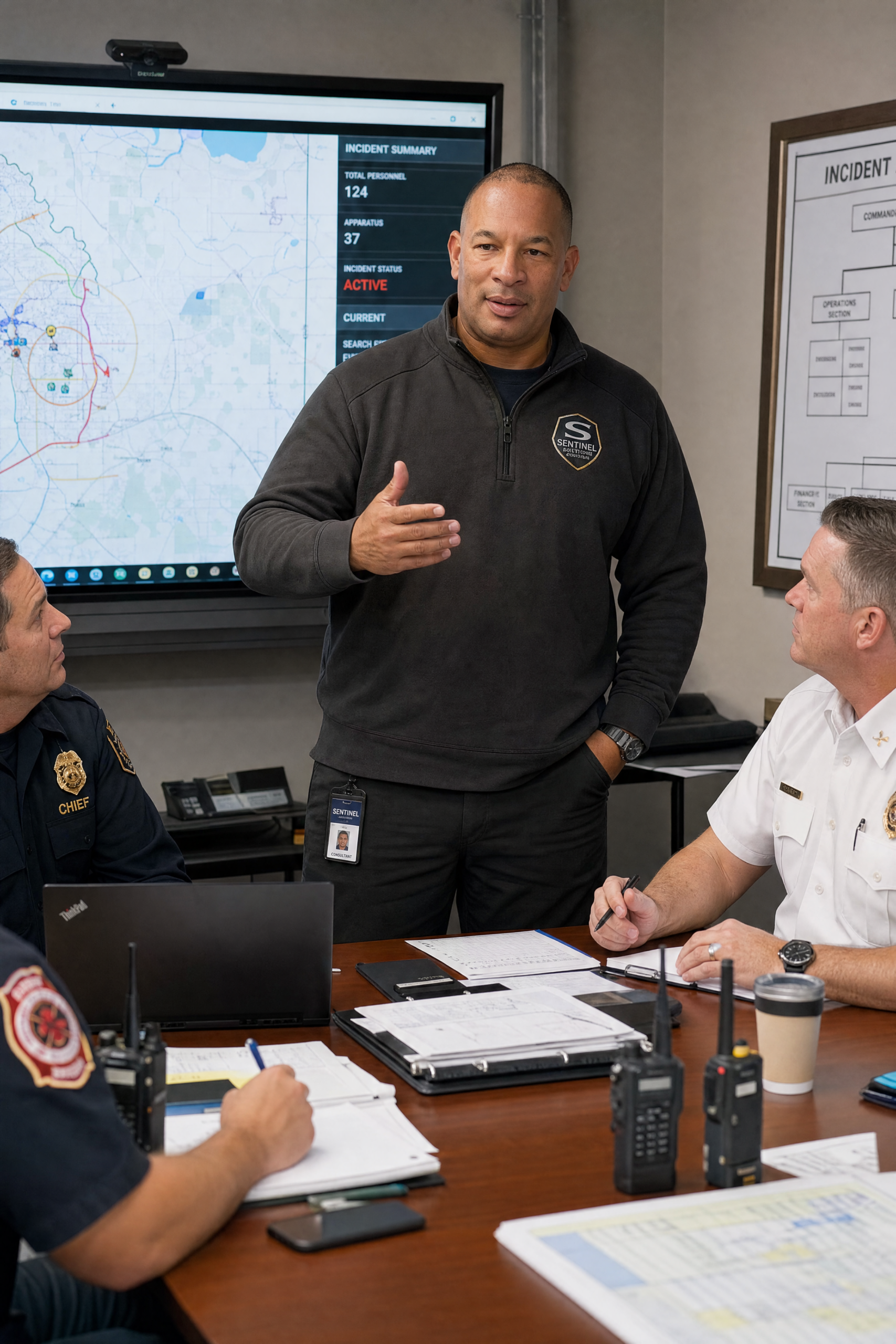
Decorated firefighter and paramedic with nearly twenty-five years of career service across Colorado fire and emergency services, currently with one of the largest internationally accredited agencies in the state. Honor Guard member and Firefighter of the Year, with credentials spanning paramedic care, hazardous materials, dive rescue, and incident command. JC grounds every fire and EMS recommendation in how departments actually train, staff, and run the floor.
MANAGING PARTNER · OPERATIONS & CHANGE MANAGEMENT
Also Supporting Your Program
The right engagement depends on where the fire department is in the program lifecycle. Each tier has its own scope discipline and its own deliverable cadence.
End-to-end managed operations for the CAD, station alerting, mobile data, and records infrastructure Sentinel helped you deploy. Sustainment, vendor coordination, version-upgrade discipline, and 24/7 incident response. The alert is still hitting the bay at the right time, because someone is still accountable for the integration.
We govern the program. We never sell the platforms.
Read moreOngoing retainer with quarterly governance reviews, pre-decision advisory, and an open line for council briefings, mutual-aid coordination, and vendor escalations. The fire department has independent counsel on the technology side of the table, before the next ISO review, the next dispatch consolidation, or the next contract cycle.
Sentinel documents. We do not litigate.
Read moreAnchored to one of SDF, SRM, SDB, or SVA. Best when the department knows which discipline is needed: a station alerting program, mobile data rollout change readiness, configuration authority on incident reporting, or post-deployment outcome governance. Fixed scope, named practice, defined deliverables.
Independent. Practitioner-led. Vendor-neutral.
Explore subscriptionsA specialized service plus a signature practice plus Sentinel Institute training, packaged as a single integrated engagement. For departments standing up a new technology stack from scratch and building the institutional capacity to run it past the next chief.
Cutting-edge. Never bleeding-edge.
Read moreTemplates, Tools, and Office Hours
Low-touch entry tier. Sentinel templates, tools, reference materials, and scheduled office hours. The agency runs its own program; Sentinel provides the assets and answers the questions when they come up. No retainer, no embedded staff, no committed scope.
Best when: The agency wants Sentinel's templates and judgment but is not ready to engage a subscription. A starting point that can scale up if the program grows.
Built for the agency. Sized for the start.
Read more about Standard Access →Most departments run multiple technology programs at once. Sentinel work in fire service work typically pairs with one or more of these companion disciplines, where the same governance discipline applies.
Station alerting integrates directly with PSAP CAD. Configuration authority on one affects the other.
Fire-based EMS shares ePCR, dispatch, and apparatus telemetry with the fire side. The data flow is one operation.
Mutual-aid response runs through the EOC. The fire department is part of the regional COP.
Coverage analysis against NFPA 1710 and 1720, accreditation discipline, and the funding to pay for both.
A thirty-minute conversation about your program, your timing, and what is actually going to get used. Then we will recommend an engagement, a subscription, or no action at all. Whatever the department actually needs.
Schedule a conversation