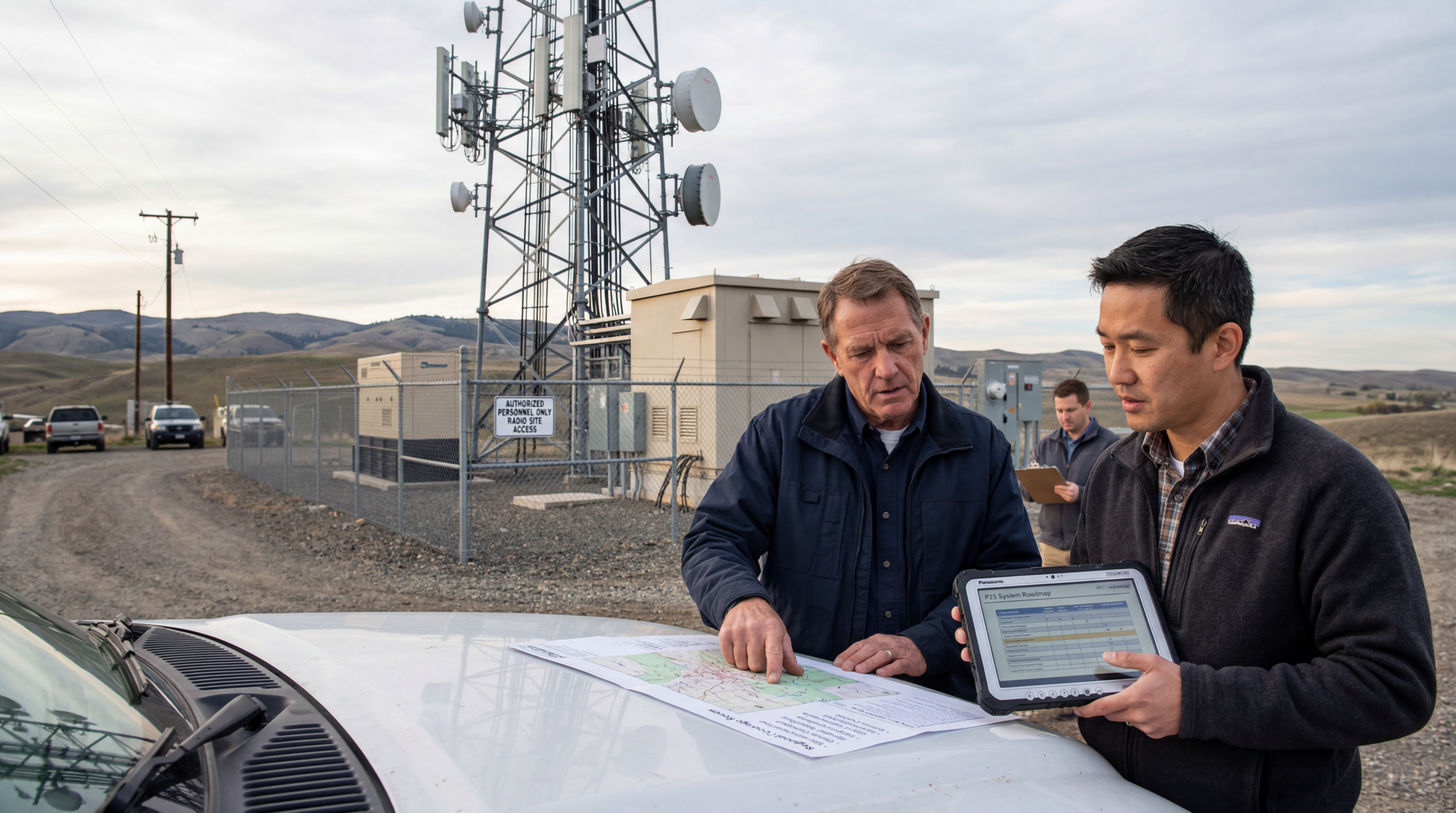
PUBLIC SAFETY COMMUNICATIONS
WHEN COMMS FAIL, EVERYTHING FAILS
More than 6,100 emergency call centers answer 240 million 911 calls every year in the United States, riding on top of a land mobile radio network that now includes over 3,600 separate P25 systems, plus FirstNet broadband, legacy analog mutual-aid channels, and every console vendor in between. On any given day, those centers sit one-in-four seats short.
Interoperability was the lesson of Oklahoma City and 9/11. Two decades later, agencies still struggle to talk across jurisdictional lines at the exact moment it matters most. Sentinel Solutions Group brings operators and engineers to the same table, so the system you build is the system that still performs at three in the morning on the night everything goes wrong.
Average 911 Dispatcher Vacancy Rate
Emergency Call Centers in the U.S.
P25 Systems Deployed Across the U.S.
CHALLENGE
Most managed service providers treat land mobile radio like it is an enterprise WiFi problem. They miss P25 coverage prediction, they do not understand FirstNet priority and preemption contracts, and they certainly cannot engineer microwave backhaul resilience. When the radio fails, the response fails, and the communications shop takes the blame for a problem the vendor never understood. Sentinel brings the radio engineering discipline your agency actually needs. We assess coverage, design replacement migrations, negotiate tower leases, validate FirstNet capability, oversee site hardening, and build the governance that keeps your radio system mission-ready. Your field responders hear the tone; your dispatchers hear the PTT; your council hears the accountability.
THE COMMUNICATIONS REALITY

CHALLENGE
COMMON CHALLENGES
OUR APPROACH
Most consultancies frame the work as picking the right vendor. Sentinel frames it as governing the public safety communications program, not the platform. The vendors come and go. The contracts get rewritten. The audit cycle never stops. Someone needs to be accountable to the communications program, not to the next sales target.
That is the work Sentinel does. We sit on the communications program side of the table, every meeting, every decision, every cycle. No resale margin. No referral fees. No commissions on the contracts we recommend. The only loyalty is to the operation.
We govern the program. We never sell the platforms.
A radio system is a 15-to-25-year decision. The vendor that wins the contract today owns the dispatch floor through the next four chiefs and the next three administrations. These are the forces shaping how those decisions get made.
Many programs are operating P25 Phase 1 systems that are aging into end-of-life, with manufacturer support windows closing. T-Band spectrum pressure, narrowband mandates, and frequency coordination challenges have added urgency, and APCO/NPSTC have published transition guidance that not all vendors interpret the same way.
Sentinel implication: A program that lets the incumbent vendor define the migration path is accepting the vendor's timeline and the vendor's scope. Configuration authority on the migration is the difference between a managed transition and a forced one.
Source: APCO International P25 guidance; National Public Safety Telecommunications Council (NPSTC) reports; FCC Public Safety and Homeland Security Bureau
FirstNet (Band 14) deployment has matured, and adoption decisions now affect device strategy, vendor relationships, and dispatch integration for the foreseeable future. AT&T's FirstNet contract runs through 2042, and program decisions made today will be operating well beyond multiple administrations.
Sentinel implication: A FirstNet decision is a strategic commitment that needs to be evaluated against the agency's LMR roadmap, not as a standalone procurement. The two systems either complement each other or compete for budget for the next decade.
Source: FirstNet Authority annual reports; SAFECOM Nationwide Survey; National Telecommunications and Information Administration (NTIA) FirstNet oversight
After-action reviews from multi-jurisdictional incidents have driven federal and state mandates for interoperability planning, regional governance structures, and patching capabilities. SAFECOM and federal grant requirements have made interoperability a precondition for funding, not an aspirational goal.
Sentinel implication: A radio decision made in isolation from regional partners is a decision that will fail at the next mutual-aid event. The regional governance question precedes the procurement question.
Source: SAFECOM Continuum and Nationwide Survey; FEMA Office of Emergency Communications; State Interoperability Executive Committees (SIECs)
CISA has issued advisories on land mobile radio supply chain risk, encryption key management, and network security for public safety communications. The radio system is now a critical infrastructure target, and the same scrutiny that applies to IT systems is applied to the dispatch center.
Sentinel implication: A radio program without a cyber posture is a critical infrastructure exposure. The vendor that does not document its supply chain and key-management practices is the vendor that becomes a CISA advisory item.
Source: CISA Land Mobile Radio (LMR) cybersecurity guidance; NIST SP 800-53 control families applicable to public safety; APCO cybersecurity recommendations
State Homeland Security Program (SHSP), Urban Area Security Initiative (UASI), and Public Safety Interoperable Communications grant funding have been the dominant source of radio modernization for many programs. Grant compliance, allowable costs, and reporting structures continue to evolve, and the funding window often does not match the procurement timeline.
Sentinel implication: A program that picks the wrong vendor under grant deadline pressure inherits the compliance burden for a 20-year system. The grant timing and the operational timing are different timings.
Source: FEMA Homeland Security Grant Program (HSGP); SAFECOM/NCSWIC grant guidance; Public Safety Interoperable Communications (PSIC) grant program
CORE CAPABILITIES
Public safety communications is a stack, P25 core, site infrastructure, subscriber fleet, interoperability, broadband convergence. We know every layer. This signature maps how Sentinel governs across all of them.
Three ongoing services for the radio network that everything else runs on. Fleet programming kept current, interoperability codified into policy, and coverage validated against what firefighters and officers actually experience in the field.
Programming, firmware updates, template management, and lifecycle tracking across your radio fleet.
Development and enforcement of cross-agency communication protocols that hold up under pressure.
Drive testing and in-building validation with documented performance reporting and gap remediation.
OUR PRACTICES
Every Sentinel engagement is governed by proprietary practices built for the realities of public safety communications technology, LMR, FirstNet, interop, and the tower-to-talkgroup chain that holds everything together, not borrowed from commercial IT playbooks.
PROGRAM MANAGEMENT
How we govern programs.
PMP-disciplined program governance structured for political visibility, audit defensibility, and multi-administration continuity. Every milestone, deliverable, and decision gate is designed for the public-sector reality, where council turnover, budget cycles, and federal funding rules shape the timeline more than any vendor’s project plan.
CHANGE MANAGEMENT
How we prepare your people.
Organizational change management built for the radio shop, the dispatch console, and the tower top, not the corporate campus. We design adoption strategies informed by shift schedules, union dynamics, civil service rules, and the operational reality that your systems cannot go dark for training. When the new radio system goes live, the people behind the console are ready.
CONFIGURATION AUTHORITY
How we own the configuration.
Configuration authority for LMR programming, P25 system deployments, broadband-LMR integration, and PTT platform rollouts. Sentinel owns the foundational decisions around talkgroup architecture, encryption posture, roaming behavior, and fleet programming, producing the Blueprint, training, and administrator documentation that survives radio technician turnover and vendor personnel changes.
VALUE ASSURANCE
How we prove the value.
Post-deployment governance for your public-safety communications investment. Sentinel independently measures whether coverage, interoperability, and reliability outcomes specified at procurement are being realized through real operational use, and documents vendor accountability when they are not.
After engagement closes, Sentinel Sustain keeps the practice active across the life of the investment. Three tiers: Core, Active, and Strategic.
Learn more →Four practices, applied to one operating environment: the radio system, the dispatch console, the FirstNet device strategy, and the regional interoperability framework. Each practice carries a specific scope and a specific deliverable cadence.
On a P25 Phase 2 migration, FirstNet integration program, or regional interoperability initiative, SDF runs the phase plan, the gate reviews, and the vendor accountability cadence across the multi-year capital cycle. The communications director sees a defensible program record at every council update, and a documented audit trail at every federal grant review. SDF holds the program steady through manufacturer transitions, frequency coordination challenges, and the inevitable mid-deployment surprise.
When a program migrates to P25 Phase 2, adopts FirstNet, or stands up a regional interoperability framework, SRM prepares the responder population for what changes and what stays the same. Field user enablement, dispatch console operator transitions, mutual-aid partner coordination, and the post-go-live support cadence are scoped against operational reality across multiple agencies.
During radio system deployment, FirstNet integration, or interoperability patching, SDB is the practitioner-delivered configuration authority that sits on the program's side of the table. Talkgroup architecture, encryption key management, FirstNet device policy, interoperability patches, and the technical decisions vendors typically push back on are documented with the program's answer in the room. SDB is delivered by Sentinel practitioners. It is not offered as training.
Twelve, twenty-four, and thirty-six months after deployment, SVA reviews whether the system is performing to the documented intent: coverage performance, talkgroup utilization, interoperability success at mutual-aid events, and configuration drift the program did not see at procurement time. The findings are advisory and non-binding by design. Sentinel documents. We do not litigate. No legal representation. No expert witness role. SVA is delivered by Sentinel practitioners. It is not offered as training.
DEEP EXPERTISE
Radio is a 15-to-25-year decision, and the vendors selling into the market know it. The plays that win the contract are not always the plays that hold up at year five. These are the five we see most often.
P25 has multiple phases, multiple suites, and multiple feature sets. A vendor that ships a partial implementation can still call the product P25 compliant, and the program discovers the gap during interoperability testing with a neighbor.
The vendor sells a P25 system with proprietary feature extensions that only work with the vendor's subscriber units. Migration to a competitor at the next refresh cycle becomes a forklift, not a transition.
The FirstNet sales narrative implies a smooth complement to LMR. The reality is a multi-year strategy decision involving device policy, application certification, and dispatch integration that the vendor will not lead the program through.
Vendor handles frequency coordination "as part of the project," and then the program inherits ongoing coordination obligations and disputes the vendor's scope did not actually cover. Spectrum issues surface years later.
Federal grant compliance, allowable cost reporting, and continuous reporting requirements get assigned to the program in the contract terms. Vendor delivers the system; program inherits the documentation burden for the system's lifecycle.
The people on the other side of every Sentinel communications program engagement have run programs like yours from the inside. Not consultants who learned them in slide decks.
Twenty years inside the largest and most-watched public safety and government technology programs in the country. LAPD Records Management modernization. LA County Sheriff. LAFD. The program management discipline he ran at LAPD became the foundation of the Sentinel Delivery Framework. The change management discipline became the Sentinel Readiness Method. Both methodologies remain in active use at LAPD and Motorola today. On every Sentinel communications program engagement, Justin owns the operations and change management arc, phase governance, stakeholder coordination, and the audit-defensible record.
Twenty years inside the engineering and integration work behind some of the most-watched public safety technology programs in the country. DC Metro CAD/RMS modernization. National Capital Region Mutual Aid Hub. Mission-critical platform deployments at scale. The configuration discipline he ran in those programs became the foundation of the Sentinel Deployment Blueprint. The post-deployment outcome discipline became the Sentinel Value Assurance practice. On every Sentinel communications program engagement, Jason owns the engineering and technology arc, P25 architecture integrity, FirstNet integration, frequency coordination, and the technical decisions that show up at the next mutual-aid event.
Behind every Sentinel communications program engagement, an advisory bench of 200+ years combined experience: P25 specialists, former NPSTC and APCO practitioners, sitting communications directors, and FirstNet adoption experts. The bench is hand-picked, the engagement is named, and the depth applies on every program.
The right engagement depends on where the communications program is in the lifecycle. Each tier has its own scope discipline and its own deliverable cadence.
End-to-end managed operations for the P25, LMR, FirstNet, and interoperability infrastructure Sentinel helped you stand up. Sustainment, vendor coordination, frequency-coordination discipline, and 24/7 incident response on the radio floor. The talkgroup is still patchable when the next mutual-aid call comes in, because someone is still accountable for the system.
We govern the program. We never sell the platforms.
Read moreOngoing retainer with quarterly governance reviews, pre-decision advisory, and an open line for council briefings, regional interoperability coordination, and radio vendor escalations. The communications program has independent counsel on the technology side of the table, before the next P25 upgrade, the next FirstNet decision, or the next contract cycle.
Sentinel documents. We do not litigate.
Read moreAnchored to one of SDF, SRM, SDB, or SVA. Best when the program knows which discipline is needed: a P25 migration program, FirstNet adoption change readiness, configuration authority on interoperability patches, or post-deployment outcome governance. Fixed scope, named practice, defined deliverables.
Independent. Practitioner-led. Vendor-neutral.
Explore subscriptionsA specialized service plus a signature practice plus Sentinel Institute training, packaged as a single integrated engagement. For programs standing up a new communications architecture from scratch and building the institutional capacity to run it across mutual-aid partners.
Cutting-edge. Never bleeding-edge.
Read moreTemplates, Tools, and Office Hours
Low-touch entry tier. Sentinel templates, tools, reference materials, and scheduled office hours. The agency runs its own program; Sentinel provides the assets and answers the questions when they come up. No retainer, no embedded staff, no committed scope.
Best when: The agency wants Sentinel's templates and judgment but is not ready to engage a subscription. A starting point that can scale up if the program grows.
Built for the agency. Sized for the start.
Read more about Standard Access →Most communications programs run multiple technology programs at once. Sentinel work in communications work typically pairs with one or more of these companion disciplines, where the same governance discipline applies.
Radio system decisions land on the dispatch floor. Configuration authority on one affects the other.
Activation-grade communications hold up under EOC pressure. The integration is the readiness.
EOC activation depends on the radio system. The decisions are connected.
A thirty-minute conversation about your program, your timing, and what is actually going to get used. Then we will recommend an engagement, a subscription, or no action at all. Whatever the communications program actually needs.
Schedule a conversationP25 systems, interoperability, and the migration questions every communications shop is facing.