EMERGENCY MANAGEMENT
We help agencies plan, train, equip, and activate across all four phases of emergency management (mitigation, preparedness, response, and recovery) so the plan holds when the incident does not.
THE DISASTER IS NOT IF. IT IS WHEN.
The five-year annual average cost of U.S. disasters is now $149 billion, more than double the forty-five-year average, with cumulative damage since 1980 crossing $2.9 trillion. Federal disaster declarations run at more than 100 per year, and roughly one in three Americans will live through a major declared disaster in the next decade. Those are not talking points; they are the working load your emergency management program has to carry.
Sentinel Solutions Group brings disciplined program management, working operational experience, and vendor-neutral technology judgment to every phase of the mission, mitigation, preparedness, response, and recovery. We plan like you mean it, because when the call comes in, the plan is the only thing that holds.
5-Year Annual U.S. Disaster Cost (NOAA)
Cumulative U.S. Disaster Cost Since 1980
Americans Face a Major Disaster in a Decade
CHALLENGE
Most emergency management programs are built by one or two dedicated people in a small office, running on legacy plans, binders that have not been reopened since the last audit, exercises that never test the hard decisions, and grant funding that arrives in fits and starts. When the event actually lands, the plan has not kept up with the hazard, the technology has not kept up with the plan, and the personnel have not kept up with either. Sentinel brings working emergency management experience and technology judgment to every phase of the mission. We refresh the plans that actually have to activate, design HSEEP exercises that pressure-test the hard decisions, harden the platforms that matter (WebEOC, Veoci, D4H, mass notification, GIS, ArcGIS Online, IPAWS) and stay through recovery closeout so lessons learned actually get captured and applied.
THE EMERGENCY MANAGEMENT REALITY
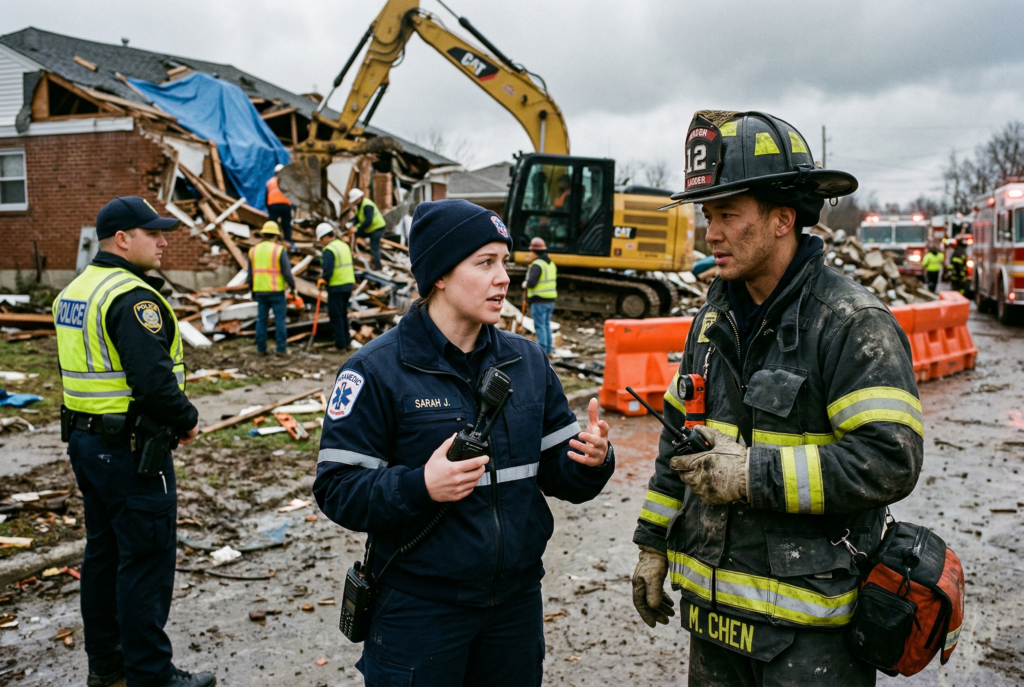
Emergency management is the discipline that binds an entire community of responders, agencies, elected officials, and private partners into a single coordinated response, before, during, and after the worst day a jurisdiction will ever have. It spans hazard analysis and mitigation grants, all-hazards and continuity plans, HSEEP-compliant training and exercises, EOC and joint information center operations, mutual aid and emergency support functions, public warning, and the multi-year recovery lifecycle that outlasts every news cycle.
CHALLENGE
Most emergency management programs are built by one or two dedicated people in a small office, running on legacy plans, binders that have not been reopened since the last audit, exercises that never test the hard decisions, and grant funding that arrives in fits and starts. When the event actually lands, the plan has not kept up with the hazard, the technology has not kept up with the plan, and the personnel have not kept up with either.
Sentinel brings working emergency management experience and technology judgment to every phase of the mission. We refresh the plans that actually have to activate, design HSEEP exercises that pressure-test the hard decisions, harden the platforms that matter (WebEOC, Veoci, D4H, mass notification, GIS, ArcGIS Online, IPAWS) and stay through recovery closeout so lessons learned actually get captured and applied.
COMMON CHALLENGES
Plans written for grant compliance, not real activation, last updated two administrations ago, with contact lists, statutes, and hazard profiles that no longer match reality.
Tabletops that walk through the easy scenarios, never pressure-test the political and operational decisions that actually break programs, and produce AARs that go on a shelf.
COOP and COG plans that check the FEMA box but have never been exercised, with no alternate facility validated, no line of succession rehearsed, and no vital records tested.
BRIC, HMGP, and FMA funding opportunities missed because the HMP is out of date, the benefit-cost analysis was never run, or the match funding was never lined up.
Mass notification stacks that are not integrated with IPAWS, WEA, or EAS, or worse, tested only during quiet hours, not during the storm that will expose the gaps.
Declarations that get stuck in recovery for years, documentation gaps that surface in OIG audits, and deobligated funds the jurisdiction cannot afford to return.
OUR APPROACH
We have lived mitigation, preparedness, response, and recovery work inside real programs, wildfires, hurricanes, active shooters, pandemics, severe weather, and the long tail of federal disaster declarations. That operational experience shapes every recommendation we make.
We evaluate plans, exercise programs, situational awareness and mass notification platforms, GIS, and grant management tools based on your operational reality, not vendor partnerships.
Every engagement draws from a bench of emergency managers, dispatchers, chiefs, engineers, and compliance specialists who have lived these roles in the field and in the EOC.
Every plan, training exercise, and technology integration we deliver aligns with CPG 101, the Incident Command System, NIMS, and the Emergency Management Accreditation Program standards.
Whether you are a rural county with volunteer staff or a metro region coordinating dozens of agencies and ESFs, we architect programs that scale from daily monitoring through full disaster declaration and multi-year recovery.
Most consultancies frame the work as picking the right vendor. Sentinel frames it as governing the emergency management technology program, not the platform. The vendors come and go. The contracts get rewritten. The audit cycle never stops. Someone needs to be accountable to the program, not to the next sales target.
That is the work Sentinel does. We sit on the program side of the table, every meeting, every decision, every cycle. No resale margin. No referral fees. No commissions on the contracts we recommend. The only loyalty is to the operation.
We govern the program. We never sell the platforms.
An emergency management program plans for the event that has not happened yet, while documenting compliance for the events that have. The technology decisions made today determine whether the program holds up at activation, at audit, and at the next federal grant cycle. These are the forces shaping those decisions.
NOAA billion-dollar disaster data has documented sustained increases in event frequency and severity, and FEMA strategic plans have identified climate adaptation as a core planning challenge. The historical baseline for plan exercising and resource staging no longer matches the operating environment.
Sentinel implication: A program planning to a 10-year-old baseline is planning to a baseline that does not exist. The technology that supports plan iteration, exercise, and revision becomes structural, not optional.
Source: NOAA National Centers for Environmental Information Billion-Dollar Weather and Climate Disasters; FEMA Strategic Plan; U.S. Climate Resilience Toolkit
Satellite imagery analysis, AI damage assessment, and predictive resource demand forecasting have entered the emergency management vendor space. FEMA and IAEM have begun policy work on AI in EM, but no operational standard exists, and vendor claims about accuracy are not consistently independently validated.
Sentinel implication: A program that adopts AI damage assessment without a validation framework is building decision support that may not hold up at after-action review. The validation methodology precedes the procurement.
Source: FEMA AI strategy publications; IAEM technology committee guidance; NIST AI Risk Management Framework
After-action reviews from major disasters consistently identify incompatible operating pictures across responding jurisdictions as a recurring failure. FEMA and SAFECOM guidance has progressively pushed toward shared, interoperable COP standards, and EMAC mutual-aid increasingly assumes data interoperability.
Sentinel implication: A program's COP decision is now a regional decision, even when the procurement is local. The platform that does not interoperate at activation will not interoperate at activation.
Source: FEMA National Response Framework; EMAC Operations Manual; National Information Sharing Strategy
Public Assistance, Hazard Mitigation Grant Program, and disaster-specific supplemental appropriations carry detailed documentation requirements that follow the funding for years. FEMA Office of Inspector General audit activity has progressively increased, and the data quality required is not optional.
Sentinel implication: A program that cannot produce auditable cost, resource, and damage data on demand is producing a future OIG finding. The data infrastructure decision is the audit-defense decision.
Source: FEMA Public Assistance Program guidance; Hazard Mitigation Grant Program; FEMA Office of Inspector General audit reports
Sustained EM workforce shortages and the cyclical nature of post-disaster surge needs have made consultant dependency a structural feature of many programs. FEMA and IAEM have documented the workforce challenge, and the technology decisions increasingly substitute for or amplify scarce staff capacity.
Sentinel implication: A program whose technology depends on consultant operation is a program that loses operational continuity between contracts. The institutional-capacity question precedes the platform question.
Source: IAEM workforce surveys; FEMA workforce strategy publications; NEMA (National Emergency Management Association) state EM director surveys
CORE CAPABILITIES
Navigate the people side of EM modernization, role definitions, training plans, and stakeholder buy-in from elected officials to volunteer coordinators to frontline field staff.
Comprehensive readiness audits covering plans, exercises, training, technology, continuity, and interoperability against CPG 101, EMAP, NIMS, and NFPA 1600 standards.
Vendor-neutral RFP development, bid evaluation, and contract negotiation for EM software, mass notification, GIS, and training platforms.
Structured oversight of multi-year EM modernization efforts (plan refreshes, exercise cycles, grant-funded projects, and recovery programs) with defined milestones and accountability.
Embedded expertise for agencies that need ongoing support, exercise facilitation, plan maintenance, technology administration, and continuous improvement programs.
Third-party review of vendor deliverables, system integrations, grant-funded project outcomes, and operational readiness to ensure you get what you paid for.
Emergency management is a profession with a legal framework, a grant framework, and an operational framework. We work in all three. This signature is how we see the complete cycle and where Sentinel's practice anchors it.
Emergency management lives or dies by whether the plans hold up under pressure, and whether anyone actually improves the ones that did not. Our specialized services focus on keeping COOP current and making exercises produce real accountability, not just binders that sit on a shelf.
Explore Specialized Services →Ongoing plan updates, exercise support, annual reviews, and continuity documentation that actually reflects current operations.
Full lifecycle exercise support with after-action tracking that produces real improvement plans, not just binders.
OUR PRACTICES
Every Sentinel engagement is governed by proprietary practices built for the realities of emergency management technology, all-hazards planning through recovery closeout, not borrowed from commercial IT playbooks.
PROGRAM MANAGEMENT
How we govern programs.
PMP-disciplined program governance structured for political visibility, audit defensibility, and multi-administration continuity. Every milestone, deliverable, and decision gate is designed for the public-sector reality, where council turnover, budget cycles, and federal funding rules shape the timeline more than any vendor’s project plan.
CHANGE MANAGEMENT
How we prepare your people.
Organizational change management built for the EOC watch floor, the field command post, and the community resilience office, not the corporate campus. We design adoption strategies informed by shift schedules, union dynamics, civil service rules, and the operational reality that your systems cannot go dark for training. When the plan activates, the people behind the console are ready.
CONFIGURATION AUTHORITY
How we own the configuration.
Configuration authority for public alert platforms, continuity of operations systems, and hazard mitigation technology. Sentinel owns the foundational decisions around alert geometry, template design, approval workflows, and integration with partner systems, producing the Blueprint, training, and administrator documentation that lets the agency respond in the minutes that matter.
VALUE ASSURANCE
How we prove the value.
Post-deployment governance for your emergency management platform investment. Sentinel independently measures whether planning, incident coordination, and recovery documentation outcomes specified at procurement are being realized across real-world events and exercises.
After engagement closes, Sentinel Sustain keeps the practice active across the life of the investment. Three tiers: Core, Active, and Strategic.
Learn more →Four practices, applied to one operating environment: the program that plans for the event that has not happened yet, while documenting compliance for the events that have. Each practice carries a specific scope and a specific deliverable cadence.
On a mass notification rollout, GIS-based COP integration, or resource-management modernization, SDF runs the phase plan, the gate reviews, and the vendor accountability cadence. The EM director sees a defensible program record at every county-board update, and a documented audit trail at every FEMA grant review and OIG audit. SDF holds the program steady through preparedness cycles, real-event activations, and the inevitable mid-deployment surprise.
When a program deploys mass notification, integrates a new COP, or shifts to a new resource-management platform, SRM prepares the staff and partner organizations for what changes and what stays the same. EM coordinator enablement, mutual-aid partner coordination, exercise-cycle integration, and the post-go-live support cadence are scoped against operational reality including activation pressure.
During mass notification deployment, COP integration, or resource-tracking platform rollout, SDB is the practitioner-delivered configuration authority that sits on the program's side of the table. Notification routing, COP source priority, resource-typing standards, multi-jurisdiction permissions, FEMA reporting field mapping, and the technical decisions vendors typically push back on are documented with the program's answer in the room. SDB is delivered by Sentinel practitioners. It is not offered as training.
Twelve, twenty-four, and thirty-six months after deployment, including post-event reviews following actual disasters, SVA reviews whether the system is performing to the documented intent: notification reach, COP integration uptime, FEMA reporting integrity, and configuration drift the program did not see at procurement time. The findings are advisory and non-binding by design. Sentinel documents. We do not litigate. No legal representation. No expert witness role. SVA is delivered by Sentinel practitioners. It is not offered as training.
DEEP EXPERTISE
Emergency management vendors sell to a buyer whose worst day has not happened yet, with funding that is reactive to the last disaster. The plays follow. These are the five we see most often.
Vendor accelerates sales activity in the weeks after a major event, when emotional momentum and supplemental funding align. Decisions made under post-event pressure produce procurements that may not match the long-term operating model.
Vendor claims alignment with FEMA standards, NIMS, and EMAC without specifying which standard, which version, or which tested capability. Audit and grant compliance reveal the gap during routine review.
Vendor cites notification reach percentages that have not been tested at the program's actual scale, with the program's actual carrier mix, in the program's actual geography. Real-event performance differs from demo performance.
EMPG, HSGP, and disaster supplemental timing creates artificial urgency, and the vendor positions accordingly. The program signs under deadline pressure and discovers integration gaps during implementation.
Platform is technically deliverable, but operating it requires sustained vendor or partner consulting. The program loses operational continuity between contracts and never builds the institutional capacity to run the platform itself.
HOW WE ENGAGE
Emergency management is not a single moment in the EOC. It is the work before, during, and after every incident. Sentinel engagements are structured around all three phases so your program is ready on the worst day.
✓ Platform assessment and hardening (WebEOC, Veoci, D4H, mass notification)
✓ HSEEP-compliant tabletop, functional, and full-scale exercise design
✓ Hazard data and GIS feed validation (weather, traffic, field sensors, social media)
✓ Role and responsibility mapping to ICS, NIMS, and ESFs
✓ Governance, plan maintenance, and EMAP audit readiness
✓ On-site or remote technical liaison during activation
✓ Real-time dashboard, common operating picture, and video wall configuration
✓ Interoperability with field agencies, mutual aid, and state/federal partners
✓ Data integrity, documentation, and communication discipline
✓ Escalation and decision-support analytics
✓ After-Action Review facilitation and Improvement Plan (AAR/IP) documentation
✓ Technology gap analysis and improvement roadmap
✓ Lessons-learned integration into procedures, training, and plans
✓ Grant justification, BCA, and Public Assistance reimbursement reporting
✓ Continuous governance cadence between incidents
The right engagement depends on where the emergency management program is in the lifecycle. Each tier has its own scope discipline and its own deliverable cadence.
End-to-end managed operations for the WebEOC, mass notification, GIS, situational-awareness, and resource-tracking infrastructure Sentinel helped you deploy. Sustainment, vendor coordination, exercise-cycle readiness, and 24/7 response support. The system is still ready when the next event hits, because someone is still accountable for it between events.
We govern the program. We never sell the platforms.
Read moreOngoing retainer with quarterly governance reviews, pre-decision advisory, and an open line for emergency-management leadership, mutual-aid coordination, FEMA reporting, and vendor escalations. The program has independent counsel on the technology side of the table, before the next exercise, the next disaster, or the next preparedness grant cycle.
Sentinel documents. We do not litigate.
Read moreAnchored to one of SDF, SRM, SDB, or SVA. Best when the program knows which discipline is needed: a mass notification rollout, GIS-based common-operating-picture change readiness, configuration authority on activation workflows, or post-event outcome governance. Fixed scope, named practice, defined deliverables.
Independent. Practitioner-led. Vendor-neutral.
Explore subscriptionsA specialized service plus a signature practice plus Sentinel Institute training, packaged as a single integrated engagement. For programs standing up a new emergency management technology stack from scratch and building the institutional capacity to operate it under activation conditions.
Cutting-edge. Never bleeding-edge.
Read moreTemplates, Tools, and Office Hours
Low-touch entry tier. Sentinel templates, tools, reference materials, and scheduled office hours. The agency runs its own program; Sentinel provides the assets and answers the questions when they come up. No retainer, no embedded staff, no committed scope.
Best when: The agency wants Sentinel's templates and judgment but is not ready to engage a subscription. A starting point that can scale up if the program grows.
Built for the agency. Sized for the start.
Read more about Standard Access →Most programs run multiple technology programs at once. Sentinel work in emergency management work typically pairs with one or more of these companion disciplines, where the same governance discipline applies.
EOC is the operational floor of the EM program. The platforms align or they fail at activation.
Activation-grade communications hold up under EOC pressure. The integration is the readiness.
Public health surveillance and EM coordination share data flow during outbreaks.
A thirty-minute conversation about your program, your timing, and what is actually going to get used. Then we will recommend an engagement, a subscription, or no action at all. Whatever the program actually needs.
Schedule a conversationThe funding, the interoperability, and the continuity that hold when the plan meets the event.
The people on the other side of every Sentinel emergency management engagement have run programs like yours from the inside. Not consultants who learned them in slide decks.
Twenty years inside the largest and most-watched public safety and government technology programs in the country. LAPD Records Management modernization. LA County Sheriff. LAFD. The program management discipline he ran at LAPD became the foundation of the Sentinel Delivery Framework. The change management discipline became the Sentinel Readiness Method. Both methodologies remain in active use at LAPD and Motorola today. On every Sentinel emergency management engagement, Justin owns the operations and change management arc, phase governance, stakeholder coordination, and the audit-defensible record.
Twenty years inside the engineering and integration work behind some of the most-watched public safety technology programs in the country. DC Metro CAD/RMS modernization. National Capital Region Mutual Aid Hub. Mission-critical platform deployments at scale. The configuration discipline he ran in those programs became the foundation of the Sentinel Deployment Blueprint. The post-deployment outcome discipline became the Sentinel Value Assurance practice. On every Sentinel emergency management engagement, Jason owns the engineering and technology arc, mass notification reach, COP integration integrity, FEMA reporting accuracy, and the technical decisions that show up at the next exercise or actual activation.
Behind every Sentinel emergency management engagement, an advisory bench of 200+ years combined experience: sitting emergency managers, FEMA-experienced grant practitioners, IAEM-active operators, and former state EM directors. The bench is hand-picked, the engagement is named, and the depth applies on every program.