
EMERGENCY OPERATIONS CENTERS
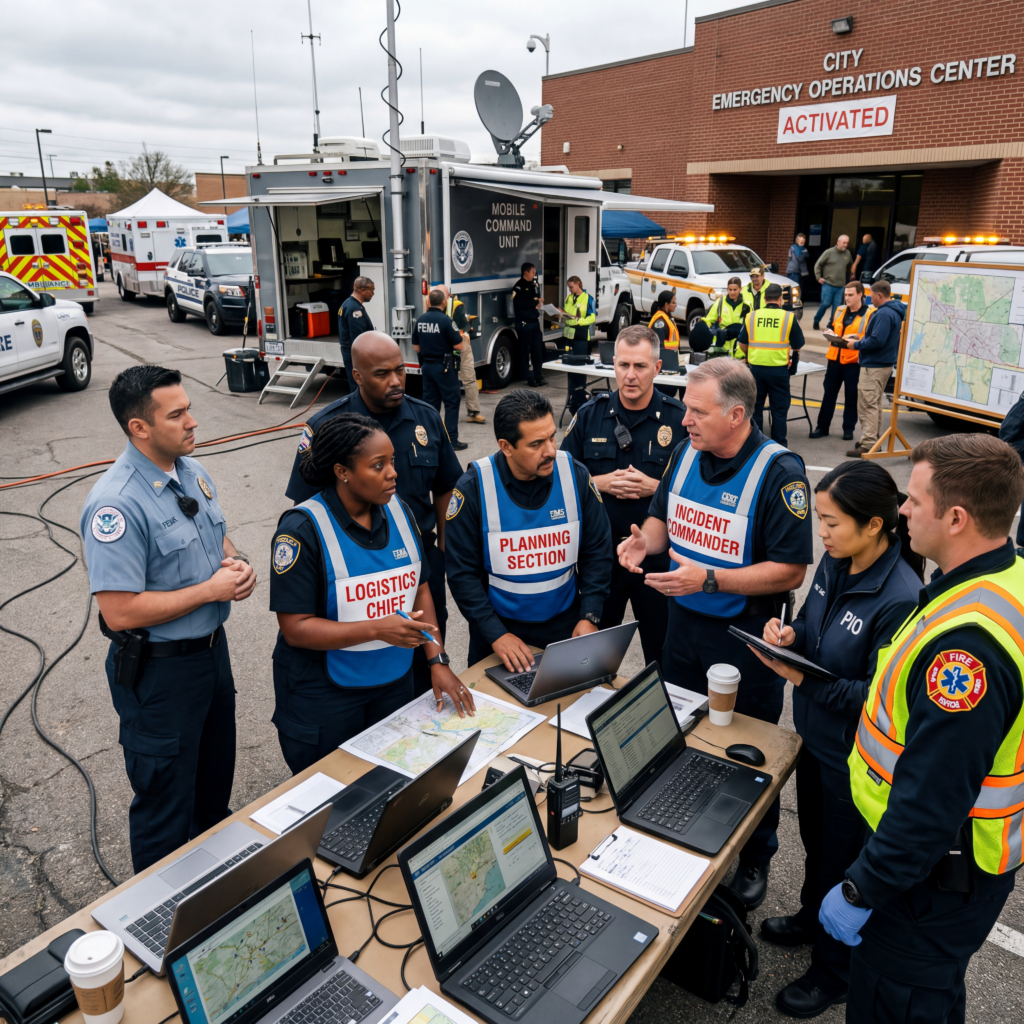
We don't guess at what an EOC needs, we've stood on the floor of one at 2 a.m. with sirens going off in three jurisdictions and a comms outage in two of them. That's not a slide in a deck. That's a memory.
CHALLENGE
Most EOCs are activated rarely, which means the technology, the training, and the muscle memory all atrophy between events. Whiteboards and paper plans still carry the load in agencies whose communities expect real-time situational awareness. Generic IT vendors treat EOC activation like a standard application rollout, missing the operational reality that every minute of activation counts. Sentinel brings EOC operations experience and technology acumen to the same engagement. We assess your activation readiness, harden the platforms that matter (WebEOC, Veoci, mass notification, video walls, GIS common operating pictures) and build the governance that keeps the EOC sharp between events. Your council, your residents, and your field responders get the coordinated response they expect.
YOUR EOC IS YOUR COMMAND POST
The United States now averages more than one billion-dollar disaster every three weeks, wildfires, hurricanes, tornadoes, severe storms, floods, and the compound events that chain across multiple states at once. When the sirens sound, your Emergency Operations Center is the single place where response becomes recovery or becomes chaos.
Too many EOCs still run on whiteboards, paper maps, and ad-hoc phone trees when it matters most. The gap between what communities expect and what centers can actually deliver widens with every activation. Sentinel Solutions Group closes that gap, pairing private-sector technology depth with working EOC activation experience to stand up centers that are ready before the call comes in.
Billion-Dollar U.S. Disasters in 2024
Billion-Dollar Events in the Past Decade
The Current Disaster Pace
THE EOC REALITY
CHALLENGE
COMMON CHALLENGES
OUR APPROACH
Most consultancies frame the work as picking the right vendor. Sentinel frames it as governing the EOC technology program, not the platform. The vendors come and go. The contracts get rewritten. The audit cycle never stops. Someone needs to be accountable to the EOC, not to the next sales target.
That is the work Sentinel does. We sit on the EOC side of the table, every meeting, every decision, every cycle. No resale margin. No referral fees. No commissions on the contracts we recommend. The only loyalty is to the operation.
We govern the program. We never sell the platforms.
An EOC sits idle most of the year and operates under maximum scrutiny on the days it stands up. The technology decisions made between activations determine whether the floor holds when it matters. These are the forces shaping what those decisions look like.
FEMA has tightened expectations on NIMS implementation, and EMAP accreditation has become a more frequent reference point in grant scoring and inter-jurisdictional mutual aid agreements. The data evidence required to demonstrate compliance has expanded beyond plans on a shelf.
Sentinel implication: An EOC that cannot produce data showing trained staff, exercised plans, and integrated systems is documenting non-compliance, even if the program is fundamentally sound. The technology decision determines what evidence exists.
Source: FEMA National Incident Management System (NIMS) Implementation Guidance; Emergency Management Accreditation Program (EMAP) Standard
Vendors are introducing AI-driven incident summarization, predictive resource forecasting, and automated common operating picture features into EOC platforms. FEMA and IAEM have begun policy discussions on AI in emergency management, but no operational standard yet exists.
Sentinel implication: An EOC that adopts AI features without an evaluation framework is building decision support that may not hold up at an after-action review. The governance decision precedes the procurement.
Source: IAEM AI in Emergency Management policy discussions; NIST AI Risk Management Framework (AI RMF 1.0)
After-action reviews from major incidents over the past decade have identified incompatible operating pictures across responding agencies as a recurring failure mode. Federal guidance has progressively pushed toward shared, interoperable COP standards, and several states now require COP integration as a condition of EM grant funding.
Sentinel implication: A WebEOC or COP decision is now a regional decision, even when the procurement is local. The platform that does not interoperate with the neighbors will not interoperate during the activation.
Source: FEMA National Response Framework; National Information Sharing Strategy; IAEM situational awareness guidance
FEMA NIMS resource typing and Emergency Management Assistance Compact (EMAC) deployments depend on accurate, current personnel and resource inventories. The data that sits in a binder during an audit will not deploy a strike team during an event.
Sentinel implication: The resource management database is operational infrastructure, not a compliance artifact. An EOC that treats it as paperwork is the EOC that finds out at activation time which resources are actually available.
Source: FEMA NIMS Resource Typing Library; EMAC Operations Manual; National Resource Hub
The Emergency Management Performance Grant (EMPG) and Homeland Security Grant Program (HSGP) are the dominant federal funding sources for EOC technology, with state-level pass-through structures and reporting requirements that follow the funding for the system's lifecycle. The grant calendar drives the procurement calendar.
Sentinel implication: An EOC that picks technology under grant deadline pressure inherits the reporting and sustainment burden for years. The grant terms and the contract terms are not the same terms, and the grant requirements outlast the grant.
Source: FEMA Emergency Management Performance Grant (EMPG); Homeland Security Grant Program (HSGP); FEMA Preparedness Grants Manual
CORE CAPABILITIES
An EOC is judged by how it performs in the first 15 minutes and how it learns in the first 15 days. Sentinel is the firm that lives in both. This signature is how we think about the full activation lifecycle.
Most EOCs are exercised more than they are activated. Our work focuses on the gap between the two: making sure readiness assessments hold up, and that incident action planning produces documents the command staff can actually use during a live event.
Explore Specialized Services →Structured assessment of EOC environments to ensure operational readiness for real-world activation, not just table-top exercises.
Structured IAP support for activations and major exercises, producing operations-ready planning documents under time pressure.
OUR PRACTICES
Every Sentinel engagement is governed by proprietary practices built for the realities of EOC technology, activation readiness, sustained operations, and after-action recovery, not borrowed from commercial IT playbooks.
PROGRAM MANAGEMENT
How we govern programs.
PMP-disciplined program governance structured for political visibility, audit defensibility, and multi-administration continuity. Every milestone, deliverable, and decision gate is designed for the public-sector reality, where council turnover, budget cycles, and federal funding rules shape the timeline more than any vendor’s project plan.
CHANGE MANAGEMENT
How we prepare your people.
Organizational change management built for the EOC watch floor, the activation cell, and the field liaison desk, not the corporate campus. We design adoption strategies informed by shift schedules, union dynamics, civil service rules, and the operational reality that your systems cannot go dark for training. When the EOC activates, the people behind the console are ready.
CONFIGURATION AUTHORITY
How we own the configuration.
Configuration authority for WebEOC, resource management, and mutual aid coordination platforms. Sentinel owns the foundational decisions that shape board layouts, incident types, resource catalogs, and activation workflows, producing the Blueprint, training, and administrator documentation that works at 3 a.m. in an actual activation, not just in tabletop exercises.
VALUE ASSURANCE
How we prove the value.
Post-deployment governance for your EOC technology investment. Sentinel independently measures whether interoperability, resource tracking, and multi-agency coordination outcomes specified at procurement are being realized across real incidents, not just in tabletop exercises. Findings become the evidentiary record for after-action reports and renewal decisions.
After engagement closes, Sentinel Sustain keeps the practice active across the life of the investment. Three tiers: Core, Active, and Strategic.
Learn more →Four practices, applied to one operating environment: the EOC floor between activations and during them. Each practice carries a specific scope and a specific deliverable cadence.
On a WebEOC migration, common-operating-picture integration, or NIMS implementation program, SDF runs the phase plan, the gate reviews, and the vendor accountability cadence. The EM director sees a defensible program record at every county-board update, and a documented audit trail at every EMAP accreditation review. SDF holds the program steady through exercise cycles, federal funding transitions, and the inevitable real-world activation that arrives mid-deployment.
When an EOC deploys a new platform, integrates with regional partners, or revises activation procedures, SRM prepares the staff for what changes and what stays the same. Section chief enablement, multi-agency coordination workflow revisions, exercise-cycle integration, and the post-go-live support cadence are scoped against the operational reality of activation pressure.
During WebEOC deployment, COP integration, or resource-management rollout, SDB is the practitioner-delivered configuration authority that sits on the EOC's side of the table. Activation workflow rules, COP source priority, resource-typing data quality, multi-agency permissions, and the technical decisions vendors typically push back on are documented with the EOC's answer in the room. SDB is delivered by Sentinel practitioners. It is not offered as training.
Twelve, twenty-four, and thirty-six months after deployment, including post-event reviews following actual activations, SVA reviews whether the system is performing to the documented intent: COP accuracy, integration uptime, configuration drift, and operational tradeoffs the EOC did not see at procurement time. The findings are advisory and non-binding by design. Sentinel documents. We do not litigate. No legal representation. No expert witness role. SVA is delivered by Sentinel practitioners. It is not offered as training.
DEEP EXPERTISE
Vendors selling into the EOC market have a playbook. The agencies that recognize the play before the contract get a different result than the agencies that find out at activation. These are the five games we see most often.
When asked about COP integration, mass notification, or resource tracking gaps, the incumbent platform vendor points to a separate vendor relationship the EOC has to manage independently. The integration is the EOC's problem; the vendor delivered what was scoped.
The platform brochure cites successful exercises, but the exercises were vendor-run scenarios with vendor-controlled inputs. The EOC asks for the after-action report, the vendor cites confidentiality, and the procurement team accepts the marketing claim.
Federal EM grant timing collides with vendor sales-cycle timing, and the vendor offers to "lock in pricing" if the contract signs by the grant deadline. The EOC signs under pressure, and discovers the scope gap during implementation.
Multi-jurisdiction COP integration is on the vendor's roadmap, with a date that conveniently lands after the contract signature. The EOC accepts the roadmap as a deliverable, the date slips, and the next mutual-aid event surfaces the gap.
Initial contract pricing assumes a default configuration. Every meaningful EOC-specific configuration becomes a professional services scope, billed at a different rate than the platform. The total cost emerges across years, not at signature.
HOW WE ACTIVATE
An activation is not just the moment the EOC opens, it is everything we do before, during, and after. Sentinel’s engagements are structured around all three phases so your EOC is sharper every time it opens.
✓ Platform assessment and hardening (WebEOC, Veoci, mass notification)
✓ Tabletop and full-scale exercise design
✓ Data feed validation (GIS, weather, traffic, field sensors)
✓ Role and responsibility mapping to ICS / NIMS
✓ Governance, documentation, and audit trails
✓ On-site or remote technical liaison during activation
✓ Real-time dashboard and video wall configuration
✓ Interoperability with field agencies and mutual aid
✓ Data integrity and communication discipline
✓ Escalation and decision-support analytics
✓ After-Action Review (AAR) facilitation and documentation
✓ Technology gap analysis and improvement roadmap
✓ Lessons-learned integration into procedures and training
✓ Budget and grant justification reporting
✓ Continuous governance cadence between activations
The right engagement depends on where the EOC is in the program lifecycle. Each tier has its own scope discipline and its own deliverable cadence.
End-to-end managed operations for the WebEOC, situational-awareness, common-operating-picture, and resource-tracking infrastructure Sentinel helped you deploy. Sustainment, vendor coordination, exercise-cycle readiness, and 24/7 incident response when the EOC stands up. The board is still accurate when the floor activates, because someone is still accountable for the integrations between exercises.
We govern the program. We never sell the platforms.
Read moreOngoing retainer with quarterly governance reviews, pre-decision advisory, and an open line for emergency-management leadership, mutual-aid coordination, and vendor escalations. The EOC has independent counsel on the technology side of the table, between activations and during them.
Sentinel documents. We do not litigate.
Read moreAnchored to one of SDF, SRM, SDB, or SVA. Best when the EOC knows which discipline is needed: a WebEOC migration, multi-agency coordination change readiness, configuration authority on common-operating-picture sources, or post-activation outcome governance. Fixed scope, named practice, defined deliverables.
Independent. Practitioner-led. Vendor-neutral.
Explore subscriptionsA specialized service plus a signature practice plus Sentinel Institute training, packaged as a single integrated engagement. For jurisdictions standing up a new EOC technology stack and building the institutional capacity to operate it under activation pressure.
Cutting-edge. Never bleeding-edge.
Read moreTemplates, Tools, and Office Hours
Low-touch entry tier. Sentinel templates, tools, reference materials, and scheduled office hours. The agency runs its own program; Sentinel provides the assets and answers the questions when they come up. No retainer, no embedded staff, no committed scope.
Best when: The agency wants Sentinel's templates and judgment but is not ready to engage a subscription. A starting point that can scale up if the program grows.
Built for the agency. Sized for the start.
Read more about Standard Access →The people on the other side of every Sentinel EOC engagement have run programs like yours from the inside. Not consultants who learned them in slide decks.
Twenty years inside the largest and most-watched public safety and government technology programs in the country. LAPD Records Management modernization. LA County Sheriff. LAFD. The program management discipline he ran at LAPD became the foundation of the Sentinel Delivery Framework. The change management discipline became the Sentinel Readiness Method. Both methodologies remain in active use at LAPD and Motorola today. On every Sentinel EOC engagement, Justin owns the operations and change management arc, phase governance, stakeholder coordination, and the audit-defensible record.
Twenty years inside the engineering and integration work behind some of the most-watched public safety technology programs in the country. DC Metro CAD/RMS modernization. National Capital Region Mutual Aid Hub. Mission-critical platform deployments at scale. The configuration discipline he ran in those programs became the foundation of the Sentinel Deployment Blueprint. The post-deployment outcome discipline became the Sentinel Value Assurance practice. On every Sentinel EOC engagement, Jason owns the engineering and technology arc, common-operating-picture integrity, COP integration, and the technical decisions that show up at activation.
Behind every Sentinel EOC engagement, an advisory bench of 200+ years combined experience: sitting emergency managers, FEMA grant practitioners, EMAP-experienced auditors, and EOC operations leaders. The bench is hand-picked, the engagement is named, and the depth applies on every program.
Most EOCs run multiple technology programs at once. Sentinel work in EOC work typically pairs with one or more of these companion disciplines, where the same governance discipline applies.
EOC activation depends on the radio system. Communications and EOC are one decision at activation.
EOC is the operational floor of the EM program. The platforms align or they fail at activation.
Mutual-aid fire response runs through the EOC. The COP integration is operational.
Interoperability and continuity are what an EOC actually runs on.
A thirty-minute conversation about your program, your timing, and what is actually going to get used. Then we will recommend an engagement, a subscription, or no action at all. Whatever the EOC actually needs.
Schedule a conversation