SECURITY & PROTECTIVE SERVICES
SECURITY ISN’T A SOFTWARE FEATURE
More than one million private security officers are working across the United States right now, more than twice the number of sworn public law enforcement. They stand post at hospitals, schools, stadiums, corporate campuses, gated communities, ports, transit hubs, courthouses, data centers, and critical infrastructure facilities that you would never want unprotected. They are, for most of the buildings and crowds in this country, the first and often only response.
Too many of those officers are under-trained, under-equipped, and under-supervised, and the liability arrives the moment something goes wrong. Sentinel Solutions Group applies real public-safety operational rigor to private protective services: policy and procedure that would survive a deposition, dispatch-grade technology that actually talks to local law enforcement, and training built by people who have sat both sides of the console.
Private Security Officers in the U.S.
The Size of Public Law Enforcement
U.S. Security Services Industry
CHALLENGE
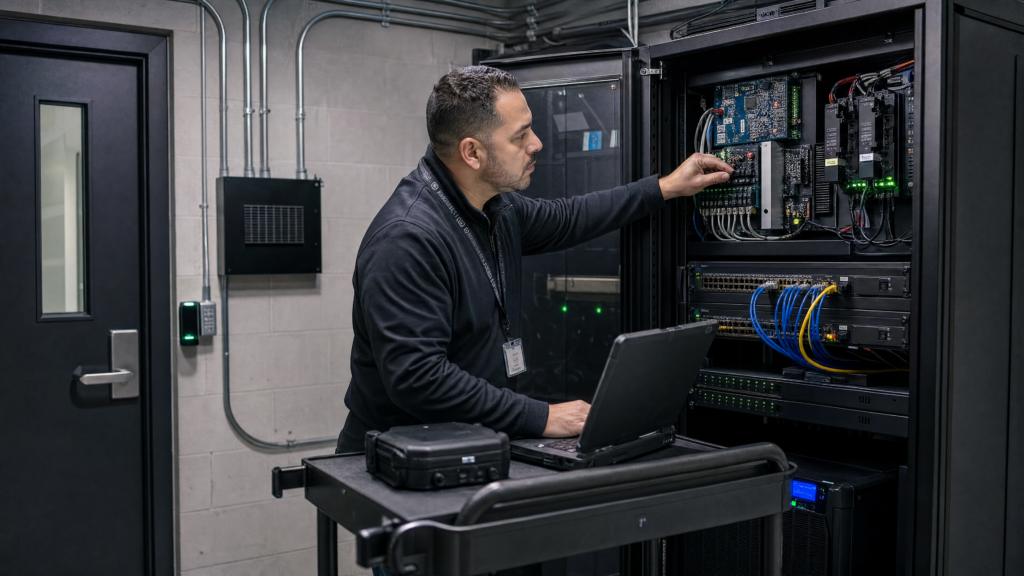
Security programs are often stitched together from disconnected systems, an access platform from one vendor, a VMS from another, guard-tour software somewhere else. Generic IT firms treat security tech like ordinary enterprise software and miss the operational realities: how incident reports feed investigations, how credential revocation actually works in a crisis, how guard rosters align with risk posture. Sentinel brings security operations discipline and technology governance to the same engagement. We assess your platform stack, rationalize vendor contracts, design integration that actually serves the security mission, and build the governance that keeps your program defensible to leadership, regulators, and, when it matters, the courtroom.
THE SECURITY REALITY
CHALLENGE
COMMON CHALLENGES
OUR APPROACH
Most consultancies frame the work as picking the right vendor. Sentinel frames it as governing the protective services technology program, not the platform. The vendors come and go. The contracts get rewritten. The audit cycle never stops. Someone needs to be accountable to the protective services program, not to the next sales target.
That is the work Sentinel does. We sit on the protective services program side of the table, every meeting, every decision, every cycle. No resale margin. No referral fees. No commissions on the contracts we recommend. The only loyalty is to the operation.
We govern the program. We never sell the platforms.
A protective services program runs the door, the camera, the badge, the patrol, the dignitary, and the emergency response, often with the same staff and the same systems. The technology decisions made today determine whether the program holds up at the next incident, the next audit, or the next executive review.
IP-based access control, networked video, IoT-enabled sensors, and cloud-managed security platforms have made the security operations center a network operations problem. ASIS International and the Security Industry Association have published guidance on the converged risk posture, and CISA has documented physical-cyber attack vectors.
Sentinel implication: A protective services program that runs physical and cyber security as separate disciplines is not running them as security. The vendor that ships a "physical" platform without the cyber lens is shipping an attack surface.
Source: ASIS International ESRM (Enterprise Security Risk Management) Guideline; Security Industry Association cyber-physical security publications; CISA Physical Security guidance
Behavioral analytics, facial recognition, license plate recognition, and AI-powered video search have moved from pilot to deployment in protective services contexts. NIST has documented persistent demographic accuracy disparities in face recognition, and state and local privacy laws have begun to constrain deployment.
Sentinel implication: A program that adopts AI analytics without a governance framework is building a future records request, a future legal challenge, and a future board hearing. Policy precedes procurement.
Source: NIST FRVT (Face Recognition Vendor Test); state biometric privacy laws (Illinois BIPA and equivalents); ASIS International guidance on technology ethics
ASIS International ESRM and ANSI/ASIS standards have established expected practices for enterprise security risk management, insider threat programs, and integrated security operations. Federal contractors and many enterprises now reference these standards in audit and compliance contexts.
Sentinel implication: A protective services program without an ESRM-aligned framework is operating below the documented standard. The auditor and the insurer will both ask which standard the program is benchmarked against.
Source: ASIS International ESRM Guideline; ANSI/ASIS Standards on Workplace Violence Prevention and Intervention; ANSI/ASIS PAP.1 Physical Asset Protection
Sustained shortages in qualified security personnel have driven adoption of force-multiplier technologies including remote video monitoring, automated patrols, drone integration, and AI-augmented dispatch. The technology decisions are increasingly substitutes for headcount, not complements to it.
Sentinel implication: The technology that backfills a workforce shortage today is the technology that gets blamed at the next incident if it underperforms. The deployment model decision precedes the procurement decision.
Source: ASIS International workforce reports; Security Industry Association industry analysis; OSAC (Overseas Security Advisory Council) practitioner guidance
State biometric privacy laws, surveillance technology ordinances, and community-oversight boards have made protective services technology procurement a public process in many jurisdictions. Vendor claims about capabilities, retention, and use must hold up at council and in litigation.
Sentinel implication: A program that procures surveillance technology without a public-defensibility lens is procuring a future ordinance challenge. The legal review and the technology evaluation are now the same review.
Source: Illinois Biometric Information Privacy Act (BIPA) and equivalent state laws; Community Control Over Police Surveillance (CCOPS) ordinances; ASIS International privacy guidance
CORE CAPABILITIES
Security is not a project that ends at commissioning. The technology drifts, the vendors change, the officers turn over, and the threat profile moves. Sentinel engages two ways: project work that stands a program up, and retained work that keeps it defensible, staffed, and improving. No hardware margin, no vendor commissions, no exclusive partnerships. Only what is right for your sites.
Security operations audit, threat-vulnerability-risk analysis, platform stack rationalization, and a roadmap that names what to fix, in what order, at what cost. You own the plan whether or not you continue with us.
GSOC stand-ups, multi-site access and video rollouts, and contract-guard transitions run with real milestones, risk registers, and independent verification that you got what you paid for.
Standing oversight of the program you already run: post orders, SOPs, access-review discipline, standards alignment (ASIS POA, UL 2050, Zero Trust), and reporting that holds up in a deposition. We govern the program. We never sell the platforms.
Embedded operators and engineers running GSOC operations, system administration, threat intelligence, and continuous optimization as a subscription. Your coverage does not depend on a headcount you cannot keep staffed.
Post-incident review, coverage-test validation, and quarterly program tuning. Every lesson learned becomes a protocol update, not a line item in next year’s after-action report.
Third-party review of vendor coverage claims, factory acceptance, commissioning, and contractor performance, on your terms and on your side of the table.
Security & protective services span risk assessment, technology architecture, command, response, and after-action. Most firms work one slice; we work the stack. This signature is how we see the full protective posture.
Three ongoing services that keep a security program operational, not decorative. Access control and surveillance kept current, threats identified before they become incidents, and SOC workflows tuned to reduce false positives and sharpen real signal.
Oversight of access control, surveillance, and alarm systems across facilities and perimeters.
Structured threat identification, monitoring, and response protocols built for the environment being protected.
Refinement of SOC monitoring and response workflows to reduce noise, sharpen signal, and shorten response.
OUR PRACTICES
Every Sentinel engagement is governed by proprietary practices built for the realities of security technology, access control, video, GSOC operations, and executive protection, not borrowed from commercial IT playbooks.
PROGRAM MANAGEMENT
How we govern programs.
PMP-disciplined program governance structured for political visibility, audit defensibility, and multi-administration continuity. Every milestone, deliverable, and decision gate is designed for the public-sector reality, where council turnover, budget cycles, and federal funding rules shape the timeline more than any vendor’s project plan.
CHANGE MANAGEMENT
How we prepare your people.
Organizational change management built for the GSOC desk, the guard post, and the executive protection detail, not the corporate campus. We design adoption strategies informed by shift schedules, union dynamics, civil service rules, and the operational reality that your systems cannot go dark for training. When the new security program goes live, the people behind the console are ready.
CONFIGURATION AUTHORITY
How we own the configuration.
Configuration authority for access control, camera management, and visitor management systems. Sentinel owns the foundational decisions around access levels, badge hierarchies, camera retention posture, and visitor workflows, producing the Blueprint, training, and administrator documentation that stands up to investigation, audit, and internal review.
VALUE ASSURANCE
How we prove the value.
Post-deployment governance for your physical security and protective technology investment. Sentinel independently measures whether access control, surveillance integration, and incident response outcomes specified at procurement are being realized in live operational conditions.
After engagement closes, Sentinel Sustain keeps the practice active across the life of the investment. Three tiers: Core, Active, and Strategic.
Learn more →Four practices, applied to one operating environment: the security operations center, the access-controlled door, the camera network, and the protective detail. Each practice carries a specific scope and a specific deliverable cadence.
On an access control modernization, video management migration, or SOC consolidation program, SDF runs the phase plan, the gate reviews, and the vendor accountability cadence. The security director sees a defensible program record at every executive briefing, and a documented audit trail at every insurance, regulatory, or board review. SDF holds the program steady through executive transitions, threat-landscape shifts, and the inevitable mid-deployment surprise.
When a program rolls out new access control, deploys video analytics, or restructures SOC operations, SRM prepares the workforce for what changes and what stays the same. Officer enablement, supervisor coordination, dispatcher transitions, and the post-go-live support cadence are scoped against operational reality across multiple sites and shifts.
During access control deployment, video analytics rollout, or SOC platform integration, SDB is the practitioner-delivered configuration authority that sits on the program's side of the table. Access policies, video retention rules, analytics thresholds, integration to alarm and dispatch, ESRM-aligned controls, and the technical decisions vendors typically push back on are documented with the program's answer in the room. SDB is delivered by Sentinel practitioners. It is not offered as training.
Twelve, twenty-four, and thirty-six months after deployment, SVA reviews whether the system is performing to the documented intent: access integrity, video coverage, alarm response, and configuration drift the program did not see at procurement time. The findings are advisory and non-binding by design. Sentinel documents. We do not litigate. No legal representation. No expert witness role. SVA is delivered by Sentinel practitioners. It is not offered as training.
DEEP EXPERTISE
Security technology vendors have built a playbook around converged sales, AI feature claims, and integration ambiguity. The programs that recognize the play before signature get a different long-term posture. These are the five we see most often.
Face recognition, behavioral analytics, and license plate readers ship with vendor accuracy claims that have not been benchmarked against NIST or independent academic evaluation. The program defends a procurement decision against a published disparate-impact study it cannot answer.
The video management platform claims open architecture, ONVIF compliance, and third-party integration. The reality at deployment is that meaningful integrations require vendor professional services and proprietary extensions.
When asked about device security, supply-chain posture, or NDAA Section 889 compliance, the vendor points to certifications and partner statements rather than the program's actual exposure. The CISO inherits the attack surface.
Cloud-managed access control or video platforms sell at attractive monthly pricing that does not name the cost of data export, contract termination, or platform migration at the next refresh. Exit cost emerges only when the program tries to leave.
Biometric privacy, surveillance ordinance, and civil-rights compliance are framed as "your jurisdiction's responsibility." The vendor delivers capability, the program inherits the legal exposure for capability the program may not actually need.
The people on the other side of every Sentinel protective services engagement have run programs like yours from the inside. Not consultants who learned them in slide decks.
Twenty years inside the largest and most-watched public safety and government technology programs in the country. LAPD Records Management modernization. LA County Sheriff. LAFD. The program management discipline he ran at LAPD became the foundation of the Sentinel Delivery Framework. The change management discipline became the Sentinel Readiness Method. Both methodologies remain in active use at LAPD and Motorola today. On every Sentinel protective services engagement, Justin owns the operations and change management arc, phase governance, stakeholder coordination, and the audit-defensible record.
Twenty years inside the engineering and integration work behind some of the most-watched public safety technology programs in the country. DC Metro CAD/RMS modernization. National Capital Region Mutual Aid Hub. Mission-critical platform deployments at scale. The configuration discipline he ran in those programs became the foundation of the Sentinel Deployment Blueprint. The post-deployment outcome discipline became the Sentinel Value Assurance practice. On every Sentinel protective services engagement, Jason owns the engineering and technology arc, access control architecture, video and analytics integration, SOC integrity, and the technical decisions that show up at the next incident.
Behind every Sentinel protective services engagement, an advisory bench of 200+ years combined experience: former law enforcement protective services leads, ASIS-certified ESRM practitioners, sitting security directors, and OSAC-experienced advisors. The bench is hand-picked, the engagement is named, and the depth applies on every program.
The right engagement depends on where the program is in the lifecycle. Each tier has its own scope discipline and its own deliverable cadence.
End-to-end managed operations for the access control, video, intrusion, and command-center infrastructure Sentinel helped you deploy. Sustainment, vendor coordination, version-upgrade discipline, and 24/7 incident response from the SOC. The badge is still working at the door at midnight, because someone is still accountable for the integration.
We govern the program. We never sell the platforms.
Read moreOngoing retainer with quarterly governance reviews, pre-decision advisory, and an open line for executive protection coordination, threat-assessment cycles, and vendor escalations. The program has independent counsel on the technology side of the table, before the next protective detail, the next site rollout, or the next contract cycle.
Sentinel documents. We do not litigate.
Read moreAnchored to one of SDF, SRM, SDB, or SVA. Best when the program knows which discipline is needed: an access-control modernization, video-management change readiness, configuration authority on the command center, or post-deployment outcome governance. Fixed scope, named practice, defined deliverables.
Independent. Practitioner-led. Vendor-neutral.
Explore subscriptionsA specialized service plus a signature practice plus Sentinel Institute training, packaged as a single integrated engagement. For programs standing up a new protective services technology stack from scratch and building the institutional capacity to operate it across multiple sites.
Cutting-edge. Never bleeding-edge.
Read moreTemplates, Tools, and Office Hours
Low-touch entry tier. Sentinel templates, tools, reference materials, and scheduled office hours. The agency runs its own program; Sentinel provides the assets and answers the questions when they come up. No retainer, no embedded staff, no committed scope.
Best when: The agency wants Sentinel's templates and judgment but is not ready to engage a subscription. A starting point that can scale up if the program grows.
Built for the agency. Sized for the start.
Read more about Standard Access →Most programs run multiple technology programs at once. Sentinel work in protective services work typically pairs with one or more of these companion disciplines, where the same governance discipline applies.
Protective services and law enforcement share access control, video, and SOC integration patterns.
Facility security and corrections share access control, video retention, and incident workflow.
Executive protection and EOC activation share situational awareness infrastructure.
Camera networks, monitoring centers, and support operations governed to a standard your clients can audit.
A thirty-minute conversation about your program, your timing, and what is actually going to get used. Then we will recommend an engagement, a subscription, or no action at all. Whatever the protective services program actually needs.
Schedule a conversation