311 & NON-EMERGENCY SERVICES
311 IS WHERE THE PUBLIC MEETS GOVERNMENT
Nearly a third of the 240 million 911 calls placed in the United States every year are not emergencies. Noise complaints. Potholes. Abandoned vehicles. Missed trash pickups. Questions about municipal services. Each one ties up a dispatcher seat, the same dispatcher who is now sitting one of every four chairs that should be filled, and pushes the person with a real emergency further back in the queue. In one analysis of Martha's Vineyard, 60% of calls to 911 were not emergencies. Baltimore cut 911 answer time in half the year it launched its 311 system.
A 311 program that actually works routes the routine away from the emergency line across phone, web, mobile app, SMS, social, and chatbot channels, into a CRM that talks to GIS, to every operating department's work-order system, to payment processing, to language services, and to 911 for the calls that turn out to be real. Sentinel Solutions Group builds 311 programs where the resident does not hear "someone will call you back," and where 911 gets back the bandwidth it should have never lost.
Of 911 Calls Are Non-Emergencies
911 Answer-Time Reduction (Baltimore 311)
Large-City Daily 311 Volume
CHALLENGE
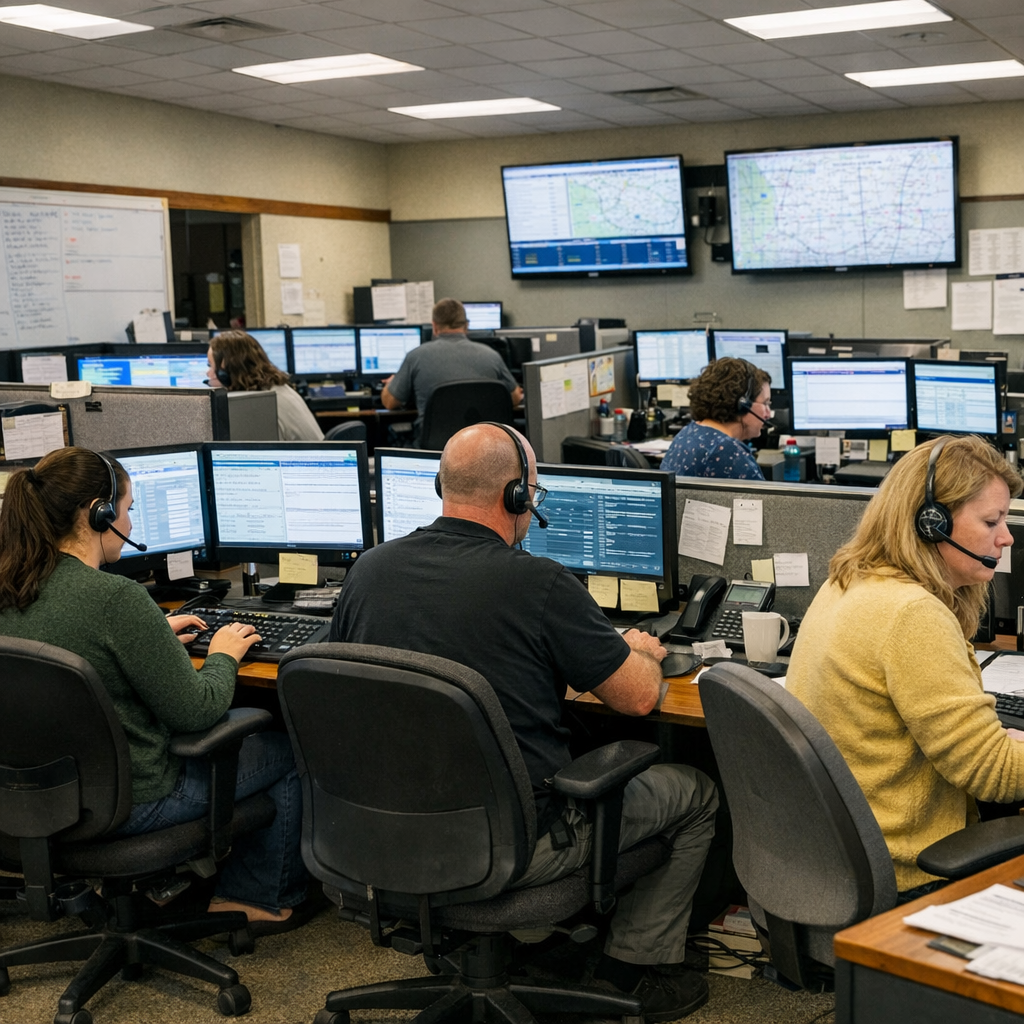
Most 311 programs live inside aging case management platforms with clunky integrations to department systems, no real-time dashboards, and a voicebot that frustrates more than it helps. Residents call 911 instead, PSAP call volume spikes, and the city council hears about service gaps the hard way, in community meetings and at election time. Sentinel brings municipal operations experience and modern technology governance. We assess your case management stack, redesign intake and routing, integrate with department systems that actually fulfill the service, deploy AI-assisted triage where it helps, and build the reporting that lets your administration demonstrate responsiveness to every resident who calls.
THE 311 REALITY
CHALLENGE
COMMON CHALLENGES
OUR APPROACH
Most consultancies frame the work as picking the right vendor. Sentinel frames it as governing the 311 and non-emergency services program, not the platform. The vendors come and go. The contracts get rewritten. The audit cycle never stops. Someone needs to be accountable to the 311 program, not to the next sales target.
That is the work Sentinel does. We sit on the 311 program side of the table, every meeting, every decision, every cycle. No resale margin. No referral fees. No commissions on the contracts we recommend. The only loyalty is to the operation.
We govern the program. We never sell the platforms.
A 311 program is the constituent's first impression of how the city works. The technology decisions made today determine whether the request gets answered at the first call, whether the data shows up on the mayoral dashboard, and whether the next budget defense holds together. These are the forces shaping those decisions.
Web, mobile, SMS, chat, social, and voice are now expected entry points to a 311 program, with constituent satisfaction surveys consistently scoring channel availability above response time. NLC and ICMA have documented the expectation shift, and benchmark cities have moved aggressively toward parity across channels.
Sentinel implication: A 311 program with a phone-first architecture is providing degraded service to the constituents who do not call. The channel-strategy decision is the equity decision.
Source: National League of Cities (NLC) State of the Cities reports; ICMA local government technology reports; Government Finance Officers Association (GFOA) constituent service guidance
AI-powered intake, conversational chatbots, automated routing, and predictive case management have entered the 311 vendor space. NIST AI RMF applies, but no 311-specific standard exists, and several large cities have faced challenges with chatbot accuracy and constituent equity.
Sentinel implication: A program that deploys AI intake without an evaluation framework is building a future records request and a future equity audit. Policy precedes procurement.
Source: NIST AI Risk Management Framework (AI RMF 1.0); ICMA AI in local government policy resources; NLC technology guidance
State and local open data ordinances, federal transparency expectations, and constituent demand for case-level data have made 311 data a published asset. Cities that publish 311 data do so on schedule, in machine-readable formats, with documented data quality.
Sentinel implication: A CRM that does not produce open-data-ready exports is producing a future ordinance challenge. The data publication decision is now part of the procurement decision.
Source: Sunlight Foundation open data guidance (legacy); What Works Cities certification standards; Open Data Charter
A 311 request typically generates work in Public Works, Parks, Code Enforcement, Sanitation, or Police. The CRM is the integration layer for cross-departmental workflow, and many programs underestimate the integration scope at procurement time.
Sentinel implication: A CRM decision made in isolation from departmental workflow is a procurement decision that fails at the first cross-departmental escalation. The integration scope precedes the platform decision.
Source: ICMA local government workflow guidance; What Works Cities operational excellence framework
DOT Smart City grants, federal infrastructure funding through IIJA, state-level digital equity grants, and HUD community development funding have created sustained federal investment in 311 and related constituent technology. Reporting requirements follow the funding for the system's lifecycle.
Sentinel implication: A program that picks technology under grant deadline pressure inherits the federal reporting burden for years. The grant timeline and the procurement timeline are not the same timeline.
Source: DOT Smart City Challenge program; Infrastructure Investment and Jobs Act (IIJA) digital equity provisions; HUD Community Development Block Grant (CDBG) program
CORE CAPABILITIES
311 is the most-touched customer service operation most cities run. The systems that back it have to serve millions of interactions while integrating with every department downstream. This signature shows the full service chain.
Three ongoing services built for the reality of 311 operations. System administration tuned to municipal service catalogs, quality assurance built around resident experience, and workflow optimization that trims intake-to-resolution time.
Ongoing configuration, service request management, and integration support for 311 platforms.
Evaluation of call quality and service consistency across channels, with structured improvement feedback loops.
Streamlining intake, routing, and resolution processes to reduce time-to-close and resident escalations.
OUR PRACTICES
Every Sentinel engagement is governed by proprietary practices built for the realities of 311 technology, resident intake through service-request closure and public trust, not borrowed from commercial IT playbooks.
PROGRAM MANAGEMENT
How we govern programs.
PMP-disciplined program governance structured for political visibility, audit defensibility, and multi-administration continuity. Every milestone, deliverable, and decision gate is designed for the public-sector reality, where council turnover, budget cycles, and federal funding rules shape the timeline more than any vendor’s project plan.
CHANGE MANAGEMENT
How we prepare your people.
Organizational change management built for the 311 call floor, the agency back office, and the community liaison desk, not the corporate campus. We design adoption strategies informed by shift schedules, union dynamics, civil service rules, and the operational reality that your systems cannot go dark for training. When the new 311 platform goes live, the people behind the console are ready.
CONFIGURATION AUTHORITY
How we own the configuration.
Configuration authority for service request platforms, routing workflows, and cross-agency coordination systems. Sentinel owns the foundational decisions that shape service catalogs, routing logic, SLA governance, and public-facing channels, producing the Blueprint, training, and administrator documentation that keeps 311 useful as the agency’s public front door and responsive as service lines evolve.
VALUE ASSURANCE
How we prove the value.
Post-deployment governance for your 311 platform investment. Sentinel independently measures whether case resolution times, departmental routing accuracy, and citizen-facing outcome commitments specified at procurement are being realized, and documents vendor accountability when they are not.
After engagement closes, Sentinel Sustain keeps the practice active across the life of the investment. Three tiers: Core, Active, and Strategic.
Learn more →Four practices, applied to one operating environment: the constituent intake channel, the cross-departmental routing rules, the service request lifecycle, and the open-data publication queue. Each practice carries a specific scope and a specific deliverable cadence.
On a CRM modernization, omnichannel rollout, or open-data integration program, SDF runs the phase plan, the gate reviews, and the cross-departmental vendor accountability cadence. The 311 director sees a defensible program record at every council update, and a documented audit trail at every mayoral dashboard review. SDF holds the program steady through administrative transitions, channel expansion cycles, and the inevitable mid-deployment surprise.
When a city deploys a new CRM, opens a new constituent channel, or integrates with new departments, SRM prepares the workforce for what changes and what stays the same. Agent enablement, supervisor workflow analysis, departmental partner coordination, and the post-go-live support cadence are scoped against operational reality across shifts and across departments.
During CRM deployment, channel integration, or cross-departmental routing rollout, SDB is the practitioner-delivered configuration authority that sits on the program's side of the table. Routing rules, SLA structures, departmental escalation logic, open-data export configuration, and the technical decisions vendors typically push back on are documented with the program's answer in the room. SDB is delivered by Sentinel practitioners. It is not offered as training.
Twelve, twenty-four, and thirty-six months after deployment, SVA reviews whether the system is performing to the documented intent: first-call resolution, cross-departmental routing accuracy, open-data publication integrity, and configuration drift the program did not see at procurement time. The findings are advisory and non-binding by design. Sentinel documents. We do not litigate. No legal representation. No expert witness role. SVA is delivered by Sentinel practitioners. It is not offered as training.
DEEP EXPERTISE
CRM vendors selling into local government move fast on demos and slow on cross-departmental implementation. The programs that recognize the play before signature build operations that hold up at the next mayoral dashboard. These are the five we see most often.
Vendor demonstrates rich functionality on a demo tenant that has been configured for the demo. Production implementation reveals that meaningful capability requires professional-services scope the program did not budget.
CRM is procured with the assumption it will route to Public Works, Code Enforcement, and Sanitation. At implementation, the integration to each department is "additional scope," and each department's system is its own integration project.
AI chatbot ships with vendor-cited accuracy claims that do not specify the benchmark, the test set, or the demographic distribution. The program deploys a chatbot that performs differently for different constituent populations.
CRM "supports open data export" but the export is manual, ad-hoc, or available through a separate tool. The program signs the open-data ordinance commitment based on the vendor claim, then handles the export as ongoing operational burden.
CRM is procured with federal smart-city, IIJA, or HUD funding, and the federal reporting requirements continue for the lifecycle of the system. The program owns the reporting burden, not the vendor.
The people on the other side of every Sentinel 311 program engagement have run programs like yours from the inside. Not consultants who learned them in slide decks.
Twenty years inside the largest and most-watched public safety and government technology programs in the country. LAPD Records Management modernization. LA County Sheriff. LAFD. The program management discipline he ran at LAPD became the foundation of the Sentinel Delivery Framework. The change management discipline became the Sentinel Readiness Method. Both methodologies remain in active use at LAPD and Motorola today. On every Sentinel 311 program engagement, Justin owns the operations and change management arc, phase governance, stakeholder coordination, and the audit-defensible record.
Twenty years inside the engineering and integration work behind some of the most-watched public safety technology programs in the country. DC Metro CAD/RMS modernization. National Capital Region Mutual Aid Hub. Mission-critical platform deployments at scale. The configuration discipline he ran in those programs became the foundation of the Sentinel Deployment Blueprint. The post-deployment outcome discipline became the Sentinel Value Assurance practice. On every Sentinel 311 program engagement, Jason owns the engineering and technology arc, CRM architecture integrity, omnichannel integration, open-data publication, and the technical decisions that show up at the next mayoral dashboard review.
Behind every Sentinel 311 program engagement, an advisory bench of 200+ years combined experience: former local government CIOs, ICMA-recognized practitioners, sitting 311 directors, and What Works Cities-aligned operations leaders. The bench is hand-picked, the engagement is named, and the depth applies on every program.
The right engagement depends on where the 311 program is in its lifecycle. Each tier has its own scope discipline and its own deliverable cadence.
End-to-end managed operations for the CRM, service request routing, knowledge-base, and constituent-channel infrastructure Sentinel helped you deploy. Sustainment, vendor coordination, version-upgrade discipline, and 24/7 ops. The pothole report is still routing to the right department on the first try, because someone is still accountable for the routing rules.
We govern the program. We never sell the platforms.
Read moreOngoing retainer with quarterly governance reviews, pre-decision advisory, and an open line for council briefings, service-level reporting, and vendor escalations. The program has independent counsel on the technology side of the table, before the next mayoral dashboard, the next channel expansion, or the next contract renewal.
Sentinel documents. We do not litigate.
Read moreAnchored to one of SDF, SRM, SDB, or SVA. Best when the program knows which discipline is needed: a CRM modernization, omnichannel rollout change readiness, configuration authority on constituent-data routing, or post-deployment outcome governance. Fixed scope, named practice, defined deliverables.
Independent. Practitioner-led. Vendor-neutral.
Explore subscriptionsA specialized service plus a signature practice plus Sentinel Institute training, packaged as a single integrated engagement. For jurisdictions standing up a new 311 program from scratch and building the institutional capacity to operate it across the full service-request lifecycle.
Cutting-edge. Never bleeding-edge.
Read moreTemplates, Tools, and Office Hours
Low-touch entry tier. Sentinel templates, tools, reference materials, and scheduled office hours. The agency runs its own program; Sentinel provides the assets and answers the questions when they come up. No retainer, no embedded staff, no committed scope.
Best when: The agency wants Sentinel's templates and judgment but is not ready to engage a subscription. A starting point that can scale up if the program grows.
Built for the agency. Sized for the start.
Read more about Standard Access →Most 311 programs run multiple technology programs at once. Sentinel work in 311 work typically pairs with one or more of these companion disciplines, where the same governance discipline applies.
Non-emergency intake and alternative response share constituent-channel infrastructure.
Mass notification, mayoral dashboards, and 311 share channel infrastructure during events.
Non-emergency overflow from 911 lands in 311. The routing decision is structural.
Staffing for the non-emergency load and the digital front door residents actually use.
A thirty-minute conversation about your program, your timing, and what is actually going to get used. Then we will recommend an engagement, a subscription, or no action at all. Whatever the 311 program actually needs.
Schedule a conversation