
HEALTHCARE · EMERGENCY MEDICINE & EDs
Independent governance, oversight, and managed technology services for the highest-acuity unit in the hospital, where minutes drive outcomes and every workflow is under load.
THE ED REALITY
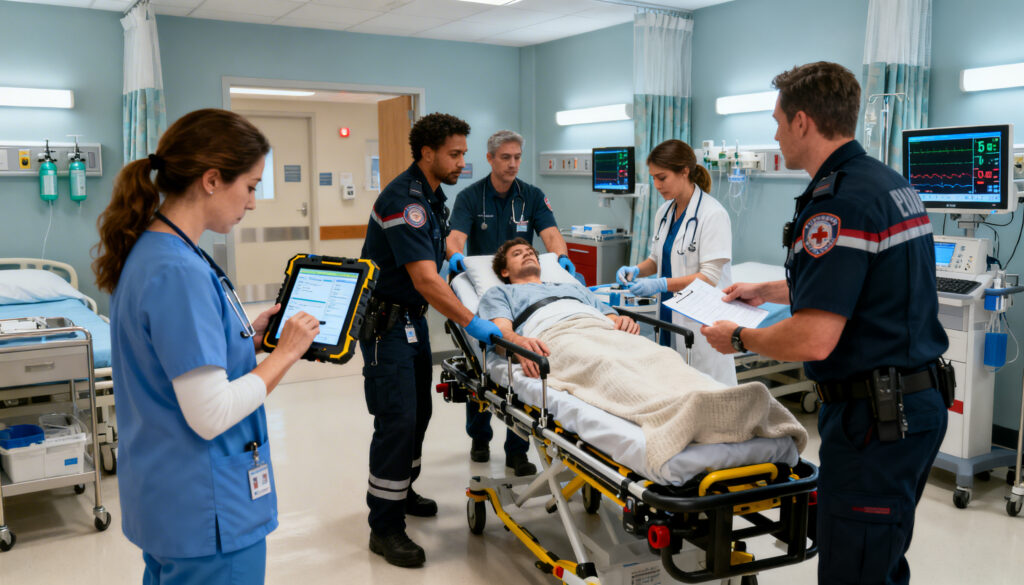
Emergency Departments are the hospital’s front door, its pressure release valve, and often its worst-instrumented unit. ED tracking boards, triage modules, patient flow orchestration, EMS integration, bedside documentation, and discharge workflows have to move at the speed of the work, or they get worked around. Modern EDs run on technology that did not exist a decade ago: real-time location systems, predictive boarding models, ambient AI scribes, tele-triage, integrated imaging, and the cybersecurity perimeter that holds it all together.
Sentinel Solutions Group makes sure those decisions land in your favor, whether you run a critical access ED seeing twenty patients a day or a Level I trauma center running at 300% capacity. We do not sell the technology. We govern the decisions around it.
140M+
ED visits per year in the United States
50%
of U.S. hospital admissions originate in the ED
6+ hrs
average ED length of stay at many U.S. hospitals (ACEP)
CHALLENGE
EDs are managing simultaneous technology pressures (tracking board modernization, EMS integration, CMS throughput metrics, boarding and capacity analytics, ambient AI adoption) while vendors compete to lock them into ecosystems they may not need. The clinicians at the bedside and the executives making decisions rarely have an independent technical voice in the room. Sentinel fills that gap: practitioner-led advisory, vendor-neutral evaluation, and program governance built by people who understand ED operations, not just ED technology.
THE CHALLENGES
CMOs, CMIOs, and IT directors are navigating a landscape that punishes the wrong technology decision and rewards the right one. These are the pressures we help hospitals manage.
Tracking boards, triage modules, boarding dashboards, and real-time capacity analytics reach end-of-life faster than they get replaced. EDs need platforms that match how the work actually moves, not the vendor’s demo flow.
Pre-arrival data, electronic PCR integration, and warm-handoff documentation remain patchwork at most hospitals. A clean EMS-to-ED data handoff cuts time-to-treatment and protects the chart.
OP-18, OP-22, ED-1, ED-2, left-without-being-seen, and boarding metrics all depend on clean timestamps and clean workflows. Poor instrumentation shows up on public scorecards.
SaaS pricing escalation, proprietary data formats, hidden integration fees, and vague SLAs are baked into most public-safety vendor contracts. Without independent scrutiny, hospitals sign deals that punish them at every renewal.
Patient safety and clinical outcomes depend on data flowing across EHR, HIE, lab, pharmacy, imaging, and revenue cycle systems, and with regional hospitals, state HIEs, public health agencies, and payers. Most hospitals still struggle with basic interoperability.
New technology only works if nurses, physicians, and clinical staff actually use it. Recruiting, training, and change management are as critical as the platform itself, and they are routinely under-budgeted in modernization programs.
OUR APPROACH
Sentinel was built by people who came up inside healthcare and the technology that supports it. Our team brings decades of bedside, administrative, and engineering experience across the largest health systems in the region, then trained clinicians on technology, workflow, and process. Our advisory board includes practicing clinicians and leaders (nurses, physicians, and clinical directors) who have served everywhere from agriculture country to the largest metro departments. That lived experience shapes every recommendation we make.
We understand the operational reality of healthcare because we have lived it. Our team knows what clinicians need at 2 a.m., and we know how to translate that into the procurement, governance, and contract language that protects the hospital long after.
We have built, sold, and deployed the EHR, HIE, clinical applications, and clinical documentation platforms healthcare organizations are evaluating. We know the contract language, the hidden SKUs, the integration gotchas, and the renewal traps that vendors do not advertise.
Our co-founder served as a Principal Systems Engineer overseeing some of the most complex healthcare IT environments in the country, and our advisory board adds decades of additional engineering depth across HIPAA, networks, infrastructure, and cybersecurity.
You do not get a single consultant, you get the full bench. Our advisory board of practicing clinicians, nursing leaders, and healthcare IT veterans is actively involved in every engagement, tailored to your specific program. Sentinel is one of the only firms that brings both deep technical expertise and operational breadth directly tied to mission-critical clinical operations.
Most consultancies frame the work as picking the right vendor. Sentinel frames it as governing the emergency medicine technology program, not the platform. The vendors come and go. The contracts get rewritten. The audit cycle never stops. Someone needs to be accountable to the department, not to the next sales target.
That is the work Sentinel does. We sit on the department side of the table, every meeting, every decision, every cycle. No resale margin. No referral fees. No commissions on the contracts we recommend. The only loyalty is to the operation.
We govern the program. We never sell the platforms.
An ED technology decision shows up on the boarding-time dashboard, in the CMS Hospital Compare report, and in the next sentinel-event review. The platform that runs triage, tracking, and disposition is the platform the department lives in. These are the forces shaping those decisions.
ED boarding has reached crisis levels documented across ACEP, ENA, and AHA reports, and CMS has tightened boarding-time measures with public reporting through Hospital Compare. The Joint Commission and CMS expectations on throughput tracking have hardened, and the data the department produces is the data CMS scores.
Sentinel implication: A department whose tracking system cannot produce defensible throughput data is producing a future CMS finding. The data quality decision is the CMS-measure decision.
Source: American College of Emergency Physicians (ACEP) boarding crisis reports; CMS Hospital Compare measures; The Joint Commission emergency care standards
AI-assisted triage, acuity scoring, sepsis early warning, and clinical decision support have moved into ED workflows rapidly. FDA SaMD oversight, recent retrospective studies on AI early-warning system accuracy, and the malpractice landscape have raised the evaluation bar significantly.
Sentinel implication: A department that adopts AI triage without a documented evaluation and human-in-the-loop framework is making a patient-safety commitment that may not hold up at chart review. The clinical-governance question precedes the procurement.
Source: FDA Software as a Medical Device (SaMD) guidance; ACEP AI policy positions; published peer-reviewed studies on ED clinical AI accuracy
Sustained behavioral health volume in EDs, documented across ACEP, ENA, and SAMHSA data, has driven adoption of telepsychiatry, behavioral health screening tools, and 988 integration capabilities. The data and workflow infrastructure required is non-trivial, and many departments are adapting tools designed for general ED care.
Sentinel implication: A department running behavioral health surge through general-ED tooling is producing documentation that may not hold up at the next CMS or Joint Commission review. The behavioral health workflow is now part of the ED tooling decision.
Source: ACEP behavioral health emergency care position statements; ENA behavioral health practice guidance; SAMHSA emergency department-level behavioral health data
Telemedicine in the ED, including teleconsultation, tele-stroke, tele-psychiatry, and tele-triage, has moved from temporary to sustained. CMS coverage policies have stabilized post-pandemic, and AHA data shows continued integration into routine ED workflow.
Sentinel implication: A department whose tracking system does not handle teleconsultation as first-class workflow is producing fragmented documentation. The telemedicine integration decision is the documentation-quality decision.
Source: CMS telemedicine coverage policies (post-PHE); American Telemedicine Association ED practice guidelines; ACEP telemedicine position statements
EM physician workforce shortages, expanded APP scope of practice, and growing reliance on contract staffing have changed the operating model in many EDs. ACEP and ENA workforce surveys have documented the shift, and the technology has to support a more dynamic, more variable staffing pattern.
Sentinel implication: A department whose tracking and acuity tooling assumes a stable, single-staffing-model environment is producing data that does not match the operating reality. The staffing model and the tooling assumption have to converge.
Source: ACEP physician workforce reports; ENA staffing surveys; AAPA emergency medicine PA practice data
CORE CAPABILITIES
Every engagement is anchored in six disciplines that protect hospitals from bad decisions, bad contracts, and bad outcomes.
Clinicians will use a system if it is built for them and rolled out the right way, and abandon it if it is not. We design change strategies informed by real-world deployments, including our founder’s Joint Commission to ICD-10 national coding transition experience, so adoption sticks.
We identify the technical, operational, contractual, cyber, HIPAA, and political risks that threaten your program, and build mitigation strategies your CEO, CMO, or board can defend in any audit, after-action, or community meeting.
RFP development, scoring rubric design, vendor evaluation, reference checks, contract negotiation, and SOW authoring. We level the playing field so the best fit wins, not the best sales team or the slickest demo.
PMP-disciplined program governance with public-sector fluency. We structure work for political visibility, audit defensibility, and multi-administration continuity, so your modernization survives elections, budget cycles, and command turnover.
Beyond advisory. Sentinel can operate alongside your team, maintaining EHR and clinical systems environments, mobile data infrastructure, clinical archives, networks, cybersecurity controls, and every system that touches patient safety and clinical integrity.
We watch the vendor so you do not have to. Independent verification and validation across milestones, data conversion, acceptance testing, training, go-live, and warranty, keeping vendors accountable to the contract you signed.
Most firms specialize in one slice, the EHR, the revenue cycle, the imaging, the analytics. We have sat at every seat and engineered every layer. This signature is how we see the full arc, and where Sentinel sits most actively.
Five ongoing services shaped by the pressures of modern healthcare. Records systems kept clean against CMS and Joint Commission reporting standards, critical incidents reviewed with defensibility in mind, and clinical analytics built to actually reduce time-to-resolution.
Ongoing EHR configuration, user management, reporting setup, and system optimization.
Continuous validation of reporting data to ensure CMS and Joint Commission reporting accuracy, with audit-ready documentation.
Independent analysis of high-risk incidents to identify trends and reduce liability exposure.
Streamlining body camera and clinical documentation processes to reduce backlog and improve audit and compliance readiness.
Full lifecycle support for RTCC development, including staffing models, workflows, and technology integration.
OUR PRACTICES
Every Sentinel engagement is governed by proprietary practices built for the realities of healthcare technology, not borrowed from commercial IT playbooks.
PROGRAM MANAGEMENT
How we govern your program.
PMP-disciplined program governance structured for multi-jurisdictional complexity, elected leadership accountability, and federal grant compliance. Every milestone and decision gate is designed for the healthcare reality, where executive transitions, board oversight, CMS mandates, and union negotiations shape the timeline more than any vendor’s project plan.
CHANGE MANAGEMENT
How we prepare your people.
Organizational change management built for bedside clinicians, charge nurses, and clinical leadership, not corporate end users. We design adoption strategies informed by shift rotations, union dynamics, field deployment realities, and the operational truth that your EHR and clinical systems cannot go dark for training. When the new system goes live, your clinicians and staff are ready.
CONFIGURATION AUTHORITY
How we own the configuration.
Configuration authority for ED tracking board deployments, triage module configuration, patient-flow orchestration, and EMS handoff integration. Sentinel owns the foundational decisions around acuity assignment, boarding workflows, throughput metrics, and discharge documentation, producing the Blueprint, training, and administrator documentation that holds up under ED surge load and Joint Commission review.
VALUE ASSURANCE
How we prove the value.
Post-deployment governance for your emergency department information system investment. Sentinel independently measures whether door-to-provider, documentation compliance, and throughput outcomes specified at procurement are being realized under real ED operating conditions.
After engagement closes, Sentinel Sustain keeps the practice active across the life of the investment. Three tiers: Core, Active, and Strategic.
Learn more →Four practices, applied to one operating environment: the ED tracking board, the triage workflow, the boarding queue, and the throughput data CMS scores. Each practice carries a specific scope and a specific deliverable cadence.
On an ED tracking migration, telemedicine integration, or behavioral-health surge response program, SDF runs the phase plan, the gate reviews, and the vendor accountability cadence. The medical director and ED administrator see a defensible program record at every executive update, and a documented audit trail at every CMS measure cycle and Joint Commission visit. SDF holds the program steady through volume surges, staff turnover, and the inevitable mid-deployment surprise.
When a department deploys new tracking, integrates telemedicine, or shifts triage workflow, SRM prepares the clinical and operational workforce for what changes and what stays the same. Triage RN enablement, physician workflow analysis, charge nurse coordination, and the post-go-live support cadence are scoped against operational reality during peak volume.
During ED tracking deployment, telemedicine integration, or acuity-tool configuration, SDB is the practitioner-delivered configuration authority that sits on the department's side of the table. Triage acuity thresholds, telemedicine workflow integration, behavioral-health screening rules, boarding-time capture, and the technical decisions vendors typically push back on are documented with the department's answer in the room. SDB is delivered by Sentinel practitioners. It is not offered as training.
Twelve, twenty-four, and thirty-six months after deployment, SVA reviews whether the system is performing to the documented intent: throughput data quality, boarding-time accuracy, telemedicine integration uptime, and configuration drift the department did not see at procurement time. The findings are advisory and non-binding by design. Sentinel documents. We do not litigate. No legal representation. No expert witness role. SVA is delivered by Sentinel practitioners. It is not offered as training.
DEEP EXPERTISE
These are the specific platforms, standards, protocols, and operational disciplines we work in every day.
WE KNOW THE TRICKS OF THE TRADE
These are the traps that consume budgets, derail timelines, and leave hospitals stuck with systems that do not serve them. We have seen them firsthand, and we know exactly how to neutralize them.
01
EHR and clinical platform vendors that encode patient data, workflow metadata, and report templates in formats only they can read. We insist on open data standards, documented schemas, and exportability clauses before the contract is signed.
02
The line items that appear after go-live: lab interfaces, imaging integrations, pharmacy connectors, HIE feeds, and “professional services” fees for every custom API call. We surface them during procurement, not after.
03
Per-user licensing that escalates with system growth, storage tiers that punish retention compliance, and per-export fees for clinical documents or data migration. We negotiate caps, predictable storage costs, and portability terms up front.
04
Cloud and managed-service vendors that sign HIPAA attestations they cannot actually fulfill, leaving your organization holding the bag at audit time. We verify HIPAA posture before the contract, not after the breach.
05
Vendors who promise “intuitive” platforms and deliver weeks of clinician training your team was never warned about. We demand realistic training hours, super-user programs, and protected ramp-up periods in the SOW.
06
Organizations that sign based on demos and reference calls curated by the vendor. We conduct independent reference checks and dig into how the platform actually performs at organizations of comparable size and complexity.
WHO YOU ARE WORKING WITH
The people who lead every Sentinel engagement have spent their careers inside hospitals, behind the engineering consoles of the country’s most complex clinical systems, and at the bedside and nursing stations that keep patients safe.
HEALTHCARE OPERATIONS & NURSING LEADERSHIP

HEALTHCARE, CLINICAL OPERATIONS & PATIENT SAFETY ADVISORY
Also Supporting Your Program
The right engagement depends on where the ED is in the program lifecycle. Each tier has its own scope discipline and its own deliverable cadence.
End-to-end managed operations for the ED tracking, EHR, telemedicine, and patient-flow infrastructure Sentinel helped you deploy. Sustainment, vendor coordination, HIPAA-aware version-upgrade discipline, and 24/7 incident response. The board is still accurate, the boarding-time alarm is still firing on time, because someone is still accountable for the integration.
We govern the program. We never sell the platforms.
Read moreOngoing retainer with quarterly governance reviews, pre-decision advisory, and an open line for medical-director response, throughput reporting, and vendor escalations. The department has independent counsel on the technology side of the table, before the next CMS measure, the next surge plan, or the next contract cycle.
Sentinel documents. We do not litigate.
Read moreAnchored to one of SDF, SRM, SDB, or SVA. Best when the department knows which discipline is needed: an ED tracking migration, telemedicine integration change readiness, configuration authority on triage and acuity workflows, or post-deployment outcome governance. Fixed scope, named practice, defined deliverables.
Independent. Practitioner-led. Vendor-neutral.
Explore subscriptionsA specialized service plus a signature practice plus Sentinel Institute training, packaged as a single integrated engagement. For EDs standing up a new department technology stack from scratch and building the institutional capacity to run it through volume surges and staff turnover.
Cutting-edge. Never bleeding-edge.
Read moreTemplates, Tools, and Office Hours
Low-touch entry tier. Sentinel templates, tools, reference materials, and scheduled office hours. The agency runs its own program; Sentinel provides the assets and answers the questions when they come up. No retainer, no embedded staff, no committed scope.
Best when: The agency wants Sentinel's templates and judgment but is not ready to engage a subscription. A starting point that can scale up if the program grows.
Built for the agency. Sized for the start.
Read more about Standard Access →Most departments run multiple technology programs at once. Sentinel work in ED work typically pairs with one or more of these companion disciplines, where the same governance discipline applies.
ED workflow lives inside the health-system platform. The platform decisions are connected.
The EMS-to-ED handoff is a structured data flow that determines documentation quality.
Behavioral health surge in EDs is a sustained operational reality. The workflow is shared.
A thirty-minute conversation about your program, your timing, and what is actually going to get used. Then we will recommend an engagement, a subscription, or no action at all. Whatever the department actually needs.
Schedule a conversation