Organizational change management is the discipline I care most about in this work.
I have a degree in change management. I have built change management into every major mission-critical deployment I have led in the last decade and a half. Jason and I have run change management through some of the largest public safety technology programs in the country. None of that experience has been more formative than the work we did at the Los Angeles Police Department.
I want to start with a story.
During discovery for the LAPD Records Management modernization, I was conducting a shadow observation with an officer. We pulled up at a domestic violence scene and he said, “Let me go get the paperwork.” He walked to the back of the patrol vehicle and opened the rear hatch. Inside was a retrofitted cabinet of drawers containing hundreds of paper forms, neatly organized. A mobile filing cabinet. He scanned a few slots, pulled the form he needed, then the second, then the third, then another. He joked that this would be quick and began completing them by hand.
That was the moment I understood the magnitude of the change LAPD was about to embrace.
The department was preparing to move from a pen-and-paper records environment to a fully electronic ecosystem. Hundreds of paper forms replaced by tablets, laptops, workstations, structured fields, real-time validation, and centralized data infrastructure. The program touched everyone. Patrol officers in the field. Detectives in investigations. Records staff in the central division. Jail booking. Forensic science. Property and evidence. Database administrators who built and ran the reports. Division chiefs and command staff. Civilian support across the entire department. It eventually reached the mayor's office, because everyone with a stake in how the city's largest department generated, retained, and reported on its records had a stake in what LAPD was building.
It was, by LAPD's own recognition, the largest technology upgrade the organization had ever attempted.
I knew when I started taking field notes that this engagement would be close to once-in-a-lifetime for me. I did not yet know that what we built at LAPD would become the spine of every change management framework Sentinel uses today.
This Insight is about why organizational change management in public safety, fire, EMS, healthcare, jail operations, and broader mission-critical government work is genuinely different from change management in corporate America. Why generic models fail in consequence environments. What actually works across the workforce, from the dispatch console to the patrol car to the records division to the booking floor to the forensic lab to the command staff briefing room. And why Sentinel built the Sentinel Readiness Method™ and Sentinel Value Assurance™ specifically for the agencies that have to perform through change without ever pausing the work.
I have worked with corporate change management firms. There are some genuinely impressive practitioners in that space. Almost none of them have meaningful public safety or mission-critical experience. They bring frameworks designed for banks, retailers, manufacturers, and Fortune 500 corporate departments into environments where the consequence model is fundamentally different. The frameworks are not wrong. They are incomplete for what this work actually requires.
Public safety, fire, EMS, military, healthcare, and mission-critical government operations are not corporate America with a badge on. The people are different. The pressures are different. The risk model is different. The relationship between the workforce and the technology is different. The cost of a learning-curve mistake is measured in different units. Almost every angle of the change management process has a differentiator that gets amplified by the industry it is applied to.
When agencies select someone to help them navigate complex change, they should specifically seek out firms whose change methodology was designed around this industry. Sentinel has the edge here because we have all worked inside it. We were the users, the supervisors, the managers, and the leaders on the agency side at one point. We were the deployment teams on the vendor side at another point. We know how the floor thinks. We know how the field thinks. We know how the records division thinks. We understand the pressures of the jobs the workforce does and why traditional change management concepts often land as elementary, or even insulting, to people doing consequence work. We know the complex personalities and traditions that public safety, fire, and government operations are built on.
We get it. We did it. We are it.
Mission-Critical Operations Are Not Office Environments
A dispatch floor is not an office. A patrol shift is not an office. A fire station is not an office. A records division processing daily case backlog is not an office. A jail booking floor running 24/7 intake is not an office. A forensic lab maintaining chain of custody on every piece of evidence is not an office. None of these environments behave the way a corporate department behaves when its technology changes.
The work does not pause.
The phones do not stop ringing because a new CAD is being deployed. Radio traffic does not wait while a dispatcher remembers where a command moved on the screen. The patrol officer who is on a call cannot pause that call because the mobile records system released a new build. The fire crew responding to a structure fire cannot delay arrival because the apparatus reporting system is in cutover. The booking sergeant intaking an arrestee cannot stop the intake because the jail management system has a configuration bug. The records clerk processing a stack of investigative reports at end of shift cannot reset the workflow because the validation rules changed overnight. The forensic technician moving evidence through chain of custody cannot use yesterday's system tomorrow because the evidence is the case.
Mission-critical work is built around speed, accuracy, repetition, confidence, and muscle memory. Over years, the workforce develops deeply embedded habits around keyboard commands, screen layouts, entry sequence, form-to-system mapping, validation rules, status changes, escalations, and the dozens of micro-workflows that make the daily job survivable under pressure. That is not resistance to change. That is operational conditioning.
The industry research supports this across roles. CAD systems are not passive administrative tools. They support emergency vehicle dispatching, unit status, incident reporting, resource management, call taking, mapping, MDC and mobile interfaces, and connections to local, state, and federal systems. Records management systems are the legal record of the agency's work and the source of every downstream report, including data submitted to the FBI's National Incident-Based Reporting System. Jail management systems carry the legal status of every person in custody. Evidence management systems carry the integrity of every prosecution. Mobile data systems are the field officer's connection to NCIC, CCIC, premise alerts, and the dispatcher who is tracking their safety. Each of these systems sits at the operational core of someone's consequence work.
Change across this workforce is not just emotional adoption. It is cognitive retraining under pressure. Operators collect, decode, prioritize, and transmit complex information under conditions that do not forgive errors. The system the operator uses is the system that processes the moment that may save a life, hold a chain of custody, document an arrest, or stand up in court two years later.
The part outsiders miss is this. In corporate America, mistakes during adoption may create rework, delay, inconvenience, or lost productivity. In public safety and mission-critical operations, mistakes during adoption can affect responder safety, public safety, liability, officer status monitoring, fire response, EMS dispatch, the legal record of a prosecution, the integrity of an evidence chain, and the quality of service delivered to someone on the worst day of their life.
The workforce does not resist change because it is stubborn. It resists unmanaged change because the workforce knows exactly what happens when uncertainty enters a life-safety, legal, or consequence workflow.
Translating Change For The Role That Has To Live With It
A fire chief, a captain, and a firefighter walk around a new engine.
The chief sees fleet budget, service life, capital depreciation, and how this purchase fits the city's long-term apparatus plan. The captain sees crew configuration, tool placement, scene access, and whether the engine will work alongside the existing mutual aid stack. The firefighter sees where their boots will live during a fourteen-hour shift, whether the cab is comfortable on a cold January morning, and whether the new engine will hold the same hose loads they have built muscle memory around for the past eight years.
Same engine. Three different stories about why it matters.
Generic change management tries to tell one story to all three. Real change management tells three stories, in three different languages, to the three different roles that have to live with the engine.
The dynamic repeats across every consequence environment. A patrol commander, a sergeant, and a patrol officer evaluate the same new records management system completely differently. A communications director, a dispatch supervisor, and a call taker have different stakes in the same CAD upgrade. A jail commander, a booking sergeant, and a corrections officer respond differently to the same jail management system replacement. A records bureau commander, a records supervisor, and a records technician each see the same retention policy change through a different lens. A fire chief, a battalion chief, and a firefighter on a shift each have different concerns about a new incident reporting platform. The forensic lab director, the supervisor, and the bench technician each have different stakes in a LIMS upgrade.
This is the part most corporate OCM frameworks miss when they walk into a mission-critical environment. They build a single value proposition for the change and broadcast it across the organization. The dashboard the system will produce. The data analytics leadership will get. The reporting modernization that will satisfy a grant requirement. None of that is wrong. None of it is relevant to the dispatcher answering the next 911 call. None of it is meaningful to the records clerk processing a stack of reports at end of shift. None of it lands with the patrol officer who is about to spend two and a half times longer entering a domestic violence report than they used to.
By my estimations on some deployments I have led, the entry time for an electronic record can be more than twice the time it took to complete the same record by hand. The electronic system rejects bad data on the spot. It requires valid information the first time. It measures and validates as the user types, prompting changes along the way. This is the right thing for data quality, downstream reporting, and the records division. It is a shock to the field user who has spent ten years filling out a paper form that the system would accept whether the information was right or not, with a records clerk on the back end to catch the mistakes.
If the field user is not adequately prepared for the entry-time adjustment, the knee-jerk reaction is negative. The new system is “slow.” The new system is “broken.” The new system is “worse than the paper.” None of those statements are technically accurate. All of them are operationally true to the person making them in the moment.
This is where change management actually matters. If the user understands the entry-time increase is normal, understands why it exists, understands what the validation is producing on the back end, understands what it will eventually mean for their career, their workload, their pay structure, or their unit's reputation, the disappointment is still real. The disappointment is no longer a surprise. The user has already prepared mentally. The frustration is acknowledged as normal rather than treated as failure.
The work is to know what each role values and frame the change in that language. Dispatchers, police officers, firefighters, EMTs, healthcare workers, records staff, evidence technicians, forensic analysts, corrections officers, supervisors, and command staff all have different stakes in the same technology. The records clerk cares about whether they will still be needed when validation moves upstream. The dispatcher cares about whether the new screen layout will slow them down on a high-acuity call. The officer cares about whether reporting will eat into the time they have to do the rest of the job. The firefighter cares about whether the new NFIRS-compliant report makes their shift end on time. The forensic analyst cares about whether the new LIMS protects chain of custody the way the old one did. The chief cares about whether the dashboard will hold up in front of the city council. The change management team has to know all of them and speak to all of them in their own terms.
Generic OCM treats the workforce as a single audience. Public safety and mission-critical OCM treats the workforce as a collection of operational roles, each with its own value calculation, each with its own stake in whether the change succeeds.
How Generic OCM And Vendor-Led Change Management Fail Here
The most common failure mode is treating OCM as a communication plan and a training calendar. That is how corporate firms often approach it. Announce the change. Identify sponsors. Produce messaging. Train users. Go live. Reinforce adoption. Generic models like ADKAR are useful in the right setting because they focus on awareness, desire, knowledge, ability, and reinforcement. In a consequence environment, those concepts have to be rebuilt around shift coverage, rank-and-file trust, operational stress, and the reality that the work does not pause.
Failure mode one: training exists, but the workforce cannot actually absorb it
The agency says everyone was trained. The attendance sheet looks good. The training happened months before go-live, on different equipment, in a classroom, with a system that did not behave like the production environment. Then go-live arrives, and the operator realizes the screens are different, the workflow is slower, the map is wrong, the form fields have moved, or the command sequence does not match what they practiced.
This is not theoretical. The San Jose CAD implementation review described training on simulated MDC terminals that were different from the equipment installed in patrol cars, short training sessions sometimes scheduled months before go-live, and users discovering at go-live that the system did not perform as demonstrated during training. The report connected those issues to stress, functionality concerns, morale problems, and operational impacts that took months to stabilize. The same pattern shows up in records modernizations, evidence system replacements, jail management transitions, and any other mission-critical cutover where training was treated as a project deliverable rather than as operational readiness.
Failure mode two: the communication never reaches the real workforce
A vendor PM sends email updates. The chief attends steering committee. A slide deck is presented at an all-hands meeting. The night shift never hears the same message. The weekend crew gets it secondhand. Part-time staff miss the conversation entirely. The fire crews on 24-on-48-off rotations get whichever message happens to land on their shift. The records second shift never sees the briefing the day shift attended. The booking floor on a holiday weekend hears about the cutover when it arrives. The people who actually work the highest-stress shifts receive the least context, because every communication channel assumes office-hours availability.
Failure mode three: the wrong people are appointed as change champions
Management names a supervisor or senior employee as the champion because the org chart says they should be influential. The floor does not trust that person. The patrol shift does not trust that person. The records team does not trust that person. Or worse, the workforce sees that person as management's messenger. The real opinion leader may be the tenured night-shift dispatcher, the senior patrol officer who everyone asks for help with reports, the records technician who quietly trains every new hire, the booking sergeant who knows every workflow exception, the fire engineer who understands both policy and reality, or the forensic lead who has actually worked every bench position.
When corporate OCM misses that, the program gets false-positive adoption. Leadership thinks the workforce is bought in because the appointed champion said so. Then cutover arrives and the real organizational culture rejects the change in real time.
Failure mode four: the vendor runs the change management
Most CAD, RMS, LMR, NG911, jail management, and evidence management vendors offer a “change management” component as part of their deployment package. Motorola Solutions, CentralSquare, Tyler Technologies, Hexagon, Intrado, Axon, and others all have versions of this. Vendor-led change management is not malicious. It is structurally limited. The vendor's change management plan is built around the project plan. The training calendar exists to support cutover. The communication exists to support adoption metrics. The “go-live” celebration exists to mark contract milestones. None of it is built around the operational reality of the agency, because the vendor does not live in that reality.
Vendor-led change management often fails because it is built around the project plan. Public safety change management has to be built around the workforce.
Who Actually Has The Workforce's Trust
Trust across a public safety or mission-critical organization does not follow the org chart perfectly. Formal authority matters, but credibility is different from rank.
Public safety organizations are paramilitary by structure. Command and control matters during emergencies. That same structure can create fixed communication channels, morale issues, and frustration when rank-and-file personnel do not feel heard. The FBI Law Enforcement Bulletin has discussed how paramilitary structures can create rigid communication channels and how soliciting ideas from rank and file can improve workflow and morale. The same dynamic exists in fire, EMS, dispatch, jail operations, records, forensics, and most government environments where the work is hierarchical and the floor or the field is where the work actually gets done.
The real change champions usually meet three tests.
They are operationally respected. They can do the work under stress, and everyone knows it.
They are socially trusted. People talk honestly around them when management is not in the room.
They are constructively skeptical. They do not cheerlead every decision. They ask the questions the rest of the workforce is already thinking.
In a dispatch center, those people may be communications training officers, senior call takers, radio dispatchers, fire dispatch specialists, night-shift informal leaders, or QA personnel. In a records environment, it may be the records specialist who knows how cases really move, the senior technician who trains every new hire, or the supervisor who can translate policy into workflow. In patrol, it may be the FTO who is currently riding with three trainees, the senior officer who helps everyone fix bad reports, or the sergeant whose squad consistently performs. In a jail, it may be the booking sergeant who has seen every intake exception, the housing officer who knows every classification edge case, or the medical liaison who works the hardest interface. In a fire department, it may be the engineer who has run every apparatus, the captain who has trained half the department, or the senior medic who actually understands the call types. In a forensic environment, it may be the bench scientist who has worked every section, the QA manager who tracks every error, or the supervisor who has testified the most times in court.
When those people are treated as true change champions, they become interpreters. They can say, “Here is what is changing, here is why it matters, here is what will be harder at first, here is what will be better once we get through it, and here is what we need to escalate.” That is very different from a management-appointed champion who simply repeats the project message.
This aligns with high-reliability thinking. HRO principles emphasize deference to expertise, meaning the organization values insight from the people with the most relevant safety knowledge, not simply the people with the highest title. Public safety has been adapting HRO concepts for years, often without naming them as such, because the work demands it.
In public safety and mission-critical operations, the org chart tells you who has authority. The workforce tells you who has influence. A serious change management effort has to know the difference.
Training Built For The Environment
Training that works in this environment is not a one-week class. It is a layered readiness campaign.
The agency cannot pull every operator off the floor for a week. Staffing is too tight. Overtime is expensive. Many comm centers, patrol shifts, fire houses, records bureaus, and jail housing units already operate at minimums every shift. A corporate training model assumes blocks of user availability that a 24/7 PSAP, a four-platoon fire department, or a continuous-operation jail simply does not have. The records bureau may have day-shift availability, but they also have a daily backlog that does not pause for training. The forensic lab cannot pause evidence processing for a week without affecting active prosecutions.
Training that works in mission-critical environments usually includes shift-tailored learning, small modules instead of one-time saturation, sandbox access that mirrors production, peer-led reinforcement, scenario-based drills, and QA and feedback loops.
The same message has to be delivered repeatedly across day shift, swing shift, night shift, weekends, holidays, relief staff, and shift-rotation crews. It cannot be a single all-hands meeting. Operators need short, targeted modules tied to actual workflows. For a comm center, that is call entry, unit status, fire recommendations, EMS workflows, premise alerts, officer safety, radio discipline, transfers, CAD-to-CAD, MDC behavior, and failure procedures. For records, it is report entry, supplements, NIBRS validation, expungement workflows, public records redaction, and retention policy enforcement. For patrol, it is mobile data, field reporting, NCIC and CCIC queries, supplement workflow, and the connections between the in-car system and the back-end records of record. For the booking floor, it is intake workflow, classification, medical interface, court interface, release workflow, and the audit trail. For fire, it is NFIRS reporting, station alerting, apparatus tracking, and incident command interface. Each role needs training tuned to the work that role actually does.
Training environments must mirror production as closely as possible. When training hardware, screen layouts, maps, or workflows differ from the live environment, confidence erodes. San Jose's CAD review specifically found that training computers and displays did not accurately simulate the equipment and interface users would rely on during live operations.
Vendor trainers can teach the software. They usually cannot teach the agency's operational culture. The strongest model pairs vendor knowledge with agency trainers and respected workforce champions who can translate the system into local practice. NENA's professional education standard emphasizes QA and QC and QI, daily observation reports, skills performance testing, performance standards, trend identification, after-action reviews, and in-service training as part of building and improving telecommunicator performance. APCO publishes similar guidance. The IACP and the IJIS Institute publish equivalent guidance for law enforcement records and reporting environments.
Training cannot be designed around when the vendor is available. It has to be designed around when the workforce can actually learn.
The LAPD Ambassador Program
At LAPD, we built a group we called Ambassadors. They were super users. They were involved in extra training and orientation throughout every stage of the deployment, across every part of the department the program touched.
Many of the leaders in that group were change leaders who participated in testing, discovery, configuration, working sessions, decision meetings, issue triage, risk management sessions, and project status meetings. They were kept in the know at all times so they could understand why decisions were being made and how those decisions affected the way the technology would work, and ultimately the way it would be used by the people doing the job. That gave them the foundation they needed to train the broader Ambassador cohort, who then trained the end-user community across patrol, records, jail, forensics, property and evidence, investigations, and the civilian support divisions.
Transparency was the key. With a change that big, the old “just do it” or “that's just the way it is” was not the way to win over users who had built their entire careers, in many cases thirty-plus years, around the existing process. The Ambassador model gave us trusted interpreters at every layer of the organization. When a patrol officer asked a question that an external trainer could not answer credibly, an Ambassador could. When a records clerk needed to understand how a workflow had been redesigned, an Ambassador had been in the room when the decision was made and could explain it in operational terms. When a forensic supervisor needed to know how chain-of-custody logging would behave under the new system, an Ambassador had the answer because they had been part of the design.
This is the model Sentinel now uses as part of SRM. The Ambassador is not a champion in name only. The Ambassador is a participant in the design, a witness to the decisions, and a trusted voice when the workforce has questions the project team cannot answer.
Marketing The Change: The Source Of Truth Hub
The other thing we did at LAPD that became part of the Sentinel methodology was treating the change like a product launch.
We marketed the modernization the way an ad agency markets a new product hitting the market. Teasers in the briefing rooms. Banners in the watch commander's office. Pop-up visits from technology specialists who would talk incrementally with users about the change. Short videos from division chiefs, commanders, and leadership staff sharing their stories about the change and why it mattered. Different messages for patrol, for records, for jail operations, for the forensic divisions, for property and evidence, for the database administrators who built the reports, and for the command staff who would be defending the program in front of the city council and the mayor's office.
Public safety, fire, EMS, and most government organizations are still founded on rank and file. There is always a push to “just do it because that is what policy says.” There is also a growing population of newer professionals who want more than that as an answer. Seeing leadership embrace the change, get excited about it, and talk about it positively conditions the workforce to feel trusting of the solution, to embrace the people implementing it, and to begin adapting before the change is even present.
The Source of Truth Hub was the game-changer.
During any massive change, anxiety is real. Anxiety is handled differently by every person in the organization. To prevent rumor, misinformation, mistruth, and misunderstanding from filling the vacuum, we built an internal website for the agency and linked it by QR code on every piece of promotion we put out. It was mobile-friendly. It was accessible from a phone in the field, from a workstation in records, from the dispatch console during a break, from the booking floor between intakes, from the forensic bench between cases, and from the command suite during executive briefings.
It became one place for the truth.
The real timeline, updated weekly. The real impact details, organized by role. A patrol officer logging in saw what mattered to a patrol officer. A records clerk saw what mattered to records. A booking sergeant saw what mattered to the jail. A forensic technician saw what mattered to the lab. A division chief saw what mattered to leadership. We structured it by role so people did not have to filter through information that did not apply to them.
That single design choice killed half the rumor problems we had anticipated. It let people focus on real changes instead of conspiracy theories and end-of-times predictions. It kept the faces of the chief, the division leadership, and the command staff visible and engaged. That visibility calmed nerves and signaled that the change was endorsed at the top.
The hub also became the platform for the work that came after go-live, which is where most change management programs collapse.
The Cutover Is An Operational Event, Not A Project Milestone
A CAD, RMS, jail management, evidence management, or other mission-critical go-live is not just a project milestone. It is an operational event.
The system transitions while the work is still happening. 911 lines are still ringing. Units are still clearing calls. Fire companies are still being recommended. Officers are still running plates. EMS still needs patient response. Booking is still intaking arrestees. Evidence is still being checked in and out of the locker. Records is still processing the daily caseload. Supervisors still need situational awareness. The agency is changing the aircraft while it is flying.
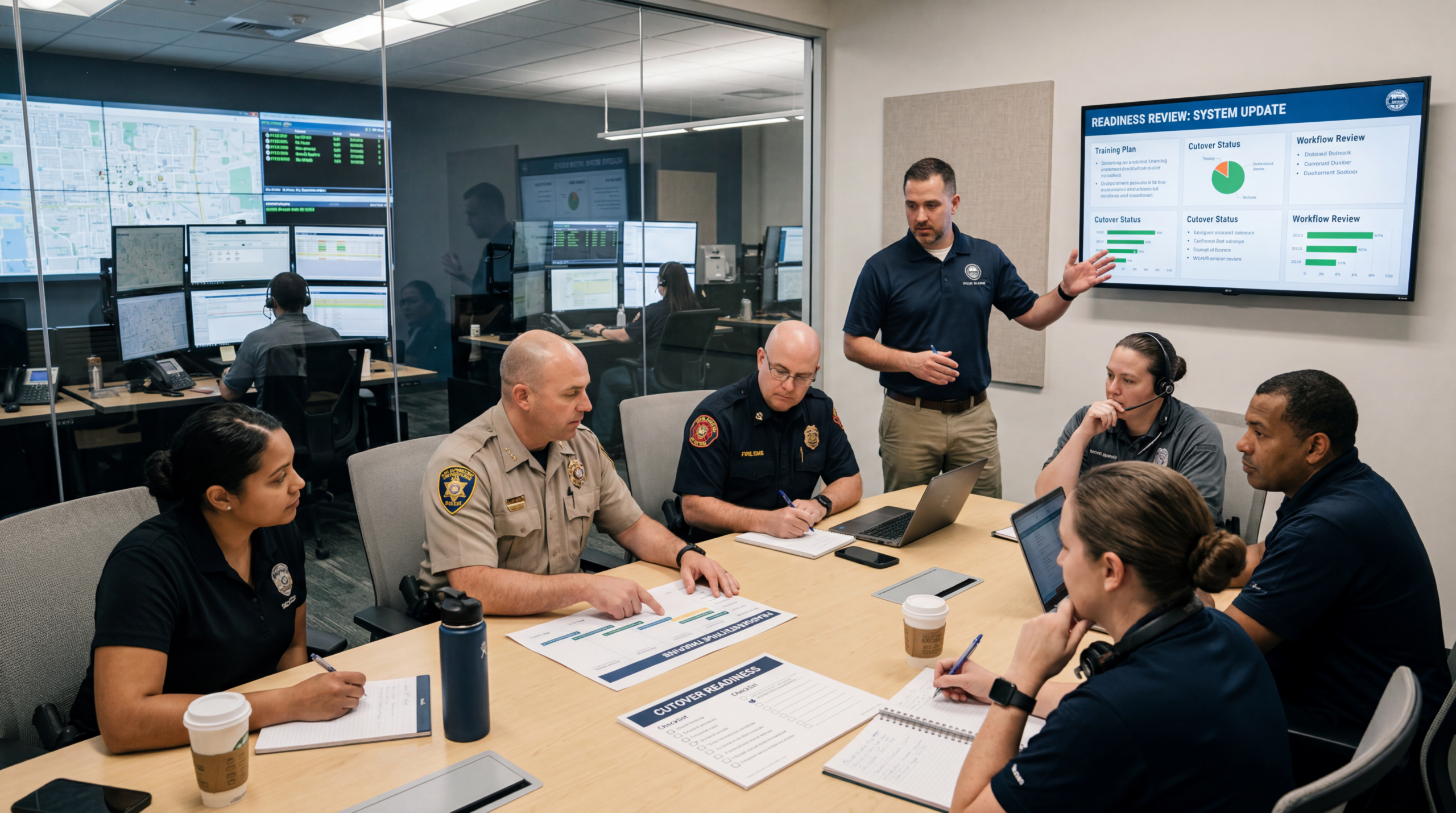
A managed cutover has to include an operational command structure, not just a technical deployment structure. There should be a cutover command post. Clear authority. Workforce support on every shift the system touches. Technical escalation paths. Vendor support presence. Agency decision-makers with the authority to act in real time. Fallback criteria. Manual procedures. Documentation protocols. A defined point at which leadership can say: continue, pause, rollback, or stabilize.
Depending on the system and the agency, a managed cutover may include parallel operations for a defined period, phased cutover by discipline or geography or module, structured command-center support on the floor and in the field, floor walkers assigned by shift and discipline, immediate defect triage, rapid configuration authority, manual backup procedures, operator-to-field communication scripts, go and no-go checkpoints, and contingency plans for every interface the system depends on.
When cutover is treated as a project milestone rather than an operational event, the program misses the human reality of the workforce. The San Jose CAD case is again instructive. The post-go-live review described immediate operational challenges, system crashes, manual and paper operations, user disbelief about the lack of a pilot deployment, conflicting answers about whether parallel operation existed, and mission-critical problems that users believed endangered public and officer safety. The same pattern shows up in poorly managed records cutovers, jail management transitions that go live without parallel intake, and evidence system migrations that leave chain-of-custody gaps the lab cannot defend in court.
A go-live plan tells the project when the system turns on. A cutover plan tells the operation how it stays safe when the system turns on.
The First 30, 60, And 90 Days After Cutover
This is where most change management plans abandon the workforce.
The vendor's deployment team leaves. The training team leaves. The agency's project manager moves to the next initiative. The workforce is left alone with the system during the hardest part of adoption. Most agencies think OCM is exclusively a preparedness methodology, and while a great deal of OCM is about preparedness, a significant amount of the program's ultimate success is decided in what happens after go-live.
The first thirty, sixty, and ninety days are not “post-project.” They are the stabilization period. That is when workarounds appear. That is when confidence is either built or lost. That is when defects become rumors. That is when small workflow issues become morale issues. That is when the workforce decides whether the system is workable.
The failure mode is easy to recognize. Operators start building shadow processes. They keep cheat sheets that are not approved. Supervisors create informal workarounds. Field users stop trusting CAD notes. Records staff correct errors after the fact, off-record. Booking creates manual logs alongside the official system. Forensic teams keep parallel paper logs because they do not trust the new evidence system yet. The vendor says the system is “working as designed.” The workforce says the system is broken. Leadership hears both and does not have a governance structure to separate defect from configuration from training issue from policy issue from legitimate enhancement request.
The public safety research reinforces why this matters. APCO's stress standard identifies burnout, compassion fatigue, shift work, lack of managerial support, and organizational issues as major contributors to telecommunicator stress, and it ties stress directly to productivity, citizen safety, and responder safety. Similar dynamics exist for patrol officers, firefighters, EMTs, corrections officers, and records staff. Adding an unstable post-cutover environment to an already stressful occupation is a recipe for attrition.
What We Did At LAPD After Cutover
At LAPD, we did not kill the change management infrastructure at go-live. We doubled it.
We stood up a help desk where users could call in for a defined period and speak with the Ambassadors who had worked with them during training. We staffed it around the clock, so night-shift patrol, late-shift records staff, third-watch dispatch, and weekend booking floors felt as supported as day-shift users. We deployed Ambassadors, change leads, and other OCM team members to physical locations throughout the city so users felt supported in person, not just on the phone.
We did not retire the Source of Truth hub. We kept it alive as the working document of the deployment. We published and updated FAQs, field guides, cheat sheets, and real-time information about issues being reported. We acknowledged shortfalls openly when they existed and provided immediate remedies for issues raised by users. The entire team stayed the course after go-live to make sure users felt the same level of support they had felt during preparation.
That is the discipline most change management programs never reach. It is the discipline Sentinel now bakes into every engagement.
Go-live is not the finish line. In public safety and mission-critical operations, go-live is the moment the training wheels come off while the workforce is already moving at full speed.
The Sentinel Readiness Method™
The Sentinel Readiness Method™ exists because generic OCM does not fully transfer to consequence environments.
Corporate OCM is built around adoption. SRM is built around operational readiness. Adoption matters, but adoption is not enough. In public safety, fire, EMS, healthcare, jail operations, and mission-critical government work, the question is not only, “Will users accept the change?” The question is, “Can the organization operate safely, confidently, and consistently through the change?” Those are different questions, and they require different methodology.
SRM has a few specific differentiators.
SRM starts before the RFP. Most change management starts after the vendor is selected. That is too late. Readiness begins when the agency starts defining the problem, the requirements, the procurement strategy, the stakeholder map, the operational risks, and the future-state workflows. If the RFP is written without change readiness in mind, the agency may buy a system that technically meets requirements but operationally overwhelms the workforce.
SRM maps change to operational consequence. A generic OCM plan categorizes stakeholders by department, influence, or level of resistance. SRM categorizes change by consequence: call-taking impact, dispatch impact, field-unit safety impact, records and legal impact, jail and corrections impact, evidence and chain-of-custody impact, fire and EMS response impact, supervisor impact, policy impact, training impact, cutover impact, and sustainment impact. The categorization drives how the work is sequenced and where the resources are concentrated.
SRM identifies trust networks, not just reporting lines. Public safety organizations are formal, hierarchical, and often paramilitary. That structure matters. It does not fully explain influence. SRM intentionally identifies the real workforce leaders, the informal trainers, the respected skeptics, and the people who can stabilize the message or quietly kill it.
SRM treats training, cutover, and sustainment as one readiness continuum. Training is not an event. Cutover is not a date. Sustainment is not a help desk that exists for thirty days. They are connected parts of operational readiness, and the discipline of running them as a continuum is what separates a successful deployment from one that limps to go-live and never quite recovers.
SRM is not change management decorated with public safety language. It is a readiness methodology built for environments where the cost of confusion is measured in operational risk.
Sentinel Value Assurance™ Is The Reason OCM Outlasts The Vendor
Vendor customer success teams exist. Motorola Solutions has one. CentralSquare has one. Tyler Technologies has one. Hexagon, Intrado, Axon, and Flock all have versions. The customer success function is real, and the people working in those roles are often genuinely trying to help.
The function does not do what most agencies think it does.
Customer success, as practiced in this industry, is most often a sales-adjacent role. The customer success manager covers a region with many accounts. They are the single point of contact who answers email and picks up the phone, but they are not the people who deployed the system. The deployment team has moved to the next engagement. Tickets stay open in support queues for days or weeks. Configuration questions get routed through layers of triage. Operational pain that surfaces in week six of go-live gets logged into a system that the customer success manager cannot directly resolve. The agency, which paid millions of dollars and spent two years of internal energy on the deployment, ends up with one harried point of contact and a ticket queue.
This is why we built Sentinel Value Assurance™.
SVA is not a help desk. SVA is the practice of keeping Sentinel engaged with the agency after deployment so the value the agency paid for actually shows up in the operation.
The SVA work includes ensuring the vendor is delivering what they promised. SVA confirms that the entire contract was delivered as scoped, that the technology performs in live use the way it performed in the demo, and that promised features that were deferred to a future release actually show up. SVA includes polling the workforce and providing the agency with metrics on whether the software is being embraced or quietly dying. SVA gives users a voice and makes sure their concerns are tracked and addressed rather than dissolving into a support queue. SVA holds the vendor accountable on SLAs, ticket response times, configuration commitments, and roadmap deliverables, with documented evidence the agency can use in renewal negotiations.
SVA also keeps OCM alive. The change management program does not end when the deployment team leaves. The Ambassador network stays activated. The Source of Truth hub stays current. The FAQ stays maintained. The field guides get updated as the system evolves. The agency does not have to rebuild its change management capability the next time a related system gets touched, because Sentinel is still in the room.
This is what differentiates Sentinel from every other firm working in this space. Most firms write the report and leave. The vendor's customer success team takes over, and the agency discovers what that actually means six months later. Sentinel stays. Our practitioners have the skill set and the mindset to embrace this work, because they have been the people sitting on the agency side after a vendor walked away. They know exactly how that feels and exactly what it costs the organization.
Sentinel documents. We do not litigate. We are also not a temporary contractor that disappears when go-live happens. While the phases move, Sentinel stays.
Real Executive Sponsorship Looks Like Something Specific
In corporate OCM, executive sponsorship is often measured by steering committee attendance, signed emails, kickoff remarks, and visible support from leadership. Those things matter. They are not enough for a mission-critical environment.
In public safety, fire, EMS, healthcare, and government operations, sponsorship is physical, operational, and personal.
It means the chief of police, the fire chief, the sheriff, the chief of communications, the operations commander, the records bureau commander, the jail commander, the CIO, the project executive, or the agency sponsor is present when the workforce is under stress. Not hovering. Not micromanaging. Present. Listening. Removing barriers. Making decisions. Backing supervisors. Supporting operators. Holding the vendor accountable. Making sure the night shift, the weekend crew, the late-shift records team, the third-watch dispatch, and the holiday booking floor get the same leadership attention as the day shift.
Real sponsorship looks like leadership walking the floor before go-live rather than just speaking at kickoff. It looks like leadership attending shift briefings across all shifts. It looks like leadership knowing the top five workforce concerns before cutover because they asked. It looks like leadership being physically present during high-risk cutover windows, including the 0200 Saturday shift change. It looks like leadership authorizing rapid decisions when safety or workflow requires them. It looks like leadership protecting the workforce from blame while still requiring accountability. It looks like leadership ensuring food, breaks, rest, peer support, and backup coverage are planned for cutover week. It looks like leadership remaining visible during the first thirty, sixty, and ninety days.
APCO's peer support implementation guidance recognizes management buy-in as critical because management controls many financial and operational aspects of public safety environments. APCO has also been clear that leaders can no longer be complacent about employee wellness in these settings. High-reliability frameworks emphasize leadership development, safety culture, data systems, training, and quality improvement as common implementation strategies. The patterns are well-documented across our industry. The agencies that lead this way succeed. The agencies that name a sponsor and then let that sponsor disappear into other priorities pay for it in the workforce's trust.
The failure mode is a named sponsor who is absent. The project has an executive sponsor on paper. The workforce never sees them. The night shift never hears from them. The supervisors feel alone. The vendor controls the narrative. Problems get minimized as “learning curve.” The workforce concludes that leadership does not understand the work, and once that trust breaks, no communication plan repairs it quickly.
In a mission-critical operation, executive sponsorship is not proven by a signature on the charter. It is proven by presence in the room when the room is under stress.
The Discipline This Industry Deserves
Organizational change management in public safety, fire, EMS, healthcare, jail operations, and mission-critical government work has to be treated as its own discipline. The industry deserves more than corporate templates, generic communication plans, and vendor-led training calendars.
The workforce is not resistant. The workforce is calibrated.
Dispatchers, patrol officers, firefighters, EMTs, records staff, evidence technicians, forensic analysts, corrections officers, supervisors, and command staff have all built their confidence through repetition, pressure, experience, and consequence. When we change the systems they rely on, we are not simply changing technology. We are changing the way they manage risk. That work has to be respected. It cannot be outsourced to a vendor whose incentive is contract milestones. It cannot be handed to a corporate change management firm whose frameworks were built for a different world.
You do not train people for the change you are bringing. You design the change for the people who have to live with it.
That is the inversion. Most change management programs treat the workforce as the variable that has to bend around the project. SRM treats the workforce as the constant the project has to be designed around. Sentinel Value Assurance™ treats the post-go-live operation as the actual measurement of success, not the contract milestone that says deployment is complete.
Jason and I have witnessed real success when the right change process was in play. We have also watched programs collapse when it was not. The things we learned at LAPD, in Maricopa County, in San Francisco, and on every other complex deployment we have led are now embedded in the way Sentinel operates. They are stories we will tell our grandchildren. They are also the reason SRM and SVA exist as offerings.
Sentinel governs the readiness. We never sell the platforms. Independent. Practitioner-led. Vendor-neutral. Built for the dispatch console, the patrol car, the records desk, the booking floor, the forensic bench, the fire apparatus, the EMS unit, and the command staff who have to live with whatever the project leaves behind.
In consequence environments, change management is not about making people comfortable with change. It is about making the organization ready to perform through change. The work begins before the RFP. It continues through cutover. It outlasts the vendor. And it is the single highest-leverage investment an agency will make in any major technology program.
If you are facing a major deployment in the next eighteen months, the most important decision in front of you is not which vendor to choose. It is whether you will treat readiness as a discipline or as a project deliverable. The discipline produces an organization that performs through the change. The deliverable produces a binder no one reads after go-live.
You already know which one your workforce deserves.