
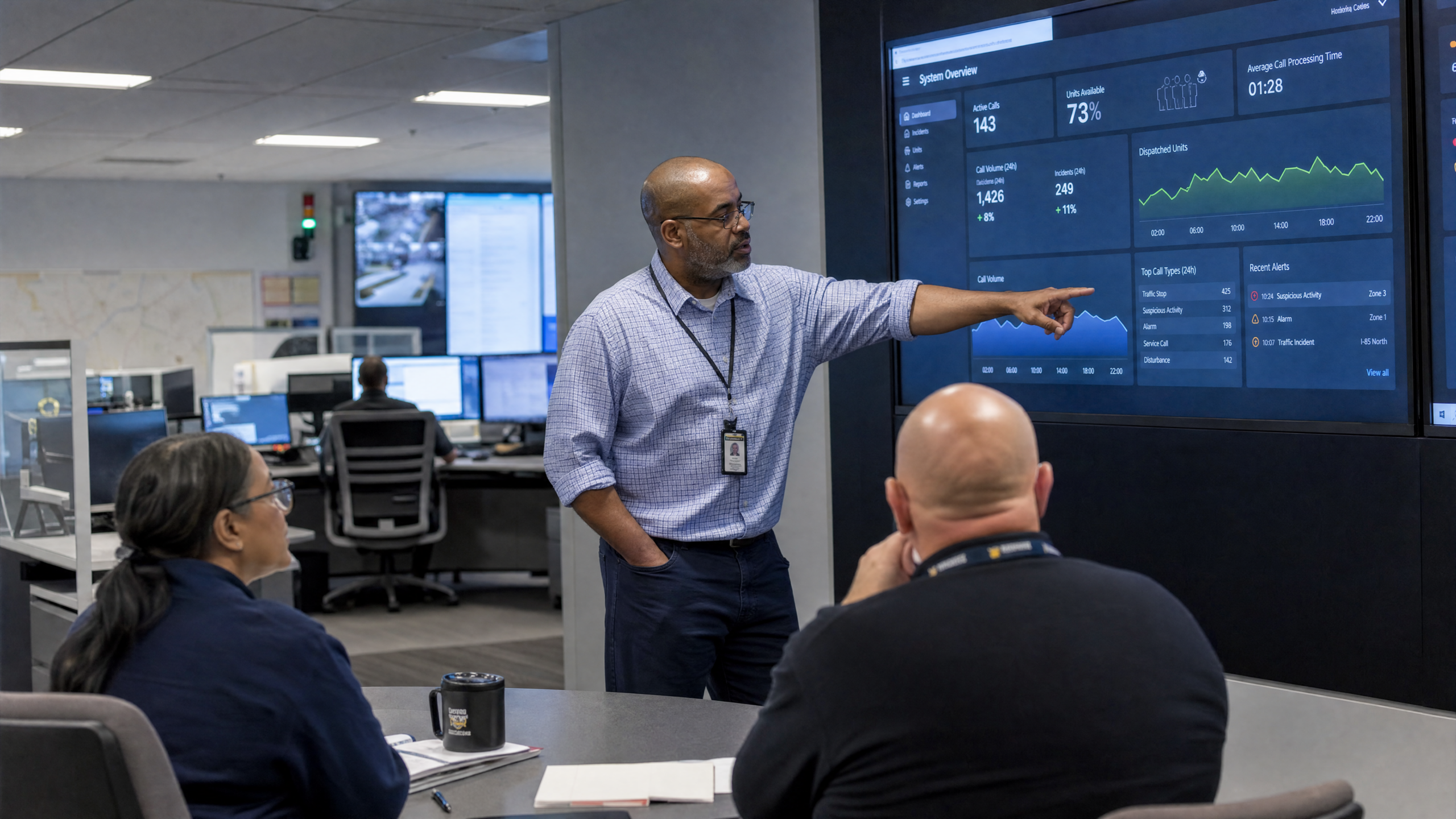
There is a moment on every major public safety technology program that nobody puts on the schedule. The system is live. The vendor’s implementation team has rolled off. The press release has been written. The project plan, the one that ran from needs assessment through procurement through cutover, shows every box checked and every milestone closed. On paper, the work is done.
It is not done. It has barely started.
We have stood in that moment from every side of it. We answered the calls on the dispatch floor. We engineered the radio networks and the consolidated CAD systems agencies depend on. We ran the LAPD-scale records modernizations that get studied in the trade press. We sat across the table as the vendor, and we sat next to the chief as the advisor. And the one thing every vantage point taught us is the same: the industry has spent forty years getting very good at selling and installing public safety technology, and almost no time getting good at what happens after.
That gap is the most expensive thing in public safety technology today. This is an article about why it exists, why it is getting wider, and why the firms built to close it look nothing like the firms that built the gap.
The work the industry was built to do
For most of the modern era of public safety technology, the job was acquisition. An agency needed a system. The hard parts were figuring out what to buy, writing a defensible specification, running a fair procurement, selecting a vendor, and getting the thing installed without the project collapsing. Those are real problems. They are difficult problems. An entire consulting discipline grew up to solve them, and the good firms in that discipline earned their fees.
So the playbook standardized around the purchase. Needs assessment. Requirements. Request for proposal. Vendor selection. Implementation support. Cutover. The language of the field organized itself around that arc, and so did the business models. A consultant was someone who helped you buy. A vendor was someone who sold you the platform and stood it up. When the system went live, the engagement ended, because the engagement was always about getting to live.
That model made sense in a world where the system itself was the hard part. Where the central question an agency faced was technical and procedural: which product, which contract, which deployment plan. In that world, helping an agency buy well was genuinely most of the value.
We do not live in that world anymore.
What changed
Three things shifted at once, and together they moved the center of gravity.
The systems got more powerful. A computer aided dispatch platform used to route calls. Now it sits at the center of an ecosystem that includes records, jail management, body worn and fixed video, license plate recognition, real time crime analytics, and increasingly artificial intelligence that triages calls and recommends responses. The technology stopped being a tool the agency operated and became an environment the agency lives inside. Buying one piece well no longer guarantees anything, because the value and the risk both live in how the pieces govern together.
The systems got more controversial. A radio upgrade was never going to draw a protest. A real time crime center will. Automated license plate readers, automated speed and red light enforcement, facial recognition, persistent video surveillance, these are not neutral procurements that succeed or fail on technical merit. They succeed or fail on public trust. A city can buy the best surveillance technology on the market and watch it die in a council chamber, or on a ballot, because the community decided it was being watched and milked rather than protected. The decision that determines whether these programs survive is not which vendor. It is whether the agency can stand in front of its community and defend what it built.
And the money got tighter and more scrutinized. Public safety technology budgets are larger than they have ever been, and the people who approve them have never asked harder questions. A chief who spent eight figures on a modernization is going to be asked, at year three and year five, what the city got for it. Not whether the system was installed. Whether it worked. Whether response times moved. Whether clearance rates improved. Whether the investment delivered what the vendor promised when the ink was wet. The answer that it deployed on schedule is not an answer to that question. It is a description of the beginning.
Put those three shifts together and the hard part of public safety technology has moved. It used to live in the purchase. It now lives downstream, in three questions the old playbook was never built to answer.
The three questions that define the new work
Can you govern it? A modern public safety ecosystem is not a product you operate. It is a program you have to govern, across multiple systems, multiple vendors, multiple administrations, and the inevitable day a key vendor walks away or gets acquired. Governance is who decides, who is accountable, who audits the access logs, who owns the configuration when the vendor’s team is gone, and how the whole thing holds together when the people who bought it have moved on. The firms that sell platforms do not do this work, because their accountability ends at their platform. Governance is the work that sits above all of the platforms, on the agency’s side of the table.
Can you defend it? Every consequential system an agency deploys now has to survive scrutiny it did not used to face. An inspector general reads the procurement file. A council demands to know why a surveillance program exists and who is watching the watchers. A community asks whether the technology serves them or surveils them. A records request lands. Defending a program is not a communications exercise bolted on at the end. It is a discipline that has to be built into the program from the start: the oversight policy, the audit protocols, the data retention governance, the documentation that survives a hostile reading, and the honest community engagement that earns the trust the technology requires. An agency that cannot defend its technology will eventually lose it, no matter how well it works.
Can you prove it worked? This is the question the entire industry is worst at, because the industry was built to deliver systems, not outcomes. When the vendor’s marketing has faded and the technology is in production, the agency needs to know whether the investment is actually delivering what was promised. That requires independent measurement of realized value, documented vendor accountability, and a structured way to respond when outcomes fall short of the agreement. Not a satisfaction survey. Not a renewal pitch. An honest, audit defensible accounting of whether the thing did what it was bought to do. Almost nobody offers this, because almost nobody has an incentive to ask the question honestly. The vendor wants the renewal. The integrator is already on the next job. The agency is left to answer to its council alone.
Govern it. Defend it. Prove it worked. That is the work now. And it is precisely the work that ends at cutover for everyone whose model was built around the purchase.
Why the firms that built the gap cannot close it
This is not a criticism of the firms that help agencies buy technology. That work matters, and we do it too, because an agency that procures badly never gets to the downstream questions at all. The point is structural, not moral. A firm organized around the purchase is built to leave at cutover, and the new work begins at cutover. You cannot serve the second half of the lifecycle with a model designed to end at the midpoint.
Look at how the field is built. The platform vendors are accountable to their platform, by definition. Their loyalty runs to the product they sell, because that is their business. The integrators and the procurement consultants are accountable to the deployment, and when the deployment closes, so does the engagement. None of this is hidden. It is the honest shape of those businesses. But it means that the moment an agency most needs an independent partner, the moment the system is live and the hard governance and trust and proof questions arrive, is exactly the moment everyone who helped buy it has rolled off.
The work that remains has no natural owner. It requires someone who is independent of every vendor, so the accounting is honest. It requires someone who has actually operated these systems and run these programs, so the judgment is real. It requires someone who stays past cutover, because that is when the work happens. And it requires a methodology built for governance and outcomes, not just for procurement and installation.
That combination is rare. It is also, exactly, what we built Sentinel to be.
The hard part was never buying the system. It is governing it, defending it to the public, and proving it worked. That is the work. That is where public safety is going.
What it takes to do this work
We are not going to pretend this is easy, or that wanting to do it is the same as being able to. The downstream work is harder than the purchase, not easier, and it demands a specific combination most firms do not have.
It demands genuine independence. Not independence as a marketing line, but as a contractual posture. The moment a firm doing value assurance has a referral relationship with the vendor it is assessing, the assessment is worthless. We refuse referral fees, resale margin, and commissions, because the entire value of governing, defending, and proving depends on having no reason to say anything but the truth. Independence is not a virtue we advertise. It is the precondition that makes the work possible.
It demands practitioners, not observers. You cannot govern a dispatch ecosystem you have never operated. You cannot tell a council whether a real time crime center is delivering value if you have never sat in one. You cannot measure whether a CAD modernization worked if you have never run one. The judgment required for this work comes from having done the job, and our founding partnership and our advisory bench are built from people who did: sitting fire chiefs, former law enforcement executives, P25 and radio specialists, jail and corrections experts, procurement attorneys, and the practitioners who built the mission critical software the field runs on. Over two hundred years of combined experience, hand picked, because the work cannot be done from the outside.
It demands methodology built for the right half of the lifecycle. The frameworks that govern a program, drive adoption on a dispatch floor, and measure realized value after go live are not the same frameworks that run a procurement. They have to be designed for the part of the work that the industry treats as an afterthought. Ours were, on the hardest programs in the field, and they are applied identically to every agency we serve.
And it demands a firm willing to stay. The defining feature of the new work is that it does not end. While the phases move, while the administrations turn over, while the vendors come and go, the agency needs a partner who is still there. That is a choice about what kind of firm to be. We made it deliberately. We are built to stay past cutover, because that is where the work lives.
Where this is going
The trend is not going to reverse. The systems will keep getting more capable, more integrated, and more consequential. The public scrutiny will keep intensifying as surveillance and automation spread and as communities demand a say in how they are policed. The budget questions will keep getting sharper as the dollars get larger. Every force that moved the center of gravity downstream is accelerating, not slowing.
Which means the agencies that thrive will be the ones who stop treating technology as something you buy and start treating it as something you govern, defend, and prove, across its whole life, with an independent partner on their side of the table for the part that matters most. And the firms that matter will be the ones built for that reality rather than anchored to the one that is passing.
The hard part was never buying the system. We learned that on the floors and in the budget meetings and on the programs that get written about. It is governing it, defending it to the public, and proving it worked. That is the work. That is where public safety is going.
That is where we have been the whole time.