
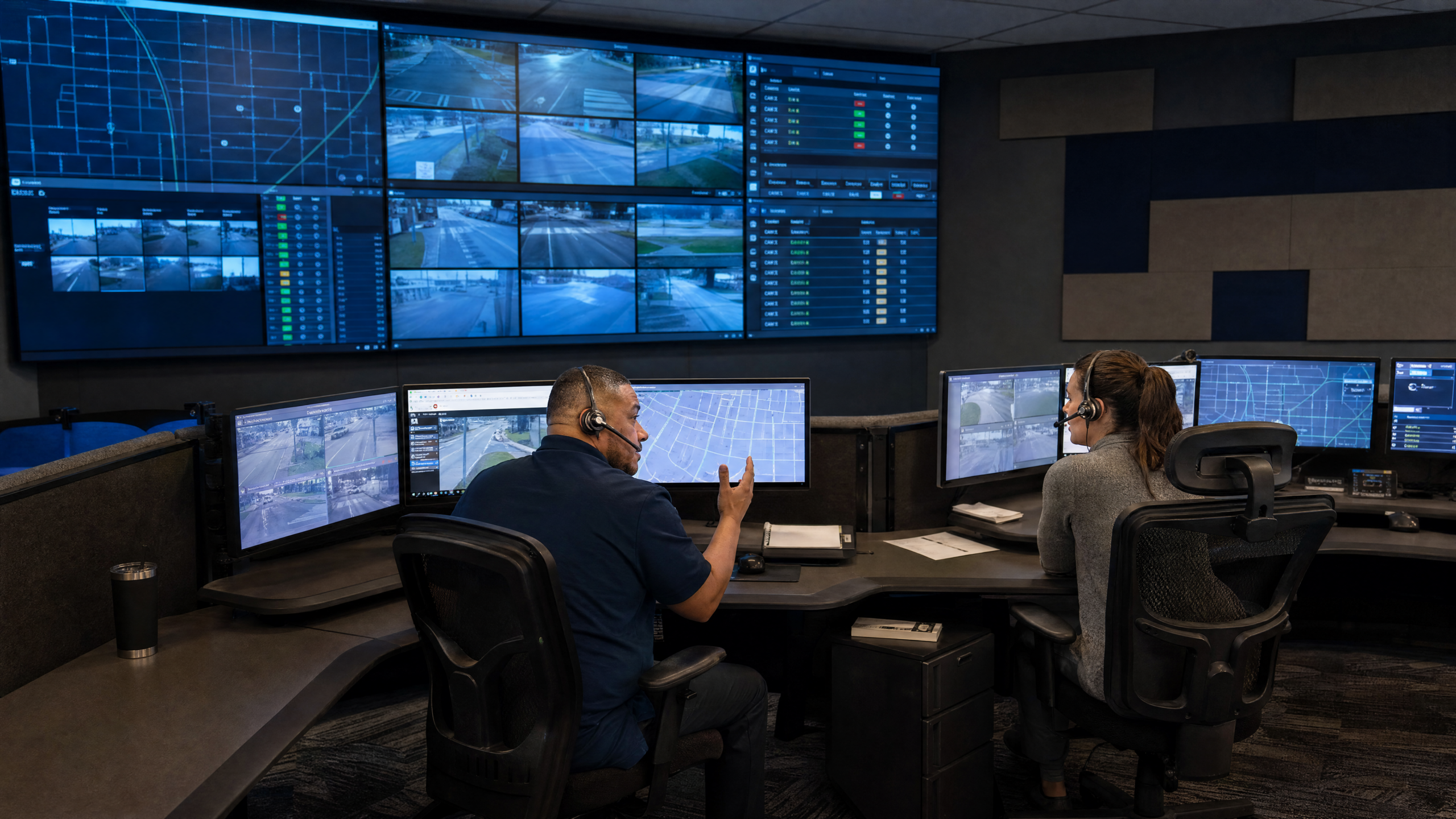
There is an old poster I remember from a dispatch center I worked in years ago. It showed an iceberg. A small white peak above the waterline, and beneath it, many times larger, the part nobody sees. That poster has stayed with me my whole career, and I have never found a better picture for what a real-time crime center actually is.
Above the waterline is the part everyone talks about. The video walls. The license plate readers. The drone feeds. The artificial intelligence that recognizes a face in a crowd the way you would recognize an old friend. It is genuinely some of the most impressive technology I have seen in twenty-five years of public safety work, and I have seen a lot of it up close. Below the waterline is everything that decides whether the center helps a community or hurts it. The policy. The privacy protection. The training. The community trust. The integrity of the people sitting in the seats. That part is larger, harder, and almost never the part that gets sold.
I want to talk about both. The good and the hard. Because right now there is a wave of cities discovering the hard part the expensive way, in council chambers and courtrooms and headlines, and there is another set of agencies quietly posting some of the best public safety outcomes in the country with the very same technology. The difference between those two groups is almost never the equipment. It is the floor they are standing on. A real-time crime center gives you a glass floor. You can see everything beneath you. That is the power, and that is the danger.
What I have actually seen
Let me start with what I know firsthand, because this is not theory for me.
The best real-time crime center deployment I have been close to was Glendale, Arizona. What made it spectacular was not the technology. It was that the agency bought in. The department embraced it, marketed it internally to its own people and externally to its community, and made clear from the first day that this was about safety and nothing else. Glendale rolled it out slowly and deliberately. They built a camera network by partnering with the community itself. They offered local gas stations camera equipment at no cost, and in exchange the department gained access to those feeds. That gave them additional eyes in the high-traffic, higher-crime areas they most needed to watch, and it gave the community a stake in the program rather than a reason to fear it. That was the start. They have expanded steadily from there.
I later managed the implementation team governing the computer-aided dispatch and mobile platforms Glendale used during the Super Bowl, and I watched their real-time crime center carry an enormous load: traffic control, surveillance, and real-time information pushed out to officers in the field. They coordinated it well, and they could do that because they had built the foundation first, including the physical center itself, constructed to the specifications that kind of operation demands. That last point matters more than people expect. A real-time crime center is not a dispatch center, even though it rhymes with one. It carries more requirements, more infrastructure, and far more is gained if the build is thought through before the consoles are ever installed.
I saw the same discipline taking shape at San Diego Police Department, who focused hard and correctly on the construction, the console placement, and the supporting infrastructure of their center. I saw a smaller community between Los Angeles and San Diego build a sharp program tuned to its own needs, leaning into interoperability with neighboring agencies and bringing its license plate reader feeds together to share crime information in real time. I watched a major world airport stand up a program from the ground up, which is its own kind of education, because an airport is a city inside a small footprint, with its own flavor of policing and response. The Port of Los Angeles was another. They integrated over a thousand camera feeds into their operation, and they built something I still describe to people years later: when a dispatcher entered a call for service, the system automatically scanned the cameras nearest that incident and pushed those feeds to the responding officers. An officer got a clickable link inside the incident on their mobile computer and could watch the scene in real time as they approached it. Real-time information about the safety and stability of a scene, before arrival. At the time, that was the very cusp of what was possible.
And then there is the Los Angeles Police Department, the original. LAPD’s real-time crime center was operating when I first set foot on their property in 2010, and it impressed me from that moment. They were likely one of the first in the country. Even then, they were doing real-time crime mapping that could take a license plate and project where a subject was likely headed next, based on prior contacts with that vehicle, who had been associated with it, and field interrogations on file. The remarkable part is that much of that source information was not even in a database yet. It was coming in on field interview cards. They built it anyway, and they have never stopped evolving it. Years later I was the principal director over the program to modernize their entire records ecosystem, which finally put that information where it could be aggregated properly. But the lesson from 2010 stuck with me: the technology is only ever as good as the agency’s commitment to using it well.
I am thankful for that range of experience, because it taught me the most important thing I know about this work. Every one of those programs was different, because every community is different. There is no template. There is only the discipline of building for the community you actually serve.
The good stuff is very good
I want to be clear-eyed about how well this works when it is done right, because the results are not small and they are not hypothetical.
Look at San Francisco. The department’s Real-Time Investigation Center has been credited with assisting in more than 500 arrests, and the city reported overall crime down 28 percent in 2024 and roughly 30 percent into 2025. Their own examples are instructive: officers identifying and following a suspect vehicle by drone and license plate alert rather than launching a dangerous pursuit, and a home-invasion crew tracked through multiple vehicle switches until they were located. That is the technology doing exactly what it should, making officers more precise and prioritizing resources for the incidents that matter most. It is worth noting the voters there expanded the department’s authority to use these tools through a 2024 ballot measure. The public was asked, and the public said yes. That sequence matters, and I will come back to it.
Look at Hartford, Connecticut. Working with the University of Pennsylvania, researchers studied 243 shooting and homicide cases over a two-year window and found that cases with video had a 442 percent increase in solvability. The department’s homicide case solvability climbed past 80 percent and reached 100 percent in 2025. Sit with that number. In a category of crime that has frustrated investigators for generations, a disciplined real-time approach turned solvability into the expectation rather than the exception.
And it is not only the big departments. Sarasota, Florida posted its third straight year of declining crime and cleared both of its 2025 homicides by arrest within 24 hours. Anne Arundel County, Maryland credited its real-time information center with double-digit drops in homicides and a 57 percent decline in carjackings. Cobb County, Georgia built its program by starting small, proving results, and scaling responsibly, which is exactly the model I would put in front of any agency that asks me where to begin.
Notice what the agencies getting these results keep saying out loud. San Francisco frames it as precision and resource prioritization. Anne Arundel’s leadership called it an integrated strategy of officers, technology, and community engagement together. None of them are selling the camera. They are selling the discipline around the camera. That is the tell.
The real story: this was never just about crime
Here is the part that gets missed. We call it a real-time crime center, but the information flowing into it serves every responder, not just law enforcement.
Think about what that information actually is. When a law enforcement system is feeding the picture, and trained telecommunicators are visually confirming what they see, you are working from a vetted source. When I dispatched, we relayed what we were told. A caller said something, the media reported something, and we passed it along as possibly true, always with that caveat hanging on the end of it. Real-time intelligence changes that equation. A large share of what comes through a real-time center is validated before it ever reaches a responder. In a world drowning in information, where so much of what comes at us has to be sorted into real and not-real, a solid, vetted source is worth more than almost anything. And that value belongs to fire and EMS every bit as much as it belongs to police.
I have watched this firsthand, and I will give you the example closest to me. My family owns a ranch in Colorado, and every summer the dry conditions in the southern part of the state create extreme fire danger. I spent eleven years in California and was there, just miles away, when the Palisades burned. So I do not talk about stretched fire resources as an abstraction. In rural Colorado and across California, those resources are thin, especially in fire season, and the entire discipline of fire dispatching, which I did for years at one of the largest centers in California, is resource management. You are not just deploying your own equipment. You are weighing mutual aid, prioritizing which fire matters most right now, and deciding where the next engine needs to go.
Real-time intelligence transforms that decision. When you can send a drone ahead of fire units to a reported grass fire and size up the scene before anyone arrives, you can confirm there is actually a fire, gauge how large it is, and prioritize accordingly. For stretched crews making mutual-aid decisions in real time, that is not a convenience. It is the difference between sending resources where they are needed and guessing. Drone footage is already used this way in wildfire settings, and it extends naturally to structure fires and to EMS, where scene size-up before arrival changes how a crew approaches what is in front of them.
It goes further. Fire and EMS respond into dangerous scenes constantly, and keeping them safe is one of our highest priorities. Real-time information lets us update responders on the path ahead, warn them about traffic, accidents, and poor driving conditions, and route them around hazards so they can keep their eyes on the road. And then there is the obvious one. We typically stage fire and EMS away from a scene until law enforcement gives a code four. Now we can show them the scene while they wait. They can watch what officers are doing. They can tune into the drone feed and see what they are about to walk into.
None of that sounds dramatic. But I have spent my entire life in this work, and I am telling you that visual confirmation is a profound advantage, because for decades we operated blind. We worked from information relayed by other people, with every delay that introduced, the delay before it reached the dispatcher and the delay before the dispatcher could relay it onward, all while that dispatcher was answering more 911 calls about the same incident or a dozen others. Ask anyone who has been in this field for twenty years how different it feels to respond with real-time eyes on a scene versus the way it used to be. The center is no longer a crime tool. It has quietly become the real-time backbone for the entire response.
Cutting-edge, never bleeding-edge
I founded Sentinel on a principle that lives in our pillars of excellence, and it governs how I think about every piece of this. We want to be on the cutting edge. We never want to be on the bleeding edge.
We live in a moment where this technology is moving faster than almost anything I have seen. And there is a reason we have speed limits. Going too fast causes harm. There is real pressure on agencies right now from the technology industry to adopt all of it, and to adopt it quickly, so much so that some vendors now bundle real-time capability into their ecosystems and subscription services at no additional cost. I want to be fair about this. Most of the companies bringing this technology forward genuinely want agencies to benefit. They want to see safer communities and lives saved and criminals taken off the street, and those are real outcomes. But anything free still has to be managed and policed exactly like something that cost a million dollars. The pressure to move fast does not relieve an agency of the responsibility to move carefully.
So let me be concrete about where I draw lines today.
Drone as first responder. I love it. I love that responders get information while they are en route to a dangerous scene. The risk is not the drone. The risk is leaving it recording at all times for any reason. There has to be specific protocol governing when a drone surveils a location, and it has to be policed to ensure that use stays tied to an emergency or a threat to life. Govern it that way and it is one of the most valuable tools a responder can have.
Real-time facial recognition. This is where I am most cautious. Our faces are no longer truly private. We unlock our phones with them. Cameras have been watching us for years, and now those cameras do not just see us, they recognize us. That is powerful, and in the wrong hands or under the wrong policy it is dangerous. When you are drawing conclusions from facial recognition, building associations and movement patterns on a person, you have to remember a principle that does not bend: people are innocent until proven guilty. Even when you are building a strong case against someone you believe is a suspect, they are not a criminal until that case is proven, and their information carries their rights with it. That data has to be protected accordingly. This is where the conversation moves into cybersecurity, storage, and safeguards, and where you need the right technical professionals in the room. When you sign up to collect this information, you sign up to protect it, and that burden lands on the agency.
Automated detection and alerting. This is where I am most comfortable. We have been doing versions of this for decades. ShotSpotter and gunshot detection are part of the same lineage. The new layer is impressive, my own sister’s home doorbell camera can tell the difference between a dog and a person and identify the type of car going by, and that capability scales powerfully to public safety. I see less inherent risk here. It is still the same rule: use it appropriately, and remember the obligation that comes with it.
The hard stuff, and where I land on it
Now the hard part, because this is where agencies are getting hurt right now, and I would be doing no one any favors by writing around it.
Over the past two years, a remarkable number of communities have installed automated license plate reader networks and then torn them back out. Eugene and Springfield, Oregon. Austin. Evanston, Illinois. Oak Park, the Chicago suburb. Flagstaff and Sedona and South Pasadena. Seattle hit pause and shut down roughly 400 readers while it ordered an outside audit. In most of these, the technology worked. That was never the question. The question was trust, and the trust broke.
I want to hold two things at once here, because both are true and the honest conversation requires both. These tools genuinely help. I just walked you through the outcomes, and I stand behind them. And these same tools, deployed without governance, have produced exactly the abuses critics warned about. Both of those statements are true at the same time, and any consultant who will only tell you one of them is not being straight with you. I am not for the cameras or against the cameras. I am for governing them so well that the question never has to reach a courtroom.
Look closely at how these programs failed, because the pattern is almost always the same, and it is almost never the hardware.
Start with Coralville, Iowa, because it is the cleanest example of the single most common mistake I see. The police chief there signed a two-year ALPR contract that was folded into the annual budget request and treated as a routine line item. The chief did not provide much information about the new surveillance system, so by the council’s own account the members did not really understand what they were approving. There was no public discussion. When the community found out, the opposition built for months, and the council ultimately voted to cancel the contract and pull the cameras off city property. Residents told the city, in effect, never again. Nothing about the camera failed. The process failed. The community was handed a decision after the fact instead of being brought into it, and once that trust was gone it did not come back.
Then there is the data itself, which is the part that should keep every chief up at night. Investigative reporting and a string of audits over the past year documented that one major ALPR vendor’s data was being searched in ways its customer agencies never authorized. One California city discovered that more than 250 outside agencies had run an estimated 600,000 searches against its data without permission. Federal agencies, including immigration enforcement, accessed local data through what the vendor later described as pilot programs, in jurisdictions that had never agreed to share with the feds. In one widely reported case, an officer in Texas searched a nationwide camera network looking for a woman who had self-administered an abortion. State audits in Illinois and elsewhere found the system was being used in ways that violated the rules. A congressional investigation followed. And in a detail that should land for anyone who has ever signed a technology contract, search query URLs, containing plate numbers, case numbers, and the stated reason for the search, were accidentally indexed by public search engines, so that sensitive investigative information was sitting in ordinary web results for anyone to find.
Go back and read what I said earlier about facial recognition and protecting data, and then look at that list again. This is precisely the thing I was talking about. When you sign up to collect this information, you sign up to protect it, and the agency, not the vendor, is the one whose name ends up in the headline and whose community pays the trust.
Here is the part I most want agencies to hear. Almost every one of those failures was preventable, and the fixes are not exotic. Look at how the communities that kept their programs did it. Dane County, Wisconsin and Oak Park, Illinois landed in roughly the same place: store and manage the data locally rather than handing it to a national pool, require independent audits of who is searching the system and why, and set hard limits on how long data is kept and who it can be shared with. Those are governance decisions. They are the privacy policy, the retention policy, the audit protocol, and the data-sharing agreement, written down before the cameras go live and enforced after. Every agency that got torn out had the option to do that work first. The ones still standing did it.
So when people ask whether I have watched one of these programs fail, the honest answer is that I have not had to watch one I was responsible for fail, and I am grateful, because that is not a name I want attached to me or my firm. I would rather study these failures from a distance and be part of the reason we have fewer of them. But I have been brought in for input on troubled programs, and the diagnosis is always one of two things: misuse of the information, or a community that was misinformed. Coralville was the second. The data scandals were the first. Both were avoidable.
The precarious part is the practice
If there is one thing I want an agency to take from all of this, it is that the hard part is never the technology. It is the practice behind how the information gets used.
These systems mine relationships, locations, and the routes people travel. The detail is extraordinary, and with extraordinary detail comes extraordinary responsibility. That responsibility falls on real people sitting in real seats, and it is a genuine test of character. Let me tell you where this gets real. Back when I trained on NCIC, we had access to a database of vehicle, wanted, and warrant information, criminal histories, and the like. It was protected, we were tested on it, and we understood the ethics of it. But there was always the dilemma that comes with any position of power. What if you wanted to look up someone you knew personally? Someone you were involved with? The system was never built for that, and we committed, when we entered this profession, not to do it. A real-time crime center is that dilemma on steroids. When you can watch a person you know drive across a city, see where they go and who they meet, all at your fingertips, that is a real temptation for some people, and a real obligation for the organization that has to prevent it. The reporting I just described, an officer using a national network to hunt for one specific woman, is that exact dilemma, except nobody stopped it. I will put it plainly. Inside an organization running this technology, there need to be as many eyes on the people using the system as there are on the streets the system is watching.
That is why policy is not a formality here. It is the whole game. An agency needs true, adopted policy on the appropriate use of this information, and then it has to communicate that policy, train on it, and build process and quality assurance and ethics requirements around it. It is not a question of whether an organization’s integrity will be tested. It is a question of when. Human error is real, and over a long enough horizon every agency will face a moment where it must answer for how this information was handled. The more an agency plans for that moment, trains against it, and builds the safeguards to mitigate it, the better off it and its community will be.
And the obligation runs outward to the community, in a way agencies consistently underestimate. The reluctance I see in many departments takes the form of “let’s not say anything, let’s just do it.” Coralville is what that looks like when it fails. It always comes out eventually, and when a community learns after the fact, the damage is severe. When you proactively tell people what you are doing, what technology is in place, and why, the response is dramatically better. San Francisco put the question on a ballot and got a yes. People who feel informed react one way. People who feel something was hidden from them react another. These are taxpayer-funded systems watching a taxpaying public, and that public deserves to be brought in, not managed after the fact.
There is a second edge to that same blade. Once you collect this information, the community expects you to use it. They expect that if their city has hundreds of cameras, something significant will not slip past unwatched. So you do not only have this capability when you want it. You have it when you do not want it, in the quiet hours, because the moment something is missed, the question becomes “how did the city not catch this?” And the answer can never be “we only look when it is convenient for us,” because that opens the door to the worst interpretation, that the tools come out only to build a case rather than to keep people safe. The promise you make to a community when you sell them on real-time intelligence is safety. You have to honor that promise in full.
Where Sentinel fits
This is exactly the gap I have watched Sentinel fill. The vendors we partner with are genuinely excellent at the technology. They deliver it, they make it work, and we are grateful for what they bring. What they often do not bring is the answer to what comes after: how to market the capability so a community embraces it, how to govern it internally so the department stands behind it, and how to ensure the information collected stays inside CJIS policy, inside department policy, and inside the bounds that protect the community’s confidence. A vendor will hand an agency something very powerful and not always explain the repercussions of that power. That is not a knock on them. It is simply not their job. It is ours.
That is the person who needs to be in the room. Not to slow the technology down, but to make sure the agency is prepared to carry it. We help an agency decide whether it even needs a given capability, choose the right partner if it does, and then build the policy that governs the system, the privacy protection that secures the data, the marketing that earns the community’s trust, and the communications plan that keeps the whole effort transparent. We are vendor-neutral, which means we have no stake in which platform an agency picks and no reason to tell them anything except the truth. We govern the program. We never sell the platforms.
Who this is for
I wrote this for the chief considering the leap, but just as much for the emergency manager trying to protect a community and stretch a thin pool of resources, for the city manager and the city attorney, for the fire chief, and yes, even for the vendor account manager who should understand what lies beneath the surface of the thing they are selling. Anyone in this profession who can take something useful from it is who I am writing for.
If you are an agency looking at this technology, study the studies. Talk to the departments that have done it well, San Francisco, Hartford, Cobb County, and the ones that have struggled, Coralville and the long list with it. Work in regional groups. Share what is working and what is not, because that exchange saves the agency down the road from an avoidable erosion of trust with its own community. And before you deploy anything, study your specific community and the history of trust between that community and the departments that will use it, including the places that trust has frayed before, because that history will shape how your program is received more than any feature on the vendor’s sheet.
If nothing else, I want our communities to see that we are having this conversation. That the professionals entrusted with this technology are thinking hard about whether we need a given piece of information, how we protect it, and how we use it responsibly. The decision to bring in these tools rarely originates in the chief’s chair. More often a trusted vendor brings something forward in good faith, believing it will help. There is real value in that relationship. But the responsibility for what happens next belongs to the agency, and it is shared by those of us in the advisory world who are supposed to help them carry it.
The bells and whistles, the genuinely incredible capability of what we can do now, I am here for all of it. I would help anyone plan a real-time crime center any day of the week, because it is some of the most remarkable technology you will ever see. But the work that actually matters is the harder work. The policy that governs it. The privacy protection that secures it. The marketing campaign that earns the community’s trust. The communications plan that keeps people informed and keeps the whole effort transparent. We chose this profession knowing that integrity and transparency are the price of the badge. When information this powerful is arriving this fast, we owe it to the people we serve to have a well-vetted plan for how we will use it, and the discipline to protect it the way it deserves.
The floor is glass. You can see everything. The only question that matters is whether you have earned the right to look.
Justin Scott is Co-Founder and Managing Partner of Sentinel Solutions Group, an independent, practitioner-led advisory and managed technology firm built for public safety, government, and mission-critical environments. Sentinel governs the program. We never sell the platforms.