OUR STORY

Founded by practitioners. Built on integrity.

Sentinel Solutions Group exists because the agencies doing the hardest work in public safety, government, and mission-critical technology deserved someone on their side of the table. We are that partner.

WHY SENTINEL

The firm the agencies needed.

Every practitioner who spends two decades inside mission-critical technology delivery sees the same pattern. There are people in this industry who do the work for the people. There are people in this industry who do the work for the numbers. Both kinds exist at every level of every firm. The higher you climb in the corporate structure, the more the second group runs the system.

That pattern is what built Sentinel. The agencies running 911 centers, fire bays, jail booking floors, dispatch consoles, and emergency operations centers cannot afford a partner whose loyalty drifts with the quarter. They cannot afford resold margins they never asked for. They cannot afford methodology engineered for billing efficiency rather than mission delivery. They cannot afford someone on the other side of the table pretending to be on theirs.

Sentinel was built to be the partner they could not find. Independent of platform vendors. Engineered for the systems that protect human life. Run by practitioners who spent their careers sitting next to the people who use the technology, not pitching at the people who buy it.

Both spent careers serving agencies of every size, from two-person dispatch centers to the largest law enforcement, fire, EMS, and government agencies in the country.

Built by people who do the work. For people who depend on it.

THE FOUNDING PARTNERSHIP

Two practitioners. One firm.

Justin Scott and Jason Floyd are the Managing Partners of Sentinel. Both founders came up in rural America. Both spent careers building, deploying, and recovering the systems agencies depend on every second of every day. The two of them lead every engagement Sentinel delivers.

MANAGING PARTNER

Justin Scott

Operations & Program Management

Justin runs the operational side of the firm. Program and project management. Organizational change management. Recruiting. Service portfolio. Governance and oversight.

THE GOVERNMENT YEARS

Justin’s career began on the government side. Emergency room technician at a regional trauma hub during the dual paper-and-MSDOS-computer era. Police dispatcher in a two-person center that pre-dated CAD. Communications officer with the Colorado State Patrol during the rollout of the state’s first computer-aided dispatch system with GIS and AVL integration. CAD Administrator, Lead Dispatcher, Certified Training Officer, and Region Communications Supervisor inside one of Colorado’s first regional consolidated comm centers.

He later served as Director of Public Safety Communications for one of the first multi-agency communications consolidations in the state, uniting seven rural fire departments, the local police, sheriff, ambulance district, city fire, and military fire and MP into one building, one dispatch center, one tech footprint. The work included regional interoperable radio policy, agency-coded radio language, ground-up GIS data for unnamed county roads, and the integration of ProQA Emergency Medical Dispatch into CAD. That deployment was organizational change management before the industry had a name for it. It was where the operational methodology that now anchors the firm was first put to work.

THE PRIVATE SECTOR

Justin spent more than twelve years in government before crossing into the private sector. There, he managed program delivery on some of the most complex public-safety technology ecosystems in the country. Washington State Patrol. Broward County Sheriff. Metro Cities Fire Authority. The law and fire agencies of the National Capital Region. Prince George’s County Police and Fire. New Orleans Police, Fire, and EMS. Jefferson Parish Sheriff. The Los Angeles Fire Department. The Los Angeles Police Department’s Records Management modernization. And eventually, the Colorado State Patrol again, this time overseeing a major infrastructure upgrade to the system he had helped design two decades earlier.

EDUCATION, CREDENTIALS & CONTINUED SERVICE

Justin built his education the way he builds programs: strategically, in layered stacks designed to credential the specific work. He holds a dual Master’s degree in Public Administration and Leadership, a Bachelor’s degree in Technical Project Management certified by the Project Management Institute, formal credentials in Facilities and Construction Management, and a commercial real-estate license. The combination gives him the academic and contractual grounding to lead engagements that span software, infrastructure, and civil construction, and to read complex procurement and contract language with the depth public-sector programs require.

His operational credentials run as deep. Justin holds Department of Homeland Security certifications in Incident Command Structure, Hazardous Materials, and Mass Casualty Incident Management, with additional DHS credentials in incident response and emergency management. He holds California POST Certification #C76P27 (CC# 3670-30901-18-003). He is a certified EMD Trainer through the National Academies of Emergency Medical Dispatch (ProQA). He authored and delivers his own curriculum in Active Shooter Response, Mass Casualty Incident Management, and Crisis Intervention for Law Enforcement, Fire, Dispatch, and EMS.

For sixteen of his twenty private-sector years, Justin continued to work part-time as a police, fire, or 911 dispatcher. Not for the money. For the proximity to the people his technology served.
MANAGING PARTNER

Jason Floyd

Engineering & Technology

Jason runs the engineering side. Managed technology services. The Sentinel Response platform. Solution design. Technical writing. Staff training and mentorship.

THE CAREER ARC

Jason’s path was technology from the start. He grew up in Utica, Nebraska, a small farming community in the eastern part of the state, before formative years in Boston shaped the directness he is known for. His career began on a help desk at Microsoft in Cambridge, Massachusetts. He moved into systems and infrastructure engineering at Hewlett Packard Enterprise, then spent nearly nine years at Motorola Solutions, advancing to Principal Systems Engineer. There he led design and delivery on intricate, high-profile public-safety technology programs, managed full system life-cycles, and worked across cross-functional teams on the kinds of ecosystem deployments that demand engineering judgment the standard playbook does not produce.

AREAS OF EXPERTISE

His expertise covers IT infrastructure management, virtualization and cloud architecture, hybrid on-premise and cloud design for agencies cautious about full conversion, disaster recovery and continuity engineering, public-safety cybersecurity, and the strategic technology oversight that mission-critical environments demand. He holds advanced certifications across VMware data center virtualization (VCP and VCAP-Design), Microsoft Azure administration, and Cisco networking. He has been personally recognized by chiefs at agencies with more than a thousand sworn officers, and his playbooks and system diagrams anchor some of the most complex public-safety deployments in the country.

DEPTH AT EVERY SCALE

Twenty-five years of professional engineering depth comes to every engagement the firm accepts. For the past five years, Jason and Justin worked as part of the same select group, leading engineering and operations across complex ecosystem programs with high visibility and high stakes. The partnership at Sentinel mirrors the partnership that produced their joint reputation in industry.

Top-tier engineering and top-tier program management. Present on every engagement. That is the Sentinel Standard.

METHODOLOGY

A methodology built for systems that cannot shut off.

Sentinel’s signature practices were not produced by a consulting handbook. They were refined across more than two decades of programs we were not hired to rescue, beginning with regional consolidations and multi-agency communications builds in the late 1990s and early 2000s, and tested at every scale through the most complex public-safety ecosystem deployments in the country. They were tested in places where the cookie-cutter methodology was the reason the project failed and the standard playbook had no answer for what came next.

We deliver methodology built specifically for mission-critical technology. Computer-aided dispatch, records management, jail management, mobile and handheld applications, land mobile radio, video infrastructure, license plate readers, real-time situational awareness, regional interoperability. Systems that operate at five-nines uptime. Systems that hold human life in balance every second they run. Standard project-management methodology was not engineered for these systems. Our methodology was.

The LAPD Records Management program was where these methodologies reached their full expression. The deployment connected land mobile radio, records, jail and booking, computer-aided dispatch, mobile and handheld applications, license plate readers, and 311 systems. The scale was unprecedented. The agency was one of the largest law enforcement organizations in the world. The standard vendor playbook had no answer for what that deployment required. Our methodology did. The program was not where we invented our practices. It was where they were vetted at the scale only the most complex environments produce.

01

Sentinel Delivery Framework™

Governs how engagements move from procurement through go-live.

02

Sentinel Readiness Method™

Governs how the agency’s operational reality adapts to the technology being deployed.

03

Sentinel Deployment Blueprint™

Configures the customer side of the table on strategic deployments.

04

Sentinel Value Assurance™

Documents whether the agency received what the vendor promised.

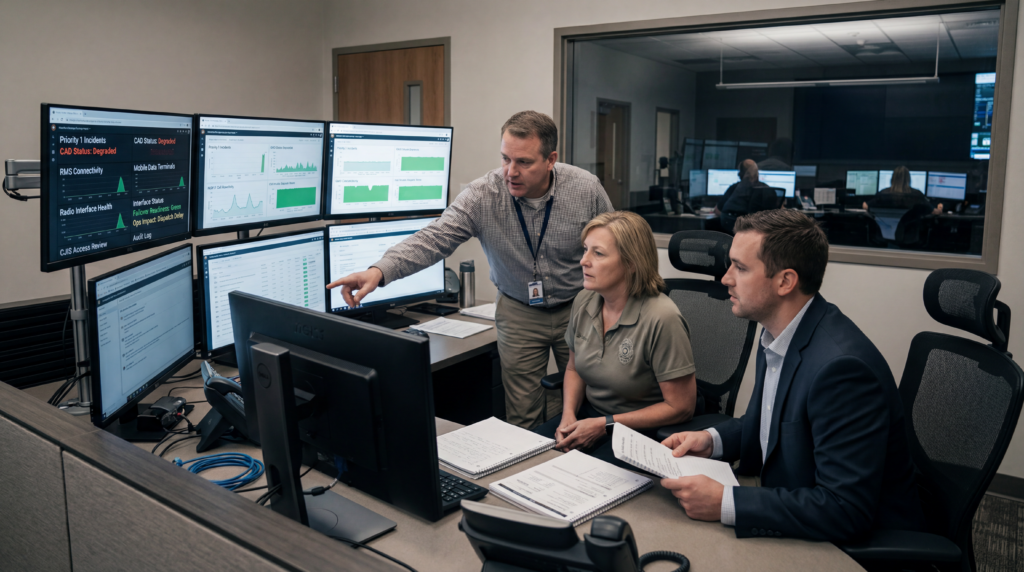
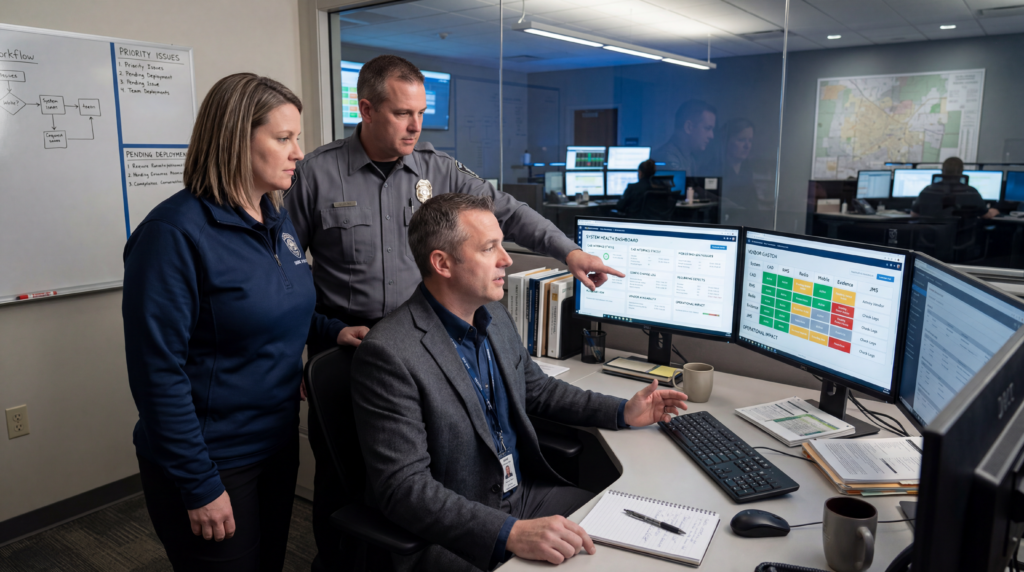
Built for the dispatch console, the briefing room, and the fire bay. Engineered for systems that protect life.

WHAT WE REFUSE

What we will not become.

Every consultancy in this industry faces the same choices about how to make money. Sentinel chose a posture and published it. The choices we refused to make are the choices that define us.

Sentinel accepts no reseller margins. No referral fees. No vendor commissions. No revenue stream that depends on which platform an agency selects. We accept payment from the agency we represent. We accept none from the vendors whose products we evaluate. When a customer would be better served by another firm, we step back and help the customer find the right representation.

That posture is held by mechanism, not by hope. The Five Pillars of Excellence are posted publicly on every Sentinel document, every engagement, and every customer-facing page. The first pillar is Integrity Without Exception. Every recommendation we make is defensible to a county commission, a city council, and an inspector general. The published standard is the protection. Every vendor who walks into a room with us knows what we will not do. Every customer who engages us knows what we will not soften. The integrity question is settled before any conversation begins.

We govern the program. We never sell the platforms.

A FOUNDER COMMITMENT

The towns that built us get the whole firm.

Both founders came up in rural America. Jason grew up in a small farming community in eastern Nebraska. Justin grew up on a cattle ranch in Trinidad, Colorado. He started his career in a two-person dispatch center that pre-dated CAD, then led one of Colorado’s first multi-agency rural consolidations, bringing seven fire departments, a sheriff, a police force, and an ambulance district onto a single dispatch floor. Both went on to deploy programs at LAPD, LAFD, and DC Metro scale. Neither forgot where the work started.

Sentinel Mainstreet™ opens the firm’s full advisory and methodology stack to small towns, villages, and rural agencies. Same SDF. Same SRM. Same SDB. Same SVA. Same practitioner bench. Same audit-defensible documentation. Scaled to the budgets and footprints those agencies can actually carry. Not a stripped-down version of Sentinel. The same Sentinel, configured for the agency’s real size.

The recruiting market does not reach the small town. Vendors price for the larger customer. Big firms quote engagements that are not designed for a fifteen-officer department, a critical access hospital, or a four-school district. The structural result: rural towns, county governments, critical access hospitals, school districts, and the public safety agencies that serve them carry the same liability and run the same critical systems as the megacenters. They pay disproportionately for the technology. They govern it with email and sticky notes. Mainstreet exists to change that pattern. Not as marketing. As founding charter.

The dispatcher in a two-person center carries the same weight as the one in a 911 megacenter. Sentinel doesn’t price like she doesn’t.

THE PARTNERSHIP OUR CUSTOMERS DESCRIBE

How we want to be remembered.

Years from now, the chiefs, directors, and command-center leaders who engaged Sentinel during a once-in-a-decade infrastructure program will describe the experience to their peers. This is how we want to be remembered.

Sentinel was present every moment we needed them, and most of the ones we didn’t know we needed them. They were one step ahead, steering us away from pitfalls and course-correcting the things we didn’t know to look for. When we called, we reached Justin or Jason directly, not a help desk in another country. Through the most complex deployment our agency has run, they were the calm during the storm. The lighthouse in the night. A guard that stayed unbiased and fair through every phase. We retain their services because we will not give up the stewardship they bring. They are the partner we never knew we needed. We cannot operate without them now.

That is the standard. We hold ourselves to it on every engagement, regardless of contract value, agency size, or program complexity.

Work with the firm the mission deserves.

If your agency is facing a complex procurement, a mission-critical technology decision, or a program that has to succeed the first time, start a scoped conversation with Sentinel. The two Managing Partners take the call.

From the Founders

Three Insights. Both founders. Same operating discipline.

When Justin and Jason write together, this is what we say. Procurement integrity, the structural bench, and why public safety is not corporate IT.

Why Sole Sourcing Is the Most Expensive Decision an Agency Can Make
Procurement

Why Sole Sourcing Is the Most Expensive Decision an Agency Can Make

Sole sourcing looks faster on the front end. It is the most expensive procurement decision an agency can make. The vendor that wins without competing wins on terms the agency can never recover.

Read the Insight
The Bench Your Agency Cannot Build
Embedded Administration

The Bench Your Agency Cannot Build

Most agencies do not need one more person. They need a bench. The answer to the public safety technology bench problem is not headcount. It is a bench built differently.

Read the Insight
Why a Generic MSP Cannot Carry a Public Safety Agency
Managed Services

Why a Generic MSP Cannot Carry a Public Safety Agency

Public safety is not corporate IT with higher uptime. It is a different category of operation entirely. The agency that mistakes one for the other will pay the difference twice.

Read the Insight
Explore all Sentinel Insights →