
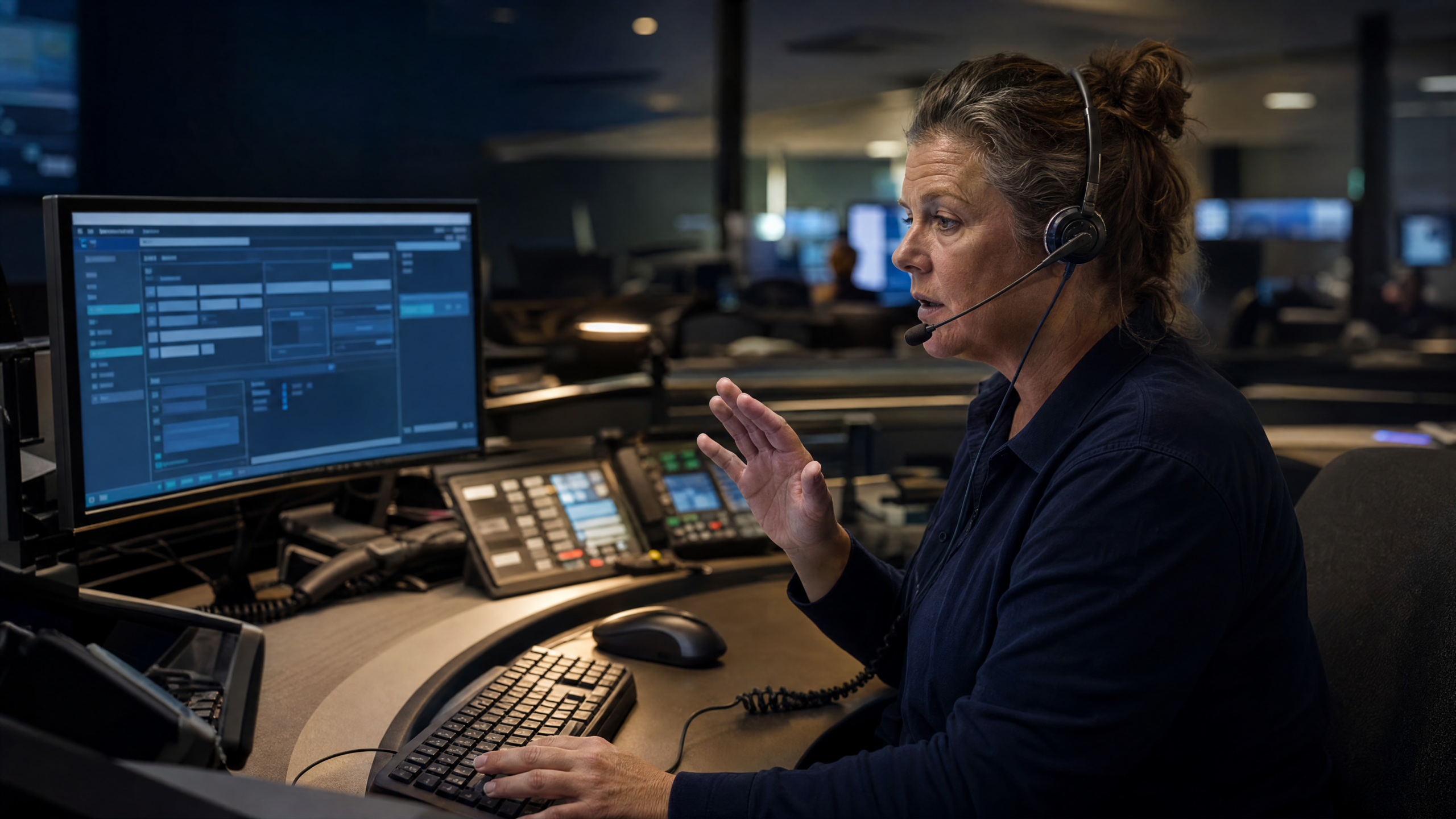
I have answered the phone at the moment someone’s life was coming apart. I have walked the housing units where the system’s decisions end up. I have configured the software that turns a human crisis into a nature code, and I have sat with people in recovery who were once nothing more than an incident number to the agencies that handled them. Every one of those seats taught me the same lesson from a different angle.
Behavioral health and substance-use crisis response does not begin when a clinician, co-responder, or police officer arrives. It begins with the first question asked, the first risk assessed, and the first decision made about who should respond. I want to explain what that means operationally, because I have watched too many agencies build the visible part of a program and skip the part that decides whether it works.
Every crisis call eventually becomes something inside a system. It receives an incident number. It is assigned a nature code. A priority is selected. Units are attached. Notes are entered. A disposition is recorded. The call becomes data, because data is how a public safety organization coordinates a response. None of that is wrong. I have built and configured those systems myself. The problem begins when the system treats the classification as though it is the person.
A person experiencing a psychiatric emergency, a substance-related crisis, a medical condition, a traumatic event, or a moment of profound situational distress can look identical to an untrained observer. The information reaching the call-taker may be incomplete, contradictory, or secondhand. The caller may not know the person. The person may be unable or unwilling to explain what is happening. The system still has to make a decision, and that decision cannot wait for a specialized team to arrive.
This is why I refuse to talk about alternative response as a vehicle, a clinician, a pilot program, or a new unit type added to CAD. Alternative response is a governed decision system. It starts with how the call is received, what is asked, what can be known, what remains uncertain, which resources are available, who has authority to select them, how the response can escalate, and who remains responsible until the person is safely connected to the next level of help.
The call has to be classified before it can be helped. The classification must never be mistaken for a diagnosis. Everything I believe about this work sits between those two sentences.
The Person Behind the Incident Number
My perspective was not built in one seat. Corrections showed me what happens after the system has made its decisions. Emergency communications showed me the uncertainty at the beginning. Technology work showed me how those decisions get translated into screens, rules, codes, and workflows. Peer-based recovery support showed me what happens when a person is given a real opportunity to move beyond the event that brought them into contact with the system.
Years ago I transported a man from a jail to a recovery program. I greeted him, shook his hand, listened to his story, and spoke to him like an adult making a difficult decision about his future. Later, he told me he had planned to walk out of that program during intake. He stayed because I had shaken his hand. In his mind, he had made a verbal commitment to someone who treated him like a man rather than a case being moved between facilities.
The action was small. The consequence was not.
I do not tell that story to claim compassion can be proceduralized. It cannot. Public safety systems cannot encode a handshake as a response type, and no policy guarantees that any interaction will create trust. What systems can do is create conditions that either support human recognition or strip it out. That distinction matters enormously in this work, because many of the people entering the crisis system have already been transported, detained, evaluated, discharged, arrested, referred, transferred, and told to repeat their story to another stranger at another number. The system may know them by several identifiers. They still experience every contact as a person.
Classification Is Not Diagnosis
The phrase “behavioral health crisis” conceals important differences. One person is experiencing a psychiatric emergency. Another is intoxicated. Another is in withdrawal. Another has a medical condition that changes cognition or behavior. Another is reacting to trauma, grief, fear, sleep deprivation, or a medication interruption. Some people are experiencing several of these at once. The call-taker often cannot know which is true.
I need agency leaders to hear this clearly: that uncertainty is not a failure. It is an operational fact. The failure occurs when a system expects a telecommunicator to produce a clinical diagnosis from incomplete information, or gives the telecommunicator no meaningful way to recognize and communicate what is unknown.
Callers told me someone was “acting crazy,” “on something,” “off their medication,” or “talking to people who are not there.” Those were honest interpretations. They were not clinical conclusions, and I was not in a position to make one either. The questions I actually needed answered were different.
None of those questions diagnoses anyone. They classify the operational conditions. That is the telecommunicator’s role at the first point of contact: identify the known risks, preserve the unknowns, communicate the context, and support the safest reasonable response decision. Not to determine why a person is behaving as they are. To make sure whoever responds arrives knowing what is actually known.
The First Minute Shapes the Entire Encounter
I learned early that the first minute of a crisis call can change what happens before anyone arrives. Picture a parent calling because an adult child is escalating inside the home. The parent is frightened. Voices are raised. The person in crisis is getting more agitated because the confrontation is still happening. A trained call-taker may be able to get the caller to step outside, move to another room, bring other family members along, remove access to an obvious hazard, or simply stop arguing while help responds. That does not resolve the crisis. It changes the scene responders walk into, and sometimes that changes everything.
The same discipline applies when the caller is a stranger to the person. I was trained to separate what a caller observed from what a caller inferred, and I teach the same distinction now. “I saw him swallow several pills” is observed information. “He is high” may be an inference. “She told me she stopped taking her medication three days ago” is reported history. “She is psychotic” is an interpretation. That distinction belongs in the call record and in the information passed to responders, because it is the honest shape of what the system knows.
Good classification does not eliminate uncertainty. It makes uncertainty visible. I would rather send responders a truthful picture with gaps in it than a confident picture that is wrong.
The Telecommunicator Is the First Operational Risk Assessor
The telecommunicator is usually the first professional to make sense of the event. We cannot see the scene. We cannot conduct a clinical assessment. We are often speaking with someone frightened, impaired, angry, confused, or reporting from a distance. We still have to produce an actionable picture. That makes the telecommunicator the first operational risk assessor in the crisis-response continuum, and I choose that phrase deliberately. It honors both the weight of the role and its boundary. Nobody is asking a call-taker to practice medicine. We are asking them to collect, classify, document, communicate, and update the information that determines whether the response is safe and suitable.
Here is the pattern I keep encountering: an agency funds a mobile crisis team, pairs a clinician with an officer, stands up a new call sign, and announces that certain calls may now receive a different response. Then it leaves the call-taking protocol, the CAD nature codes, the recommendation rules, the transfer procedures, the supervisor authority, the quality review, and the resource-status process untouched. The specialized team exists, but the system was never redesigned to find the calls that team is built for. That is not an alternative-response system. It is an additional resource waiting to be discovered through an old workflow.
Alternative Response Must Begin at Call Intake
If an agency wants that sentence to be operationally true rather than a slogan, the work is specific. Define the questions that matter. Determine how the answers affect classification. Establish which conditions require law enforcement, EMS, fire, a clinician consult, a mobile crisis team, a peer responder, a co-response unit, or continued telephone support. Define what happens when the information is unclear, because it will often be unclear.
Then make the CAD environment tell the truth. Nature codes, determinants, recommendations, unit types, premise information, resource availability, and escalation pathways have to reflect the agency’s actual response options. I have configured these systems, so I will say it plainly: a recommendation for a mobile crisis team is meaningless if the team is not operating at that hour. A 988 transfer pathway is incomplete if the call-taker cannot see whether the receiving center can accept the call. A clinician consultation option does not operationally exist if nobody knows how to request it, how long it takes, or what to do while waiting. A co-response program is not available because it appears in a policy. Dispatch has to know where the team is, what it can accept, what excludes it, who approves it, and what happens when conditions change.
Authority Must Grow With Governance
People sometimes push back on giving telecommunicators a larger decision role, and the concern deserves a straight answer. The answer is not to exclude the call-taker from the process. It is to build authority responsibly, in stages that match the system’s maturity.
An agency can start by training call-takers to recognize defined crisis indicators and request a supervisor or clinician consultation. The next stage allows protocol-directed recommendations when specific criteria are met. A more mature model permits supervised diversion to a mobile crisis or alternative-response resource. The most advanced model lets qualified telecommunicators assign an alternative response under defined protocols, with real-time escalation options and robust quality review. At every stage, the authority has to match the maturity of the protocol, the quality of the training, the reliability of the resources, the clarity of the exclusions, the capability of the CAD and call-handling environment, the accessibility of supervisors and clinical consultation, and the strength of post-event review.
Empowerment without structure transfers risk onto the telecommunicator. I have felt that weight, and it is not fair. Structure without meaningful authority leaves the telecommunicator responsible for gathering information nobody uses. That is not fair either. A credible model needs both.
Scene Safety and Human Dignity Are Not Opposing Values
This field keeps getting framed as a choice between compassion and safety. I reject the framing, and I have earned the right to reject it from both directions. A humane system does not ignore a reported weapon, active violence, medical distress, imminent self-harm, or a rapidly changing scene. A safety-conscious system does not assume every unusual behavior requires the most restrictive response. The objective is the least restrictive safe response supported by the information available at that moment. The word “safe” is doing real work in that sentence, and I will not remove it.
Not every behavioral-health or substance-use call requires law enforcement. But responsible diversion cannot run on wishful thinking, political pressure, or the assumption that a clinical title prepares someone for an uncontrolled scene. A street officer is not a clinician. A clinician who has worked primarily in an office is not automatically ready for an unstable scene. An EMS crew is not a substitute for a mobile crisis team. A peer responder should never be expected to manage a threat that requires law-enforcement authority. I have worked alongside every one of those disciplines, and the model works when their differences are acknowledged and deliberately connected, not papered over.
That connection requires reciprocal training. Public safety personnel need real education in behavioral health, substance use, trauma, communication, de-escalation, and the community resources that actually exist in their jurisdiction. Behavioral-health and peer professionals need training in scene awareness, public safety communications, incident structure, responder positioning, escalation signals, and the limits of their role. The goal is not to make everyone the same kind of responder. It is to build a team whose differences are understood before those differences become conflict at a scene.
A Co-Responder Program Is Not a Car
The most common mistake I see is confusing the visible part of the program with the program. The visible part may be an officer and a clinician riding together, an unmarked vehicle, a mobile crisis van, or a new unit identifier in CAD. Those are resources. The program is the governance around them.
When I evaluate a program, these are my questions. What problem is it designed to solve? Which calls are eligible? Which conditions require exclusion or immediate escalation? Who can dispatch the team? What happens when the team is unavailable? Who leads before the scene is secure? When and how can leadership transfer? What channel does the team communicate on? What information may be shared? Where can the person be transported? Which facilities will accept them? What happens when a destination refuses? Who follows up afterward? How are repeat contacts reviewed? What outcomes will leadership and the public actually see?
A program that cannot answer those questions is asking its people to improvise policy during live incidents. That is unfair to the officer. It is unfair to the clinician. It is unfair to the telecommunicator. Most of all, it is unfair to the person in crisis.
A Warm Handoff Is a Transfer of Responsibility
The handoffs between 911, 988, mobile crisis, EMS, law enforcement, and community services are the most vulnerable moments in the entire system. A person in crisis should never be told “that is not ours” and transferred into uncertainty. My standard is simple: the first organization receiving the contact retains responsibility until the next organization has actively accepted it.
That is what a warm handoff means. The transferring professional communicates what has already been learned, stays connected until the receiving professional is engaged, explains the reason for the transfer, and does not force the person to start their story over. Additional questions may be necessary. Repeating the reason for seeking help should not be. I have been the person receiving that repeated story, and I have watched what it costs someone to tell it for the fourth time.
The principle has operational and technology consequences. Agencies must agree on transfer procedures. Call-takers need current contact methods. Supervisors need escalation paths. Systems should preserve information when it is lawful and technically possible, and privacy, consent, data-sharing authority, and record ownership must be settled before the first difficult transfer, not during it. The transfer is not successful when the button is pressed. It is successful when responsibility has been accepted.
And the response has to be able to change, because classification is a starting decision, not a verdict. A call assigned to mobile crisis may reveal an immediate safety threat. A law-enforcement response may secure a scene and hand leadership to a clinician. A telephone intervention may resolve the danger and reveal a need for follow-up. A rigid system keeps sending the original plan after the facts have changed. A governed system adapts while preserving accountability.
What I Tell Agencies to Build Now
No agency needs to wait for a perfect national model. It needs to stop building on assumptions. This is the work I walk leadership teams through.
Map every entry point. Crisis contacts arrive through 911, 988, non-emergency lines, officer observation, EMS requests, hospitals, shelters, schools, families, and community providers. Different doors should not create disconnected systems of responsibility.
Define the operational questions. Decide what the call-taker must establish about immediate safety, medical concerns, weapons, threats, location, vulnerable people, reported substance use, known history, current behavior, and the caller’s relationship to the person. Separate observed facts from assumptions, in the protocol and in the record.
Establish eligibility and exclusions. Name the conditions under which a mobile crisis, peer, clinician-only, or co-response resource may be considered, and the conditions that require law enforcement, EMS, or fire. Write it down. Informal knowledge held by a few veterans is not a system.
Make resource availability visible. Dispatch must be able to see which resources are operating, where they are, what they can accept, expected response times, and what to do when they are unavailable. A resource that cannot be seen operationally does not reliably exist.
Define authority. Specify what call-takers, dispatchers, supervisors, clinicians, officers, EMS personnel, and field commanders may each decide, when consultation is required, and how disagreements get resolved.
Build the handoff. Create warm-transfer procedures among 911, 988, mobile crisis, law enforcement, EMS, hospitals, stabilization facilities, treatment programs, shelters, and community services. Name the organization that holds responsibility during every transition.
Cross-train the disciplines. Stop training public safety and behavioral health in isolation. Each group needs to understand the operating environment, language, authorities, risks, and limits of the others.
Review real outcomes. Examine the calls that were diverted and the ones that were not, the failed transfers, repeat contacts, refusals, escalations, injuries, delays, complaints, and the successes. The purpose of review is never to punish a reasonable decision made with limited information. It is to make the next decision better.
What Success Should Mean
Programs get judged by the easiest numbers available: calls diverted, arrests avoided, emergency-department transports reduced. Those numbers may matter. Not one of them is sufficient alone. A high diversion rate can conceal poor classification. A low arrest rate does not prove the person reached care. A completed transport does not prove the destination was right. A closed CAD incident does not prove the crisis was resolved.
Measure what happened to the person. Connection to appropriate care. Acceptance at the destination. Time from first contact to accepted handoff. Repeat crisis contacts. Escalations and de-escalations. Injuries to responders and participants. Failed or refused transfers. Resource availability by hour and geography. Follow-up completion. Disparities in who receives which type of response. Whether the person had to repeat their story. Whether the original need was addressed. A program should not be judged by whether it reduced another system’s visible workload. It should be judged by whether the response stayed safe, appropriate, accountable, and connected.
Alternative response should deliver the least restrictive safe response through a governed, risk-tiered system that can escalate, transfer leadership, and follow through as conditions change.
This is the position I brought to Sentinel, and it is the position the firm takes. Alternative response begins at the first point of contact. Telecommunicators must be trained and supported as operational risk assessors. Classification must guide response without pretending to be diagnosis. Clinicians, peer professionals, law enforcement, EMS, fire, 911, and 988 must understand one another’s roles. No organization should transfer a person in crisis into uncertainty, and the first organization remains responsible until the next has actively accepted the handoff. The program must be measured by outcomes, not announcements.
Communities will build different models. A metropolitan system may have 24-hour mobile crisis coverage, embedded clinicians, and integrated 911 and 988 technology. A small community may have one officer on duty, a volunteer EMS service, and no dedicated team at all. The governance standard should not disappear because the resources are thinner. Smaller agencies may need the structure more, because they have less margin when a transfer fails or the expected resource is unavailable. Build the model for the community that actually exists, not the service array leaders wish existed.
The Call Still Belongs to a Person
Public safety will keep creating incident numbers. CAD systems will keep classifying events. Telecommunicators will keep asking structured questions, and responders will keep making hard decisions with incomplete information. I am not trying to remove structure from crisis response. I have spent my career building it. I am trying to build better structure.
A handshake cannot be coded into CAD. Respect cannot be dispatched as a unit. Empathy cannot be reduced to a nature code. But policy, training, technology, and governance can create the conditions in which people are seen before they are sorted, where safety and dignity reinforce each other instead of competing, and where a crisis call has a path to care rather than only a disposition.
The system may ultimately send a police officer. It may send EMS. It may send a clinician, a mobile crisis professional, a peer responder, or a co-response team. It may keep the person on the line and connect them directly to support. Whatever it sends, it should remember what the incident number represents. A person called because someone needed help.
I was the voice that answered. That is where the response begins.
My position aligns with current national guidance on coordinated crisis response, including NENA’s standard for 9-1-1 and 988 interactions, SAMHSA’s National Behavioral Health Crisis Care Guidance, and SAMHSA’s guidance on strengthening 988 and 911 crisis response, each of which emphasizes clear roles, structured coordination, warm transfers, and system-level collaboration.
Continue the Conversation
Your crisis-response program begins before dispatch. Sentinel helps public safety, behavioral-health, healthcare, and government leaders evaluate the policies, call-classification models, CAD workflows, response resources, 911 and 988 coordination, training, handoffs, and outcome measures that determine whether alternative response works as an operating system rather than only as a pilot program.