PUBLIC SAFETY · 911, PSAP & DISPATCH
Independent advisory, vendor-neutral technology governance, and managed services for the organizations that answer the call.
We don't sell you software. We sit on your side of the table when the vendor's sales engineer is quoting from a deck we already know line by line, and we remember what happens at 3 a.m. when the system they sold you actually goes down.
CHALLENGE
Communications centers are being asked to modernize CAD, migrate to NG911, defend against cyber threats, and retain a workforce in crisis, all at the same time. Vendors are eager to sell solutions. No one in the room is unambiguously aligned with the agency’s interest.
THE DISPATCH REALITY
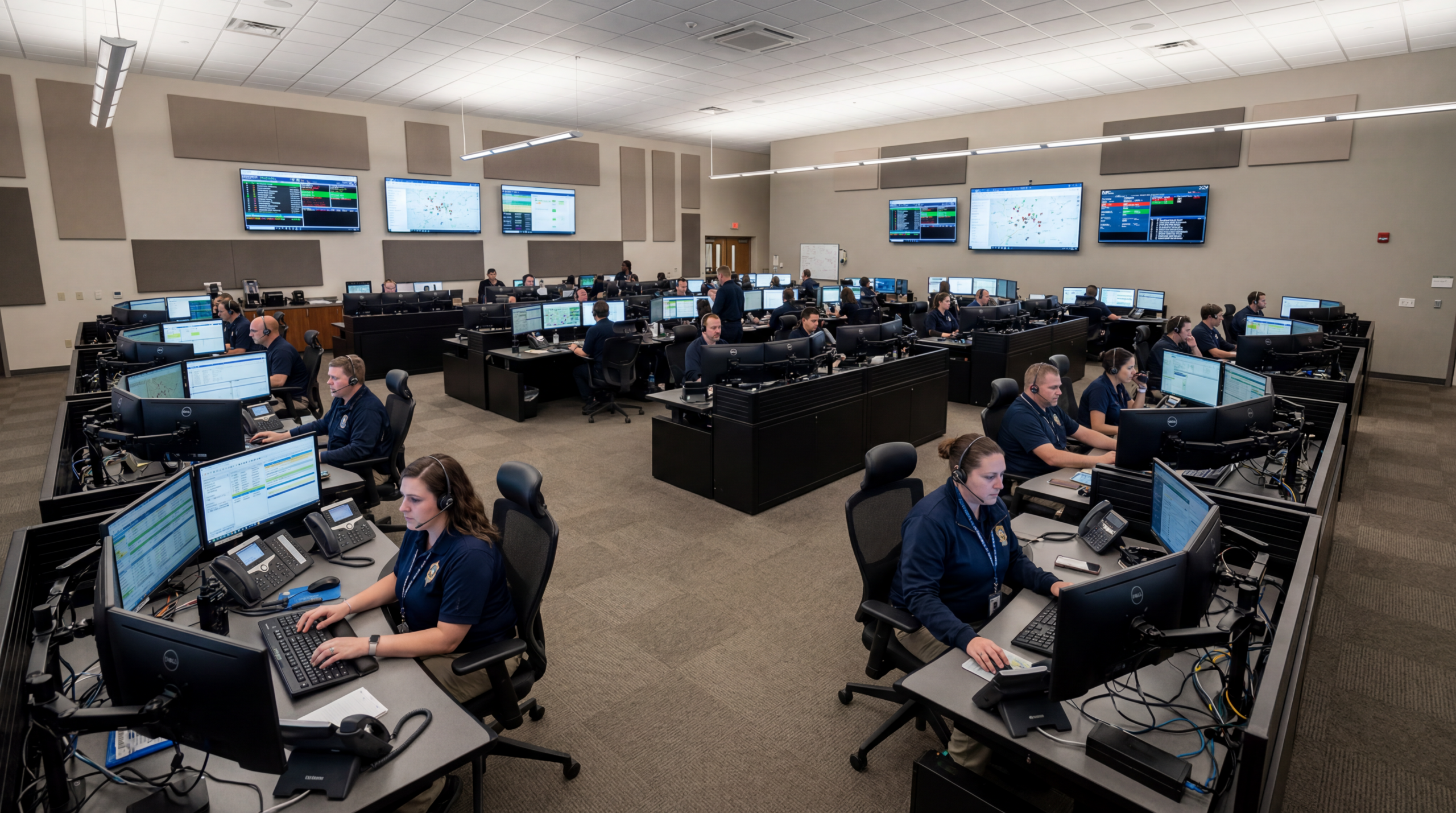
American 911 centers answer 240 million calls every year across more than 6,100 PSAPs, with one in four dispatcher seats sitting empty, cyber threats probing every endpoint, and the largest 911 modernization in the system’s history underway all at once. The NENA standard calls for 90% of emergency calls to be answered within ten seconds; nationally, centers miss that target more often than they hit it, and every missed second is a real person waiting on the other end of the line.
Sentinel Solutions Group exists because the decisions that determine whether an ECC succeeds or fails, which CAD to select, how an ESInet is architected, whether the center is ready for i3 and EIDO, how to recruit and hold the people who work the seats, deserve independent, vendor-neutral expertise from practitioners who have lived the work on both sides of the console.
240M+
emergency calls answered annually in the U.S.
6,100+
public safety answering points nationwide
10 SECONDS
NENA Standard 911 Answer Time
THE CHALLENGES
PSAP directors are running modernization, staffing, and cybersecurity programs simultaneously, often with aging systems and flat budgets. These are the pressures Sentinel helps agencies navigate.
Transitioning from legacy selective routers to i3-compliant ESInets, NGCS, and multimedia-ready infrastructure is a multi-year program that few agencies are staffed to manage alone. GIS readiness, MSAG/ALI reconciliation, and EIDO adoption add layers of risk.
Staffing shortages, mandatory overtime, escalating call complexity, and the national push to reclassify telecommunicators as protective service are reshaping what it means to run an ECC. Retention, wellness, and training programs must evolve.
PSAPs have become prime targets for ransomware and nation-state actors. Legacy networks, flat architectures, and unpatched endpoints create attack surfaces that can take a center offline during the worst possible moments.
Proprietary data formats, escalating SaaS fees, undisclosed integration costs, and contract renewal leverage are used to tilt deals in the vendor’s favor. Most agencies discover the real cost years after signing.
Aging CAD, RMS, logging recorders, and radio consoles are reaching end-of-life at the same moment NG911 is arriving. Agencies need modernization roadmaps that balance risk, funding, and operational continuity.
CAD-to-CAD integration, FirstNet connectivity, regional ESInet participation, 988 crisis line handoff, and records sharing with law, fire, EMS, and hospitals all demand governance most centers don’t have.
OUR APPROACH
Most consultants come from one world. Sentinel was built by practitioners who have worked inside dispatch centers, run regional communications operations, engineered the platforms the industry runs on, and sold and deployed the very systems our clients now use. That combined perspective means we recognize the traps before they close, and we know exactly how to negotiate, architect, and govern the decisions that follow.
We have built, sold, and implemented the platforms you are evaluating. We know the contract language, the hidden SKUs, the discount ceilings, and the integration gotchas that don’t appear in the RFP response.
Our founder has run a regional communications center, instructed active shooter courses for dispatchers, and implemented countywide alerting. We understand what happens in your room because we have been in your chair.
Our co-founder served as a Principal Systems Engineer overseeing some of the most complex public safety IT systems in the country, and our advisory board brings decades of additional engineering depth across CJIS, networks, and mission-critical architectures.
You do not get a single consultant. You get a bench of ten practitioners, actively involved in every engagement and tailored to the specific program. Sentinel is one of the only firms that brings both deep technical expertise and operational breadth directly tied to mission-critical public safety operations.
Most consultancies frame the work as picking the right vendor. Sentinel frames it as governing the PSAP and dispatch program, not the platform. The vendors come and go. The contracts get rewritten. The audit cycle never stops. Someone needs to be accountable to the PSAP, not to the next sales target.
That is the work Sentinel does. We sit on the PSAP side of the table, every meeting, every decision, every cycle. No resale margin. No referral fees. No commissions on the contracts we recommend. The only loyalty is to the operation.
We govern the program. We never sell the platforms.
The technology decisions a PSAP makes today will be operating well past the next election cycle. These are the forces shaping what those decisions look like, and what they will demand of the floor.
The shift from legacy selective routing to IP-based ESInets is moving from pilot to mandate, with state-by-state cutover plans accelerating. The FCC has documented a 50-state patchwork where roughly half the country has reached operational NG911 readiness, and the remaining states are under pressure from federal funding and interoperability requirements.
Sentinel implication: The legacy CPE that has worked for two decades will not handle the multimedia call types coming behind it. The PSAP is being asked to accept a vendor recommendation while the standards are still moving.
Source: FCC Annual Report on State Collection and Distribution of 911 Funds; NENA i3 Standard for Next Generation 911
AI call triage, transcription, and routing augmentation are the fastest-growing product category in the PSAP technology vendor space. NENA has formed a working group on AI in 911, and NIST has published the AI Risk Management Framework that applies, but no dispatch-specific governance standard exists yet.
Sentinel implication: Vendors are pitching capability the floor cannot evaluate against a standard. The PSAP either becomes the standard-setter for its own deployment, or accepts what the vendor calls a standard.
Source: NENA AI in 911 Working Group; NIST AI Risk Management Framework (AI RMF 1.0)
FCC Phase II location accuracy requirements have been progressively tightened, and z-axis (vertical) location requirements are now in effect for all wireless calls in the top 25 markets. The accuracy data is auditable, and the call-handling vendor is not the carrier, but the PSAP gets the records request.
Sentinel implication: Configuration decisions on which location data sources to trust, and how to handle conflicts between them, used to be invisible. They are now part of the discovery record.
Source: FCC Wireless E911 Location Accuracy Requirements (47 CFR § 9.10); NENA Location-Based Routing standard
State-led consolidation of small PSAPs into regional centers has been a continuous trend for over a decade, driven by funding economics and NG911 cost-sharing. NASNA has documented sustained reduction in U.S. PSAP count, with the trend accelerating where state surcharge mechanisms have been modernized.
Sentinel implication: A PSAP making a 5-to-7-year platform decision needs to know whether it will still exist as an independent agency at the end of that contract. The platform decision and the consolidation decision are now the same decision.
Source: NASNA (National Association of State 911 Administrators) Annual State Reports; NENA 911 Statistics
The 911 SAVES Act, NG911 grant programs administered through NHTSA and NTIA, and disaster supplemental appropriations are now the dominant source of NG911 modernization funding for many states. Grant windows are short, application requirements are technical, and the procurement calendar follows the grant calendar.
Sentinel implication: A PSAP that picks the wrong vendor relationship can lose months of grant runway. A PSAP without independent technical evaluation is approving an architecture under deadline pressure.
Source: NHTSA Office of EMS / 911 Grant Program; NTIA NG911 Grant Program; 911 SAVES Act (47 USC § 615a-1)
CORE CAPABILITIES
Every engagement is anchored in six disciplines that protect agencies from bad decisions, bad contracts, and bad outcomes.
People make or break a CAD or NG911 migration. We design change strategies informed by real-world deployments (including our founder’s experience leading the LAPD UCR-to-NIBRS transition) so staff adopt, rather than resist, the new reality.
We identify the technical, operational, contractual, cyber, and political risks that threaten your program, then build mitigation strategies your leadership team can actually defend in a council meeting, audit, or after-action review.
RFP development, scoring rubric design, vendor evaluation, reference checks, contract negotiation, and SOW authoring. We level the playing field so the best fit wins, not the best sales team.
PMP-disciplined program governance with public-sector fluency. We structure work for political visibility, audit defensibility, and multi-administration continuity, not private-sector velocity at the expense of oversight.
Beyond advisory. Sentinel can operate alongside your team, maintaining dispatch consoles, servers, networks, logging recorders, radios, and cybersecurity controls so your telecommunicators never lose a tool mid-call.
We watch the vendor so you do not have to. Independent verification and validation across milestones, acceptance testing, data conversion, training, go-live, and warranty, keeping vendors accountable to the contract you signed.
Most firms specialize in one slice, the call-taker, the CAD, the radio, the records. We have sat at every console and engineered every layer. The signature below is how we think about your system end-to-end, and where Sentinel's practice sits most actively in the flow.
Eight ongoing services scoped to the operational realities of a PSAP floor. Embedded administrators, recurring quality assurance, staffing optimization, and certification programs that fill the capabilities your agency cannot justify hiring for full-time.
Ongoing maintenance of spatial data supporting call routing, address points, ESZ boundaries, and location accuracy.
Dedicated CAD administration covering unit recommendations, response plans, and daily operational health.
Health monitoring, retention compliance, and restore drills for full call and radio recording defensibility.
Structured review of calls and radio traffic to identify training needs and reduce legal exposure.
Development and refinement of dispatch protocols for high-liability scenarios with full operational alignment.
Data-driven staffing models and schedule redesign to improve coverage and justify headcount.
End-to-end career development and certification from call-taker through executive leadership.
Structured training officer program with Sentinel oversight for consistency and defensibility.
Two Wave 1 courses live for 911 and dispatch professionals. Delivered by practitioners who have sat at the console, supervised the floor, and reviewed the calls afterward. Both end with toolkits the agency keeps.
How to sound, decide, and document like the job is being reviewed in court, because it is.
A multi-module professional certificate for telecommunicators, dispatchers, CTOs, supervisors, and center directors operating in a recorded, discoverable, and reviewable environment. Built from real case reviews and supervisor debriefs.
The supervisory work that catches small problems before they become headlines.
Supervisor development for communications center leaders. How to coach live, catch drift early, manage veteran dispatchers through change, and build the kind of center people stay in.
OUR PRACTICES
Every Sentinel engagement is governed by proprietary practices built for the realities of public safety and mission-critical technology, not borrowed from commercial IT playbooks.
PROGRAM MANAGEMENT
How we govern programs.
PMP-disciplined program governance structured for political visibility, audit defensibility, and multi-administration continuity. Every milestone, deliverable, and decision gate is designed for the public-sector reality, where council turnover, budget cycles, and federal funding rules shape the timeline more than any vendor’s project plan.
CHANGE MANAGEMENT
How we prepare your people.
Organizational change management built for the dispatch floor, the patrol car, and the fire station, not the corporate campus. We design adoption strategies informed by shift schedules, union dynamics, civil service rules, and the operational reality that your systems cannot go dark for training. When the new CAD goes live, the people behind the console are ready.
CONFIGURATION AUTHORITY
How we own the configuration.
Configuration authority for CAD deployments, NG911 transitions, and call-handling platform migrations. Sentinel owns the foundational decisions that shape how calls are received, routed, and recorded, from response-plan configuration through protocol provisioning. The Blueprint, training, and administrator documentation we produce survive dispatcher turnover and administration changes.
VALUE ASSURANCE
How we prove the value.
Post-deployment governance for your CAD and NG911 investment. Sentinel independently measures whether the call-handling, dispatch, and reporting outcomes specified at procurement are being realized in operation, and documents vendor accountability when they are not. Findings become the evidentiary basis for next-cycle renewal decisions.
After engagement closes, Sentinel Sustain keeps the practice active across the life of the investment. Three tiers: Core, Active, and Strategic.
Learn more →Four practices, applied to one operating environment: the dispatch floor. Each practice carries a specific scope and a specific deliverable cadence.
On a CAD migration, NG911 cutover, or console deployment, SDF runs the phase plan, the gate reviews, the vendor accountability cadence, and the cross-agency stakeholder coordination. The PSAP director sees a defensible program record at every council update, and a documented audit trail at every state-funding milestone. SDF holds the program steady through procurement cycles, telecommunicator transitions, and the inevitable mid-deployment surprise.
When a PSAP shifts to NG911, swaps CAD vendors, or consolidates with a neighbor, SRM prepares the floor for what changes and what stays the same. Telecommunicator workflow analysis, supervisor enablement, dispatch protocol revisions, and the post-go-live support cadence are scoped, sequenced, and measured. The cutover does not rest on a single training session.
During CAD deployment or major reconfiguration, SDB is the practitioner-delivered configuration authority that sits on the PSAP's side of the table. Call routing rules, integration parameters, location data source priority, agency-specific business rules, and the technical decisions vendors typically push back on are documented with the PSAP's answer in the room, not the vendor's default. SDB is delivered by Sentinel practitioners. It is not offered as training.
Twelve, twenty-four, and thirty-six months after a CAD or console deployment, SVA reviews whether the system is performing to the documented intent: routing accuracy, integration uptime, configuration drift, and operational tradeoffs the PSAP did not see at procurement time. The findings are advisory and non-binding by design. Sentinel documents. We do not litigate. SVA is delivered by Sentinel practitioners. It is not offered as training.
DEEP EXPERTISE
These are the specific technologies, standards, protocols, and operational disciplines we work in every day.
WE KNOW THE TRICKS OF THE TRADE
These are the traps that consume budgets, derail timelines, and leave agencies stuck with systems that do not serve them. We have seen them firsthand, and we know exactly how to neutralize them.
01
Vendors that encode your data in formats only they can read. We insist on open data standards, documented schemas, and exportability clauses before the contract is signed.
02
The line items that appear after go-live: custom interfaces, “professional services” fees, API throttling, and sandbox charges. We surface them during procurement, not after.
03
Year-one discounts that balloon at renewal, usage-tier creep, and per-seat pricing that punishes growth. We negotiate caps, escalators, and renewal protections up front.
04
Deployments that collapse under staff resistance because change management was an afterthought. We structure OCM as a first-class program workstream from day one.
05
Vendors who promise “minimal training” and deliver weeks of classroom instruction. We demand realistic training hours and protected ramp-up periods in the SOW.
06
The leverage shift that happens once data, integrations, and staff knowledge are locked in. We design exit ramps and portability clauses into every deal.
WHO YOU ARE WORKING WITH
The people who lead every Sentinel engagement have spent their careers inside PSAPs, on command floors, and behind the engineering consoles of the country’s most complex public safety systems.

MANAGING PARTNER · OPERATIONS & CHANGE MANAGEMENT

911/PSAP, P25 & RECORDS MANAGEMENT ADVISORY
Also Supporting Your Program
The right engagement depends on where the PSAP is in the program lifecycle. Each tier has its own scope discipline and its own deliverable cadence.
End-to-end managed operations for the dispatch consoles, CAD, and call-handling infrastructure Sentinel helped you stand up. Console sustainment, CAD/RMS vendor coordination, version-upgrade discipline, and 24/7 incident response on the dispatch floor. The system is still answering the call at 3 a.m., because someone is still accountable for the floor.
We govern the program. We never sell the platforms.
Read moreOngoing retainer with quarterly governance reviews, pre-decision advisory, and an open line for council briefings, NG911 transition planning, and CAD vendor escalations. The PSAP has independent counsel on the technology side of the table, every shift change.
Sentinel documents. We do not litigate.
Read moreAnchored to one of SDF, SRM, SDB, or SVA. Best when the PSAP knows which discipline is needed: a CAD migration program, console rollout change readiness, configuration authority during a vendor swap, or post-deployment outcome governance. Fixed scope, named practice, defined deliverables.
Independent. Practitioner-led. Vendor-neutral.
Explore subscriptionsA specialized service plus a signature practice plus Sentinel Institute training, packaged as a single integrated engagement. For PSAPs standing up a new dispatch operation from scratch and building the institutional capacity to run it themselves.
Cutting-edge. Never bleeding-edge.
Read moreTemplates, Tools, and Office Hours
Low-touch entry tier. Sentinel templates, tools, reference materials, and scheduled office hours. The agency runs its own program; Sentinel provides the assets and answers the questions when they come up. No retainer, no embedded staff, no committed scope.
Best when: The agency wants Sentinel's templates and judgment but is not ready to engage a subscription. A starting point that can scale up if the program grows.
Built for the agency. Sized for the start.
Read more about Standard Access →Most PSAPs run multiple technology programs at once. Sentinel work in PSAP work typically pairs with one or more of these companion disciplines, where the same governance discipline applies.
CAD and RMS share the dispatch floor. Configuration authority on one is configuration authority on the other.
Station alerting integrates directly with PSAP CAD. The handoff is engineered, not assumed.
P25, FirstNet, and interoperability decisions land on the dispatch floor first.
A thirty-minute conversation about your program, your timing, and what is actually going to get used. Then we will recommend an engagement, a subscription, or no action at all. Whatever the PSAP actually needs.
Schedule a conversationAlternative response begins with the first question a telecommunicator asks. Susanne Valdez on classification, dignity, and the governed decision system behind crisis response.
Read the article →The disciplines 911 leaders engage Sentinel for most, and the analysis behind our positions.